DemoGrasp

Search documents
单条演示即可抓取一切:北大团队突破通用抓取,适配所有灵巧手本体
3 6 Ke· 2025-10-29 08:55
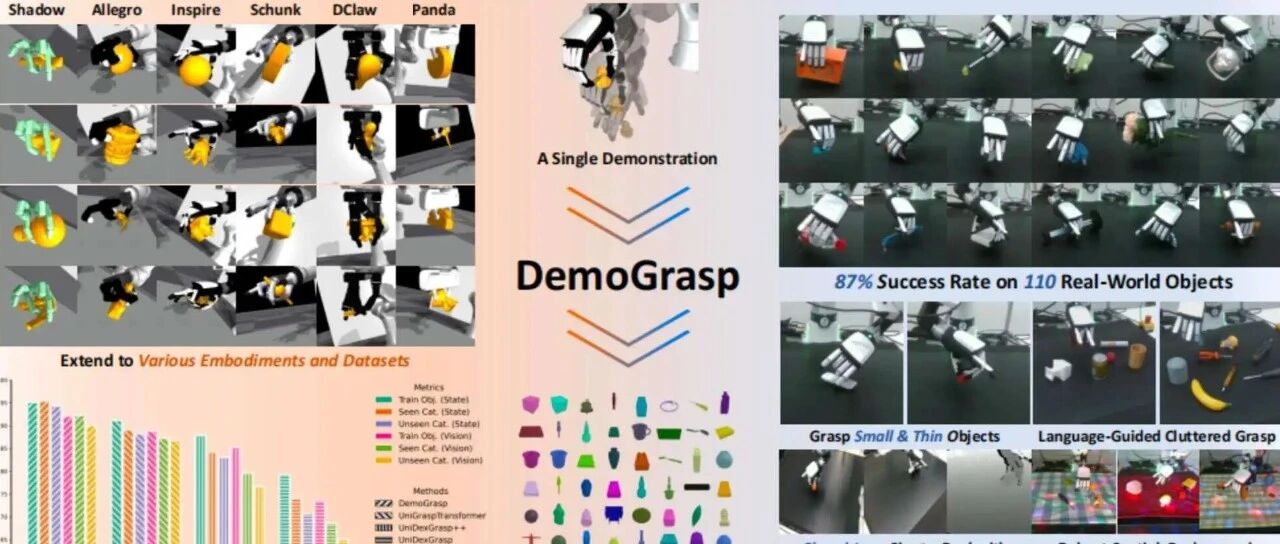
Core Insights - The article discusses the introduction of the DemoGrasp framework, a novel approach to robotic grasping that addresses challenges in traditional reinforcement learning (RL) methods, particularly in high-dimensional action spaces and complex reward functions [1][4][6]. Group 1: Framework Overview - DemoGrasp is designed to enhance the efficiency of grasping tasks by utilizing a single successful demonstration trajectory as a starting point, allowing for trajectory editing to adapt to various objects and poses [4][8]. - The framework transforms multi-step Markov Decision Processes (MDP) into a single-step MDP based on trajectory editing, significantly improving learning efficiency and performance transfer to real robots [4][6]. Group 2: Learning Process - The learning process involves editing the trajectory of a successful grasp to accommodate new objects, where adjustments to wrist and finger positions are made to fit unseen items [8][12]. - DemoGrasp employs a simulation environment with thousands of parallel worlds to train the policy network, achieving over 90% success rate after 24 hours of training on a single RTX 4090 GPU [8][10]. Group 3: Performance Metrics - In experiments using the DexGraspNet dataset, DemoGrasp outperformed existing methods, achieving a visual policy success rate of 92% with only a 1% generalization gap between training and testing datasets [10][13]. - The framework demonstrated adaptability across various robotic forms, achieving an average success rate of 84.6% on 175 different objects without adjusting training hyperparameters [14][15]. Group 4: Real-World Application - In real-world tests, DemoGrasp successfully grasped 110 unseen objects with a success rate exceeding 90% for regular-sized items and 70% for challenging flat and small objects [15][16]. - The framework supports complex grasping tasks in cluttered environments, maintaining an 84% success rate for single-instance real-world grabs despite significant variations in lighting and object placement [16][17].

DemoGrasp:一次演示是怎么实现灵巧手通用抓取的?
具身智能之心· 2025-10-10 00:02
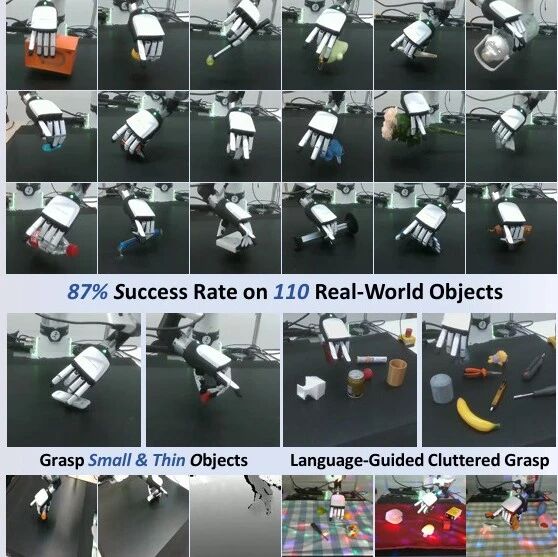
Core Insights - The article discusses DemoGrasp, a novel method for universal dexterous grasping that allows robots to learn grasping strategies from a single demonstration [2][3][6]. Group 1: Methodology - DemoGrasp utilizes a simple and efficient reinforcement learning framework that enables any dexterous hand to learn universal grasping strategies by collecting just one successful grasping demonstration [6]. - The method involves editing the trajectory of robot actions to adapt to new objects and poses, determining grasping positions and methods through adjustments in wrist and hand joint angles [2][3]. Group 2: Performance and Validation - In simulation experiments, DemoGrasp achieved a success rate of 95% when using the Shadow hand to manipulate objects from the DexGraspNet dataset, outperforming existing methods [2]. - The method demonstrated excellent transferability, achieving an average success rate of 84.6% on six unseen object datasets, despite being trained on only 175 objects [2]. Group 3: Applications and Capabilities - The strategy successfully grasped 110 previously unseen real-world objects, including small and thin items, and is adaptable to variations in spatial positioning, background, and lighting [3]. - DemoGrasp supports both RGB and depth input types and can be extended to language-guided grasping tasks in cluttered environments [3].
仅需 1 次演示,机器人就能像人手一样抓遍万物?DemoGrasp 刷新灵巧抓取天花板
具身智能之心· 2025-10-04 13:35
Core Viewpoint - The article discusses the innovative DemoGrasp framework, which enables robots to perform dexterous grasping tasks with a single demonstration, overcoming traditional challenges in robotic manipulation [2][20]. Group 1: Traditional Challenges in Robotic Grasping - Traditional reinforcement learning methods struggle with high-dimensional action spaces, requiring complex reward functions and often leading to poor generalization [1][2]. - Robots trained in simulation often fail in real-world scenarios due to the lack of precise physical parameters and environmental variations [1][2]. Group 2: Introduction of DemoGrasp - DemoGrasp, developed by a collaboration of Beijing University, Renmin University of China, and BeingBeyond, utilizes a single successful demonstration to redefine grasping tasks [2][4]. - The framework significantly improves performance in both simulated and real environments, marking a breakthrough in robotic grasping technology [2][4]. Group 3: Core Design of DemoGrasp - The core innovation of DemoGrasp includes three main components: demonstration trajectory editing, single-step reinforcement learning (RL), and visual-guided virtual-real transfer [4][10]. - The design allows robots to optimize "editing parameters" instead of exploring new actions, greatly reducing the dimensionality of the action space [6][7]. Group 4: Performance Results - DemoGrasp outperforms existing methods in simulation, achieving a success rate of 95.5% in testing with seen categories and 94.4% with unseen categories [10]. - The framework adapts to six different robotic embodiments without hyperparameter adjustments, achieving an average success rate of 84.6% on unseen datasets [11]. Group 5: Real-World Performance - In real-world tests, DemoGrasp achieved an overall success rate of 86.5% across 110 unseen objects, demonstrating its capability to handle various everyday items [14]. - The framework successfully grasps small and thin objects, such as coins and cards, which traditional methods struggle with due to collision issues [14]. Group 6: Limitations and Future Directions - Despite its strengths, DemoGrasp has limitations in handling functional grasping tasks and highly cluttered scenes [17][19]. - Future improvements may include segmenting demonstration trajectories for better decision-making and integrating visual feedback for dynamic scene adjustments [19][20].