Dior Homme

Search documents
LVMH利润下滑9%,美妆的角色变了
3 6 Ke· 2026-01-30 02:38
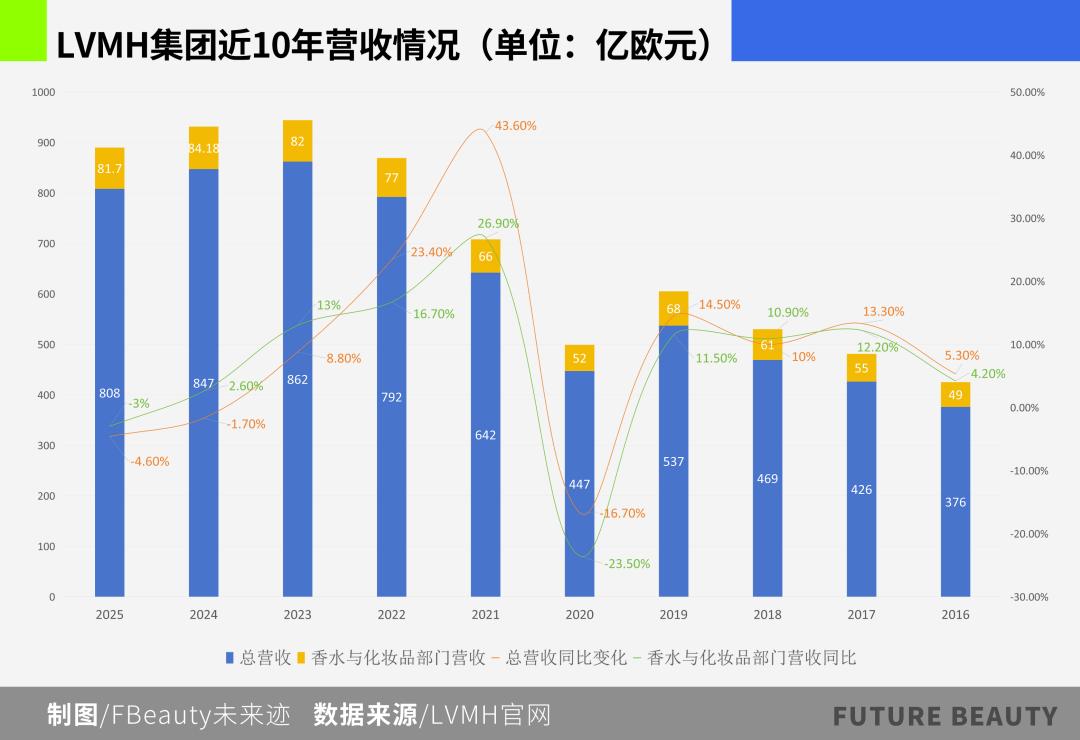
Core Insights - LVMH has experienced a significant business growth over the past decade, but is now entering a "slow normal" phase, with 2025 revenue reported at €80.8 billion (approximately ¥671.6 billion), a decline in revenue and profit compared to the previous year, yet showing signs of stabilization in quarterly performance with a 1% organic revenue growth in Q4 [1][4] Group 1: Financial Performance - The group's revenue and operating profit have decreased year-on-year, with operating profit at approximately €17.8 billion (around ¥147.9 billion) and net profit at about €10.9 billion (approximately ¥90.6 billion) [1] - The fashion and leather goods segment remains the largest and most profitable, although it saw a decline in 2025, while maintaining high operating profit margins [7] - The wine and spirits segment has been a drag on overall performance due to slowing demand for cognac and external environmental impacts [7] Group 2: Market Dynamics - The beauty and selective retail segments, which include Sephora, have shown resilience, with the beauty segment's operating profit increasing by 8% despite stable revenue, indicating effective cost control and product optimization [8] - The selective retail segment achieved a 4% organic growth in 2025, with profits rising by 28%, showcasing its role as a channel platform that meets diverse consumer demands [8] Group 3: Consumer Behavior Changes - There is a notable shift in consumer behavior, particularly in China, where consumers are willing to pay for high quality and strong design but are less tolerant of symbolic pricing and demand more authenticity in brand narratives [9][10] - The luxury dream is evolving from a focus on symbols to a more complex experience and content-driven approach, requiring brands to connect deeply with local cultural narratives [9][10] Group 4: Strategic Adjustments - LVMH is focusing on core assets that are controllable and replicable, indicating a potential reevaluation of brands that require high investment and rely on celebrity endorsements [26] - The company is adopting a strategy of innovation for growth while maintaining efficiency to protect profits, emphasizing better product structures and controlled channels [28] - Retail strategies are shifting towards adaptation rather than expansion, with a focus on meeting consumer needs and preferences in a more competitive environment [29] Group 5: Future Outlook - The beauty segment is increasingly seen as a critical touchpoint for consumer engagement and profit generation, especially in the context of fluctuating market conditions [30] - LVMH's ability to translate its strategies into stable growth will depend on its capacity to refine product offerings, channel strategies, and local narratives to resonate with evolving consumer expectations [30]

LVMH利润下滑9%,美妆的角色变了
FBeauty未来迹· 2026-01-29 11:04
Core Viewpoint - LVMH Group has experienced significant growth over the past decade, but is now entering a "slow normal" phase, with 2025 revenue reported at €80.8 billion (approximately ¥671.6 billion) and net profit at €10.9 billion (approximately ¥906 million), indicating a decline compared to the previous year, although there are signs of stabilization in quarterly performance [3][6]. Group Performance Overview - The fashion and leather goods segment remains the largest and most profitable, although it is expected to decline in 2025. Despite this, the operating profit margin remains high, indicating that brands like Louis Vuitton and Dior are maintaining pricing and channel discipline [10]. - The wine and spirits segment has been a drag on overall performance, with demand for cognac slowing down due to external factors, which directly impacts profits [10]. - The fragrance and beauty segment has shown resilience, with revenue remaining stable in 2025 while operating profit increased by 8%, reflecting effective product management and cost control [10][11]. - The selective retail segment, particularly Sephora, achieved 4% organic growth in 2025, with profits rising by 28%, showcasing its role as a channel platform that meets diverse consumer demands [11]. Consumer Behavior Changes - There has been a notable shift in consumer behavior, particularly in China, where consumers are willing to pay for high quality and design but are less tolerant of symbolic pricing. They demand authenticity and clearer reasons for purchases [12][13]. - The luxury dream is evolving, moving towards a more experiential and content-driven narrative rather than solely relying on symbolic value [12]. Strategic Adjustments - LVMH is focusing on core assets that are controllable and have clear profit models, while being cautious with brands that require high investment and rely on celebrity endorsements [26]. - The company is adopting a "cost-saving" approach in beauty, emphasizing innovation for growth and efficiency to maintain profits, rather than relying on price reductions [26][27]. - Retail strategies are shifting towards adaptation rather than expansion, with a focus on aligning product offerings with consumer trends and enhancing the value proposition of retail spaces [27]. Future Outlook - The beauty segment is increasingly recognized for its potential to drive profits during volatile periods, serving as a testing ground for understanding consumer changes in China [28]. - The ability of LVMH to translate these insights into stable growth will depend on its capacity to make nuanced and adaptive choices in product offerings, channels, and local narratives [29].
再投高端品牌 LVMH发力香水赛道
Bei Jing Shang Bao· 2026-01-22 15:48
Group 1 - LVMH Group's private equity firm L Catterton has acquired a minority stake in the French high-end perfume brand EX NIHILO, with the investment amount expected to exceed 200 million yuan, and the transaction is anticipated to be completed in Q1 2026, pending regulatory approvals [1] - EX NIHILO, founded in 2013, has expanded its fragrance offerings from 9 to 78, with prices ranging from $165 to $365, and is known for its collaborations with artists and modern French aesthetics [1] - In recent years, LVMH has invested in several niche high-end perfume brands, including BDK Parfums, Vyrao, and Maison Berger, indicating a strategic focus on the growth potential of these brands [2] Group 2 - LVMH's perfume and cosmetics segment is one of the few areas still experiencing growth, with revenue of 4.08 billion euros in H1 2025, showing a slight increase of 1% in Q2, while overall group revenue has declined [3] - The luxury market is shifting from oligopoly to a more diversified landscape, with brands focusing on product innovation and service improvement to enhance competitiveness [4] - The expansion of the fragrance market and the increasing consumer base have prompted not only luxury groups but also major beauty companies like L'Oréal and Estée Lauder to invest in the fragrance sector [3][4]
投资高奢香水品牌,LVMH集团发力香水香氛领域
Bei Jing Shang Bao· 2026-01-22 11:57
Core Viewpoint - LVMH Group, through its private equity firm L Catterton, has acquired a minority stake in the high-end French perfume brand EX NIHILO, signaling confidence in the growth potential of niche luxury fragrance brands [1][4]. Group 1: Investment Details - The investment amount for the acquisition of EX NIHILO is estimated to exceed 200 million yuan, with the transaction expected to be completed in the first quarter of 2026, pending regulatory approvals [1]. - EX NIHILO was founded in 2013 and has expanded its fragrance offerings from 9 to 78, with prices ranging from $165 to $365 [3]. Group 2: Market Position and Growth - LVMH has been actively investing in niche high-end perfume brands, including BDK Parfums, which has seen a sales growth of over 40% in 2025 and operates over 250 stores globally [3][4]. - The perfume and cosmetics segment of LVMH generated revenue of 4.08 billion euros in the first half of 2025, with a slight increase of 1% in the second quarter [5]. Group 3: Industry Trends - The luxury perfume market is expanding, with major beauty companies like L'Oréal and Estée Lauder also making acquisitions to strengthen their positions [5]. - The luxury market is shifting from oligopoly to a more diversified landscape, with a focus on product innovation and service improvement as key competitive factors [5].