FSD V13

Search documents
Robotaxi 出行帝国,能再造特斯拉?
3 6 Ke· 2026-01-08 00:21
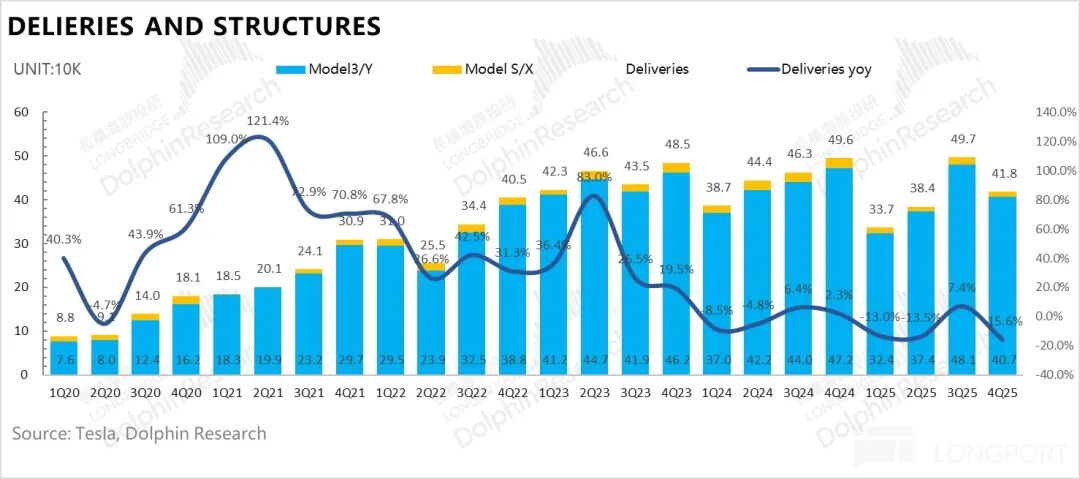
Group 1 - Tesla's Q4 2026 delivery data showed a disappointing result, with only 418,000 vehicles delivered, a 16% decrease quarter-over-quarter, and a total of 1.64 million vehicles for 2025, an 8.6% year-over-year decline, marking the second consecutive fiscal year of declining sales [1][3] - Despite the weak fundamentals, Tesla's stock price surged, nearing $500 before the Q4 delivery data release, indicating a disconnect between sales performance and stock valuation, driven by a shift in market perception from "automobile manufacturing" to "AI narrative" [3][5] - The Robotaxi business has transitioned from "concept validation" to "commercial rollout," with significant milestones achieved, including the removal of safety drivers from the Austin test fleet, which is seen as a key catalyst for stock price growth [5][6] Group 2 - Traditional ride-hailing platforms face a market cap ceiling due to limited growth potential in the shared mobility market, with Uber and Didi's combined market cap at $200 billion, representing only 14% of Tesla's current $1.5 trillion market cap [7][10] - The shared mobility market in China is constrained, with private car usage dominating the transportation landscape, accounting for approximately 85% of the market, while shared mobility's growth remains limited [10][11] - In the U.S., private cars also dominate, with ride-hailing and traditional taxi services comprising less than 2% of the total commuting market, indicating a low penetration rate for shared mobility [14][16] Group 3 - The cost structure of ride-hailing services does not provide a significant advantage over private car ownership, with costs being comparable in both China and the U.S., limiting the appeal of ride-hailing services [21][24] - The profitability of ride-hailing platforms is constrained by high driver payouts, with Uber retaining only about 30% of gross transaction value (GTV) after paying drivers, leading to low profit margins [27][30] - The introduction of Robotaxi could potentially transform the ride-hailing business model by eliminating driver costs, thus significantly lowering operational costs and improving profitability [31][33] Group 4 - Robotaxi's market growth is expected to be driven by cost advantages that could convert private car ownership into service consumption, although it may not significantly increase overall travel demand [33][34] - The operational cost of Robotaxi is projected to drop significantly, potentially reaching as low as $0.4-$0.6 per mile, which would be competitive against private car ownership costs [49][51] - The market potential for Robotaxi is substantial, with projections indicating that if pricing can undercut private car costs, it could capture a significant share of the transportation market, potentially reaching a market size of $420-485 billion by 2035 under optimistic scenarios [54][55] Group 5 - Revenue contributions from Robotaxi could vary significantly based on market penetration and pricing strategies, with estimates ranging from $58 billion under pessimistic assumptions to $2.2-2.6 trillion under more favorable conditions by 2035 [58][60]


【Tesla每日快訊】 FSD V13 = 完美?前AI總監「無瑕疵」報告,比馬斯克吹牛更可怕!🔥HW3/HW4的算力鴻溝(2025/11/13-1)
大鱼聊电动· 2025-11-13 07:05
FSD (Full Self-Driving) Technology - Karpathy, former Tesla AI director, experienced near-perfect FSD V13 performance on HW4 Model X, highlighting significant improvements in handling complex scenarios [1][2][3] - Tesla is using "Software 2.0," an end-to-end AI model, which relies heavily on HW4 hardware and high-resolution cameras, potentially offering a superior FSD experience compared to HW3 [3] - Tesla has started FSD testing in South Korea [1] Market & Sales Performance - Tesla Model Y and Model 3 remain the world's best-selling EVs, but face increasing competition from BYD's diverse model lineup [4] - Model Y achieved sales of 140,904 units in September, while Model 3 sold 67,374 units [4] - BYD's top 9 models collectively outsold Tesla's Model Y and 3 in September, with approximately 286,000 units compared to Tesla's 208,278 units [4] Industry & Competitive Landscape - Ford CEO acknowledged being "shocked" by Tesla's engineering efficiency, particularly noting that Ford's electric Mustang Mach-E has 1.6 kilometers more wiring than Tesla's Model 3 [4] - JD Power data indicates that 24.2% of US active car shoppers are "very likely" to consider an EV, the highest point of the year [4] - Approximately 60% of potential buyers are "somewhat likely" to switch to EVs in the next 12 months [4] Tesla's Strategy - Tesla is opening its Supercharger network to non-Tesla EVs, integrating it with Google Maps, and aiming to set industry standards [4] - Tesla's Supercharger director is working to integrate real-time wait time predictions and dynamic route planning into Google Maps, features already available on Tesla's own navigation system since 2017 [4]