Find系列

Search documents
全球手机均价首破2900元,谁在为“涨价潮”买单?
Zhong Guo Jing Ying Bao· 2026-02-06 10:48
Core Insights - A "price increase storm" is sweeping the global smartphone market, with the average selling price (ASP) expected to exceed $400 for the first time by Q4 2025, reaching $424, driven by a 13% year-on-year revenue growth to a record $143 billion, despite only a 5% increase in shipment volume [1][2] Group 1: Market Trends - The high-end trend remains the core driver of the smartphone market, with consumers purchasing more expensive devices, indicating a shift from "scale expansion" to "value expansion" in the industry [1] - Apple emerges as the biggest winner, with a 23% year-on-year revenue growth and a market share of 59%, significantly benefiting from the iPhone 17 series and an increase in Pro version sales [2] - The pricing pressure is more pronounced among domestic brands, with Xiaomi experiencing a 9% revenue decline and an 11% drop in shipment volume, while OPPO saw a 23% revenue increase due to its high-end product lines [2][3] Group 2: Price Increase Drivers - The price hikes are attributed to soaring supply chain costs, particularly in memory chips, with DRAM prices skyrocketing by 171.8% year-on-year and LPDDR5X memory prices increasing by over 110% [4] - The rising costs of flagship processors, such as Qualcomm's Snapdragon 8 Gen 2, which costs $280, have also contributed to the overall increase in smartphone prices [4][5] - The AI wave is squeezing production capacity, with priority given to AI and server needs over smartphone production, further exacerbating the situation [4][5] Group 3: Industry Implications - The price increase trend is expected to continue, with forecasts suggesting the global smartphone ASP will reach $412 by 2029, driven by high-end market growth and rising component costs [5] - The current price surge presents an opportunity for industry reshuffling, where weaker brands may be eliminated, while those achieving technological breakthroughs can establish a foothold in the high-end market [6] - Consumers are advised to adjust their purchasing strategies, considering longer upgrade cycles and focusing on previous flagship models or mid-range devices that offer competitive features [6]
全球手机季度收入创历史新高!均价首破400美元!
Sou Hu Cai Jing· 2026-02-05 06:32
Group 1 - The global smartphone market revenue is expected to grow by 13% year-on-year in Q4 2025, reaching $143 billion, marking a historical high for a single quarter [1] - The average selling price (ASP) of smartphones has increased by 8% year-on-year, surpassing $400 for the first time in a single quarter [1] Group 2 - Apple achieved record highs in both shipment volume and revenue in Q4 2025, with year-on-year growth of 14% and 23% respectively, driven by the iPhone 17 series and a super cycle of upgrades [3] - Samsung maintained its position as the second-largest revenue contributor globally with an 11% market share, experiencing a 12% year-on-year revenue growth and a 17% increase in shipment volume, the highest among the top five brands [3] - Xiaomi's revenue and shipment volume declined by 9% and 11% year-on-year respectively, impacted by supply constraints and rising component costs affecting its entry-level and mid-range product lines [5] - OPPO's revenue and ASP grew by 23% and 6% year-on-year, driven by the expansion of its high-end product lineup, particularly the Reno 14 and Find series [5] - Vivo's revenue also increased by 6% year-on-year, supported by strong performance in the Chinese and Indian markets [5]


realme重回OPPO“襁褓”,陈明永不再执着高端化
3 6 Ke· 2026-01-08 13:13
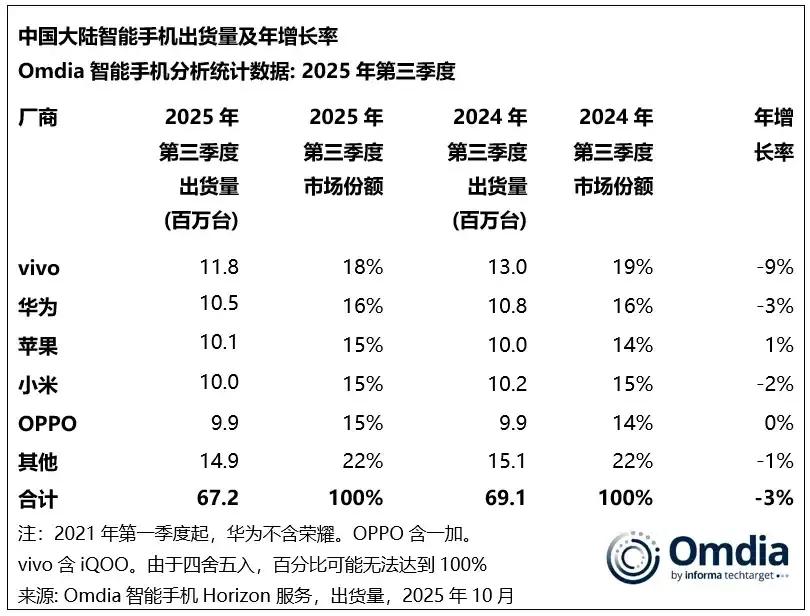
Core Viewpoint - OPPO is shifting its strategy from aggressive high-end market expansion to consolidation and cost reduction, as evidenced by the return of its sub-brand realme under its umbrella [1][2][12]. Group 1: Market Performance - OPPO's global shipment volume in Q1 2025 was approximately 23.5 million units, with a market share of 7.7%, ranking fifth [3]. - By Q3 2025, OPPO's shipment volume in mainland China dropped to 9.9 million units, also ranking fifth [4]. - The company faced significant challenges in maintaining its market position, with a notable decline in performance compared to competitors [3][4]. Group 2: Strategic Shift - OPPO's high-end strategy, initiated in 2020, aimed to elevate its brand through significant investments in technology and product development, including self-developed chips and premium devices [5][11]. - The company has recognized the unsustainable nature of its high-end focus, leading to a strategic pivot towards more practical market survival and share acquisition [10][12]. - The return of realme is seen as a critical move to enhance overall sales and consolidate resources, allowing OPPO to leverage its strengths in the mid-range and budget segments [12][13]. Group 3: Organizational Changes - Significant personnel changes occurred in late 2025, indicating a fundamental shift in OPPO's strategic direction, with key executives reassigned to focus on overseas markets rather than high-end domestic competition [8][10]. - The restructuring reflects OPPO's need to adapt to external pressures and prioritize market share over high-end aspirations [9][10]. - The integration of realme into OPPO's brand matrix aims to streamline operations and enhance competitiveness against rivals like Xiaomi and Honor [12][14].