GLM预训练框架

Search documents
东吴证券:智谱从清华实验室到港股AI新贵 关注模型迭代与生态飞轮
Zhi Tong Cai Jing· 2026-01-08 08:52
Core Viewpoint - Dongwu Securities expresses optimism about Zhipu AI's strengths in local model technology, open-source ecosystem, and local implementation capabilities, anticipating stable growth in local business and cloud services as the main growth driver, suggesting to pay attention to the company [1] Company Overview - Zhipu AI, established in 2019, is a leading independent general large model developer in China, originating from Tsinghua University's Knowledge Engineering Group (KEG) [1] - The company has developed its own GLM (General Language Model) pre-training framework, which differs from mainstream GPT architectures, offering unique advantages in long text understanding, logical reasoning, and low hallucination rates [1] - Zhipu AI follows a dual strategy of open-source and commercialization, creating a comprehensive model matrix covering language, multimodal, code, and intelligent agent fields, with flagship products GLM-4.5 and GLM-4.7 ranking high in international benchmark tests [1] Market Position - According to Frost & Sullivan data, Zhipu AI ranks first among independent general large model developers in China and second overall, with a market share of 6.6% as of 2024 [2] - By mid-2025, the company has served over 8,000 institutional clients, with 9 out of the top 10 internet companies in China using GLM models [2] - The global download volume of open-source models exceeds 45 million, with over 2.7 million registered developers on the MaaS platform, and daily token consumption reaching 4.2 trillion by November 2025 [2] Business Model - The business model centers around the MaaS (Model as a Service) platform, driven by both localized and cloud deployments [3] - Localized deployment targets government and enterprise clients, providing private operation and customization services, accounting for 84.8% of revenue in the first half of 2025 with a gross margin of 59% [3] - Cloud deployment, through API calls and subscription services, is rapidly growing, making up 15.2% of revenue in the first half of 2025, with a focus on increasing API revenue share in the long term [3] Financial Performance - Historical financial performance shows high revenue growth, with revenues of 0.57 million, 1.25 million, and 3.12 million yuan from 2022 to 2024, reflecting a compound annual growth rate of over 130% [3] - In the first half of 2025, revenue reached 1.91 billion yuan, a year-on-year increase of 325%, surpassing the total revenue for 2023 [3] IPO Details - The IPO price is set at 116.20 HKD per share, with a global offering of 37.42 million H shares, raising approximately 4.3 billion HKD, leading to a market capitalization of about 51.1 billion HKD post-funding [4] - The raised funds will primarily enhance general large model research (about 70%), optimize the MaaS platform infrastructure (about 10%), expand ecosystem cooperation and strategic investments (about 10%), and supplement working capital [4] - Key investors include prominent institutions such as Shanghai Gao Yi, GF Fund, and Taikang Life, with the founding team controlling about 33% of shares through a concerted action agreement [4] Competitive Advantages - The company's core competitive advantages lie in its full-stack self-research technology system, leading model performance, open-source ecosystem, and deep adaptation to domestic computing power [4] - The R&D personnel account for 74%, with a core team from Tsinghua KEG, possessing deep academic accumulation in natural language processing [4] - The rapid iteration of the GLM series, particularly GLM-4.7, shows strong performance in programming scenarios, while AutoGLM enables AI to autonomously operate smartphones and computer GUIs, marking a new paradigm for agents [4] Revenue Forecast - Revenue projections for 2025-2027 are estimated at 790 million (up 151%), 1.55 billion (up 97%), and 3.22 billion (up 108%), with a gradual shift from localized to cloud-dominated revenue structure [5] - The overall gross margin is expected to reach 50% in 2025, stabilizing around 51% in 2026-2027, with cloud gross margins improving from low levels to 40% [5] - The valuation for Zhipu AI in 2026 is projected at a PS ratio of 30 times, higher than comparable companies, but with significant room for compression as revenue grows rapidly [5]

MiniMax、智谱招股书拆解:海外爆款与国内刚需,谁更好赚钱
Sou Hu Cai Jing· 2025-12-23 02:00
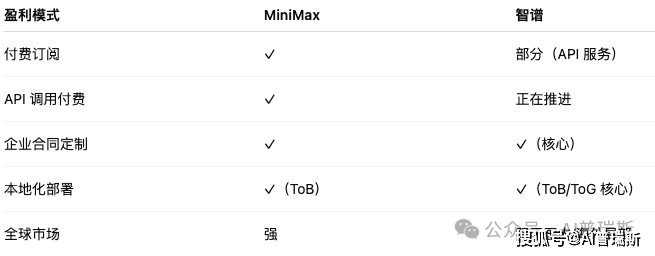
Core Insights - The articles highlight the contrasting business models of two Chinese large model companies, MiniMax and Zhipu, as they disclose their IPO prospectuses, raising the question of how large models can generate revenue [1] Business Models - MiniMax focuses on a consumer-oriented approach, emphasizing "AI Native Apps" with core products like Talkie and Xingye, which are built on large models [3] - Zhipu targets enterprise and institutional clients, building its business around MaaS and localized deployment, rather than consumer applications [10] Revenue Growth - MiniMax's AI native product revenue is projected to grow from $758,000 in 2023 to $21.8 million in 2024, and further to $38.02 million in the first three quarters of 2025, constituting over 70% of total revenue [5] - Zhipu's revenue from localized deployment reached 162 million yuan in the first half of 2025, accounting for 84.8% of total revenue [10] Profitability Metrics - MiniMax's gross margin improved from -24.7% in 2023 to 12.2% in 2024, and further to 23.3% in the first three quarters of 2025 [11] - Zhipu maintains a gross margin around 50% from 2022 to the first half of 2025, with localized deployment margins nearing 60% [11] Research and Development Investment - Zhipu's R&D expenses reached 1.595 billion yuan in the first half of 2025, with an R&D expense ratio exceeding 800%, indicating a capital-intensive approach to gaining SOTA capabilities [13] - MiniMax's R&D expense ratio was over 2000% in 2023 but decreased to 337% by the first three quarters of 2025, reflecting improved operational leverage as revenue grows [13] Market Focus - MiniMax is highly globalized, with less than 30% of its revenue coming from mainland China, while Zhipu remains focused on the domestic market, primarily serving state-owned enterprises and large financial institutions [14][15] Capital Background - Both companies have strong backing from major investors, with MiniMax supported by Alibaba, Tencent, and Sequoia, while Zhipu has backing from Tencent, Meituan, and Ant Group, indicating potential synergies in computing power and ecosystem [16] Conclusion - The contrasting narratives of MiniMax and Zhipu present two distinct paths in the large model business landscape, with MiniMax focusing on consumer engagement and user growth, while Zhipu emphasizes enterprise-level solutions and high-margin localized deployments [17][18]