
HAMR硬盘

Search documents
西部数据电话会:2026年产能已售罄,长约签署到2028年,AI推理正在重塑HDD估值体系
硬AI· 2026-01-30 12:45
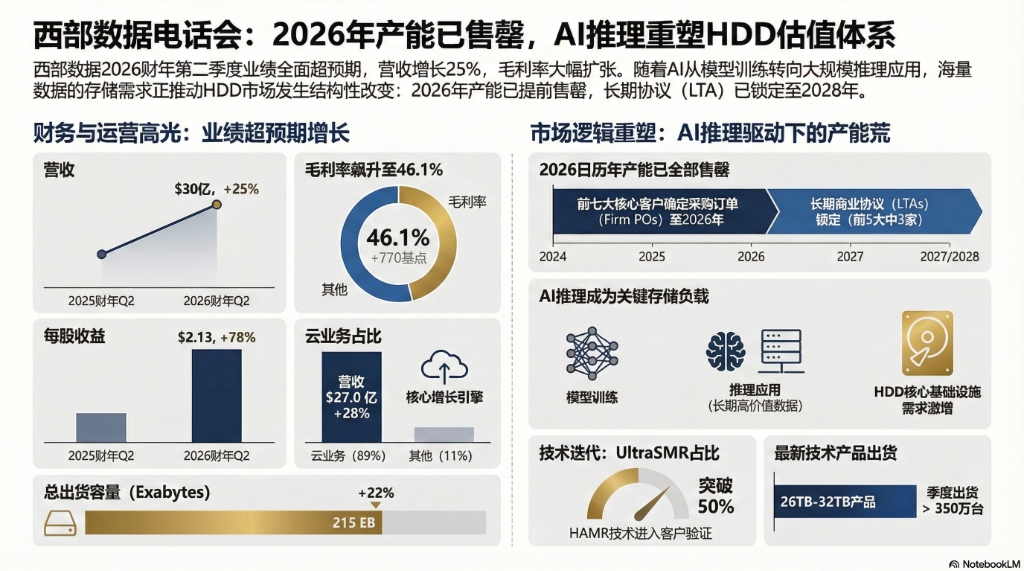
Core Insights - Western Digital's gross margin surged to 46.1%, with incremental gross margin expectations reaching 75% due to price increases and cost reductions [2][4][35] - CEO Irving Tan announced that 2026 production capacity is sold out, with long-term agreements signed with three of the top five customers extending to 2027-2028 [4][10][12] - The demand for HDDs is expected to grow structurally driven by AI inference applications, which generate vast amounts of new data that require low-cost storage [2][18][20] Financial Performance - In Q2 of FY2026, Western Digital reported revenue of $3.02 billion and adjusted EPS of $2.13, both exceeding market expectations [3][4] - Net profit for the quarter reached $1.84 billion, or $4.73 per share, marking a 210% increase from $594 million ($1.27 per share) in the same quarter last year [4][35] - The company delivered 215 exabytes of data, a 22% year-over-year increase, including over 3.5 million units of the latest generation ePMR drives [33][34] Margin and Cost Dynamics - The gross margin improvement reflects a shift towards high-capacity drives and strict cost control across manufacturing and supply chains [35] - CFO Kris Sennesael confirmed that the incremental margin is around 75%, driven by a 2-3% increase in average selling price per terabyte and a 10% year-over-year decrease in manufacturing costs per terabyte [7][8][43] Long-term Agreements and Customer Relationships - Western Digital has secured all firm purchase orders for 2026 from its top seven customers and signed long-term agreements with three of the top five customers, indicating strong customer trust and recognition of value [10][12][46] - The long-term agreements include both pricing and quantity terms, reflecting a strategic approach to managing customer relationships in a tight supply environment [13][63] Technology and Market Trends - The company is accelerating the customer validation timeline for HAMR (Heat-Assisted Magnetic Recording) technology by six months due to supply pressures [17][56] - The transition from AI model training to inference applications is expected to create significant storage demand, benefiting HDDs as data centers return large amounts of inference data to HDDs [18][20][59] Future Outlook - For Q3 FY2026, Western Digital expects revenue of $3.2 billion, reflecting approximately 40% year-over-year growth, with gross margin projected between 47% and 48% [38] - The company continues to focus on supporting customer needs for exabyte-scale storage while completing the certification and release of next-generation ePMR and HAMR drives [30][38]



西部数据(WDC.US)2026财年第二季度电话会:2026年的产能基本已售罄
智通财经网· 2026-01-30 06:22
Core Insights - Western Digital (WDC) has sold out its production capacity for the calendar year 2026 and has secured purchase orders with its top seven customers, including long-term agreements extending to 2027 and 2028 with some clients [1][6][20]. Financial Performance - For Q2 of fiscal year 2026, the company reported revenue of $3 billion, a 25% year-over-year increase, and earnings per share of $2.13, exceeding guidance [9][10]. - The cloud business accounted for 89% of total revenue, generating $2.7 billion, up 28% year-over-year [10]. - Client business revenue was $176 million, a 26% increase, while consumer business revenue was $168 million, down 3% [11][12]. - Gross margin improved to 46.1%, reflecting a shift towards high-capacity hard drives and strict cost control [12]. Market Trends and Demand - The growth of AI applications is driving structural growth in HDD demand, as AI generates vast amounts of new data that require low-cost storage solutions [1][4]. - The company is focusing on high-density storage solutions to meet the increasing demand from hyperscale data center customers [5][6]. Product Development and Innovation - The latest generation of ePMR products shipped over 3.5 million units, offering capacities up to 32TB, indicating strong customer confidence [6][9]. - The company is accelerating its HAMR technology innovation and has begun certification work with hyperscale customers [6][30]. - UltraSMR technology is expected to increase its share in the nearline product mix, providing significant benefits in terms of storage density and profitability [27]. Strategic Partnerships and Future Outlook - The company has adopted a customer-centric approach, establishing dedicated teams for large hyperscale clients to enhance relationships and visibility into demand [20][23]. - Western Digital plans to continue focusing on supporting customer needs for exabyte-scale storage while advancing the certification and release of next-generation ePMR and HAMR hard drives [7][36].
西部数据电话会:2026年产能已售罄,长约签署到2028年,AI推理正在重塑HDD估值体系
Hua Er Jie Jian Wen· 2026-01-30 04:50
Core Insights - Western Digital reported Q2 FY2026 revenue of $3.02 billion and adjusted EPS of $2.13, both exceeding market expectations [3] - The company achieved a net profit of $1.84 billion, translating to $4.73 per share, marking a 210% increase from $594 million ($1.27 per share) year-over-year [3] - Despite strong financial results, the stock price fell nearly 3% post-announcement, attributed to profit-taking after a 60% rise in January [3] Financial Performance - Q2 gross margin surged by 770 basis points year-over-year to 46.1%, with Q3 guidance raised to 48% [4] - Incremental margin confirmed at approximately 75%, driven by a 2-3% increase in average selling price (ASP) per TB and a 10% decrease in manufacturing costs per TB [4] - Operating expenses were $372 million, down 120 basis points as a percentage of revenue, with operating income slightly above $1 billion and an operating margin of 33.8% [19] Long-term Contracts and Pricing Strategy - CEO Irving Tan revealed that the company has secured all firm purchase orders for 2026 from its top seven customers and signed long-term agreements (LTA) with three of the top five customers, extending to 2028 [5] - The LTAs include both pricing and quantity terms, reflecting a structural value shift recognized by customers [5][27] Technology and Market Trends - The company is accelerating the customer validation timeline for HAMR (Heat-Assisted Magnetic Recording) technology by six months due to supply constraints [7] - CEO Tan emphasized that the transition to HAMR will not negatively impact overall profitability, as initial margins will be neutral or beneficial [7] - The shift in AI value chain from model training to inference applications is expected to drive demand for HDDs, as inference generates vast amounts of data requiring low-cost storage [8][9] Future Outlook - For Q3 FY2026, the company expects revenue of $3.2 billion, reflecting approximately 40% year-over-year growth, with gross margin projected between 47% and 48% [20] - The company plans to continue focusing on high-capacity HDDs and has seen strong adoption of its latest ePMR products, with over 3.5 million units shipped [14][19]
Seagate (STX) 2025 Conference Transcript
2025-09-03 15:52
Seagate (STX) 2025 Conference Summary Company Overview - **Company**: Seagate Technology Holdings PLC (STX) - **Industry**: Data Storage Solutions Key Points and Arguments Financial Performance - Seagate reported a strong quarter with sequential revenue and profitability growth expected for Q3, following increases in Q1 and Q2 [8][12][30] - The company anticipates demand growth in the nearline segment to be around mid-20s percentage, with a notable 90% growth in the last four quarters [12][30] Product Development and Demand - Seagate has achieved qualification for its MR product with four major cloud customers, aiming to complete qualifications for all top seven customers by June [3][4] - The focus is on increasing exabyte volume through higher capacity drives, moving customers from 24 terabyte EMR to 32 terabyte HAMR drives [9][10] - The company has started qualification for a 40 terabyte HAMR drive, indicating progress in meeting demand [10][63] Customer Relationships and Order Visibility - Seagate emphasizes the importance of build-to-order partnerships, requiring three to four quarters of visibility for orders to ensure production aligns with customer needs [14][16][21] - The company is cautious about longer-term visibility due to the complexity of customer plans and the number of clients involved [20][21] Market Dynamics and Competitive Landscape - Seagate is currently under shipping demand, with a focus on maintaining a balance between supply and demand to support pricing and mitigate the impact of potential market cycles [51][52] - The company does not prioritize market share but rather focuses on producing and selling exabytes efficiently [64] Technological Advancements - The transition from PMR to HAMR technology is expected to significantly reduce costs per terabyte, enhancing profitability as capacity increases without a proportional increase in materials [70][74] - Seagate believes that the gap in cost between HDDs and NAND will widen in the coming years, favoring HDDs for large-scale storage needs [76][79] AI and Future Demand - AI is driving increased data retention and generation, leading to higher storage demands. Seagate sees this as a significant growth opportunity [32][35] - The company acknowledges that innovation will continue to create new applications for data storage, further increasing demand [38][39] Capital Expenditure and Financial Strategy - Seagate's CapEx is projected to be 4% to 6% of revenue, indicating a low capital intensity compared to other sectors [80][82] - The company is initiating share buybacks and maintaining dividends, reflecting confidence in cash flow generation and financial health [97][99] Operational Efficiency - Transitioning to HEMR technology has allowed Seagate to streamline operations and reduce operational expenses, contributing to improved margins [86][88] Investor Considerations - Seagate encourages investors to recognize the strong demand dynamics in the cloud space and the potential for future growth driven by AI and other innovations [102][103] Additional Important Insights - The company is prepared to manage cyclical fluctuations in demand while focusing on long-term growth strategies [36][104] - Seagate's operational model is designed to generate strong free cash flow, which supports shareholder returns and strategic investments [82][100]
