HPC3.0高性能计算平台

Search documents
Robotaxi规模化突围,文远知行找到自动驾驶“造血”密钥
财富FORTUNE· 2025-12-02 14:36
Core Insights - The autonomous driving industry is experiencing a significant divide, with idealists failing in a capital winter while pragmatic players are achieving scalable commercial success [1][3] - The competition has shifted from algorithm precision and testing mileage to a comprehensive contest of business capabilities, global vision, and strategic endurance [1] - WeRide's latest Q3 financial report showcases a remarkable growth trajectory, with total revenue increasing by 144.3% to 171 million yuan, gross profit soaring by 1,123.9%, and net loss reduced by 70.5% [1][4] Financial Performance - WeRide's total revenue reached 171 million yuan, driven by a transformative business model [4] - Robotaxi revenue surged to 35.3 million yuan, a year-on-year increase of 761%, now accounting for 20.7% of total revenue [4] - The gross profit margin of 32.9% leads the industry, indicating a potential path to profitability as losses narrow significantly [4][24] Operational Efficiency - In Q3, WeRide's order volume in Guangzhou increased several times, with each vehicle completing up to 25 rides in 24 hours [5][6] - The launch of pure unmanned Robotaxi operations in Abu Dhabi marks a critical commercial milestone, demonstrating the viability of autonomous driving in real-world environments [7] Cost Control and Technology - WeRide's collaboration with Lenovo has led to a 50% reduction in Robotaxi GXR's autonomous driving suite costs, with an 84% decrease in lifecycle costs compared to previous generations [8] - The company plans to expand its fleet in the Middle East to 1,000 vehicles by 2026 and deploy hundreds of thousands globally by 2030 [12] Global Expansion and Licensing - WeRide holds licenses in eight countries, establishing a significant compliance barrier in the autonomous driving sector [13][16] - The recent acquisition of key licenses in the UAE and Switzerland supports WeRide's global commercialization efforts [14][16] Strategic Partnerships and Local Adaptation - WeRide's partnerships with local entities, such as Swiss Federal Railways and ride-hailing giants like Uber and Grab, enhance its market presence and operational efficiency [18] - The integration of a universal autonomous driving platform allows for consistent deployment across different regions, reducing engineering costs and ensuring technology uniformity [17] Future Prospects and Market Position - WeRide is exploring further commercialization opportunities, including autonomous minibuses, with contracts secured in Guangzhou and Shenzhen [20] - The company uniquely combines L4-level autonomous driving with L2+ assisted driving solutions, creating a competitive advantage in the market [22] - Following the release of its financial results, WeRide's stock prices surged, reflecting market confidence in its diversified business model and operational capabilities [24]

从美股到港股,文远与小马的“全球Robotaxi第一股”之争,谁是赢家?
Xin Lang Cai Jing· 2025-10-16 04:11
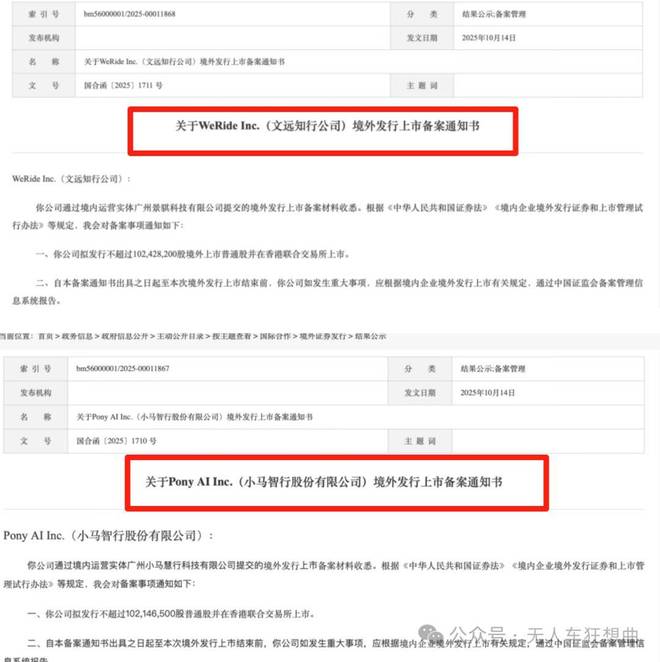
Core Viewpoint - The competition for the title of "Global Robotaxi First Stock" has intensified as both WeRide and Pony.ai received approval for overseas listings, each claiming the title, leading to market confusion regarding their actual standings [1][2]. Group 1: Company Listings and Claims - Both WeRide and Pony.ai have claimed the title of "Global Robotaxi First Stock," with WeRide listing on NASDAQ on October 25, 2024, and Pony.ai following a month later on November 27, 2024 [2]. - The one-month difference in listing dates has significant implications for their claims to the title, as the concept of "first" is inherently singular [2]. Group 2: Global Operations and Market Position - WeRide is the only company globally to have obtained autonomous driving licenses in seven countries, operating in over 30 cities across 11 countries, showcasing a strong global presence [7]. - The partnership between WeRide and Uber in the Middle East has led to the establishment of a significant commercial Robotaxi fleet, with plans to expand operations to 15 major cities globally within five years [9]. Group 3: Business Models and Revenue Generation - WeRide's business model focuses on a light-asset approach, collaborating with local operators to generate revenue through hardware sales, software licensing, and profit-sharing, breaking the cycle of "burning cash" typical in autonomous driving companies [14]. - In contrast, Pony.ai has concentrated its efforts on the domestic market, emphasizing a "first-tier city priority strategy" but faces limitations in scaling due to the inherent constraints of operating in major cities [16]. Group 4: Financial Performance and Commercialization - WeRide reported a revenue of 127 million yuan in Q2, a 60.8% year-on-year increase, with Robotaxi revenue reaching 45.9 million yuan, a staggering 836.7% increase, accounting for 36.1% of total revenue [20]. - Pony.ai's Q2 revenue was higher at 154 million yuan, but its Robotaxi revenue was only 10.9 million yuan, significantly lower than WeRide's, indicating a disparity in their commercial success [20]. Group 5: Long-term Development and Future Prospects - Pony.ai's strategy includes the launch of its seventh-generation Robotaxi, which aims for cost reductions and profitability, with plans to deploy 1,000 units globally by the end of the year [26]. - WeRide has introduced the HPC3.0 high-performance computing platform, significantly reducing the cost of autonomous driving systems, positioning itself for rapid expansion [28]. - The competition in the Hong Kong market between these two companies will not only focus on who lists first but also on whose business model can withstand the test of time [28].