无人物流

Search documents
智能驾驶将跻身国际科技竞争核心领域
Ke Ji Ri Bao· 2025-12-23 01:35
Group 1 - The automotive industry is expected to play a crucial role in global advancement and technological innovation by 2026, with smart driving becoming a core area of international technological competition [1] - Technologies such as lidar, semi-solid batteries, 5G, Beidou, smart driving chips, and multimodal large models are experiencing a surge in adoption within the automotive sector [1] - Smart driving is anticipated to significantly impact technology, industry, and society, driving advancements in chips and AI, and fostering trillion-dollar industries like autonomous taxis and logistics, while enhancing traffic safety and efficiency [1] Group 2 - From 2026 to 2030, the automotive supply chain and technology are expected to accelerate their influence on other industries, with breakthroughs in solid-state batteries, augmented reality, brain-computer interfaces, 6G, quantum computing, electric vertical takeoff and landing vehicles (eVTOL), and intelligent robotics [2] - By 2026, L2-level combined driving assistance features are projected to become mainstream, with a penetration rate exceeding 70%, becoming standard in economy electric vehicles priced around 100,000 yuan [2] - The regulatory framework for L3-level smart driving is expected to relax, expanding trial areas from limited zones to entire cities, thereby broadening road rights and application scenarios [2] Group 3 - The automotive market in China is entering a phase of high sales but low growth, with the dominance of new energy vehicles (NEVs) solidifying further [3] - Domestic automotive sales are projected to exceed 28.2 million units in 2026, reflecting a modest growth of 2%, while NEV sales (including exports) are expected to reach 20 million units, achieving a market penetration rate of 57% [3] - The total number of NEVs in the domestic market is anticipated to surpass 60 million units by 2026 [3]
AI从技术到生态,乌镇峰会的开源共识
2 1 Shi Ji Jing Ji Bao Dao· 2025-11-10 12:04
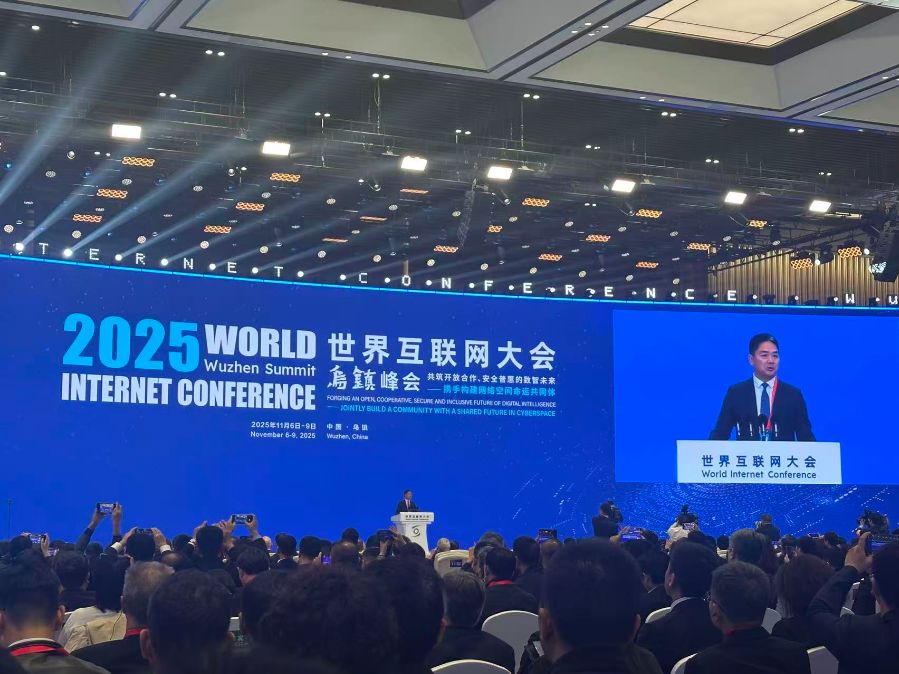
Core Insights - The narrative of the Wuzhen Summit has shifted from "Internet+" to "Artificial Intelligence+" [1][2] - The summit highlighted the increasing focus on hard tech entrepreneurs and the growing application of AI across various industries [2] Industry Trends - The future of the internet is moving from traffic competition to industrial revolution, with significant advancements in logistics and AI infrastructure [3] - Companies like JD.com and Alibaba are investing heavily in AI technologies, with JD.com planning to establish the world's first fully automated delivery station by next year [3] Technological Innovations - AI technology is transitioning from mere technical breakthroughs to large-scale application innovations, promoting deep integration of technology and industry [4] - The concept of "Spatial Intelligence" is emerging as a significant area of discussion, with applications in robotics and video generation [4][5] Application Scenarios - "Spatial Intelligence" technology is expected to have core application scenarios in cultural tourism and education, enabling immersive experiences through various hardware [6] - The development of a new generation of spatial intelligence platforms aims to create virtual spaces that interact in real-time with the real world [5][6] Open Source Movement - Open source has become a foundational structure for the future of the internet, with Alibaba creating the largest AI open-source community in China [8] - The open-source paradigm is reshaping AI competition, allowing for innovation in computing power, algorithms, and data [8][9] Community Engagement - The engagement of developers in open-source projects is crucial for the advancement of AI technologies, with competitions encouraging contributions from a diverse range of participants [8] - Companies are leveraging community feedback to iterate on tools and enhance core data, creating a positive feedback loop for development [8]


从美股到港股,文远与小马的“全球Robotaxi第一股”之争,谁是赢家?
Xin Lang Cai Jing· 2025-10-16 04:11
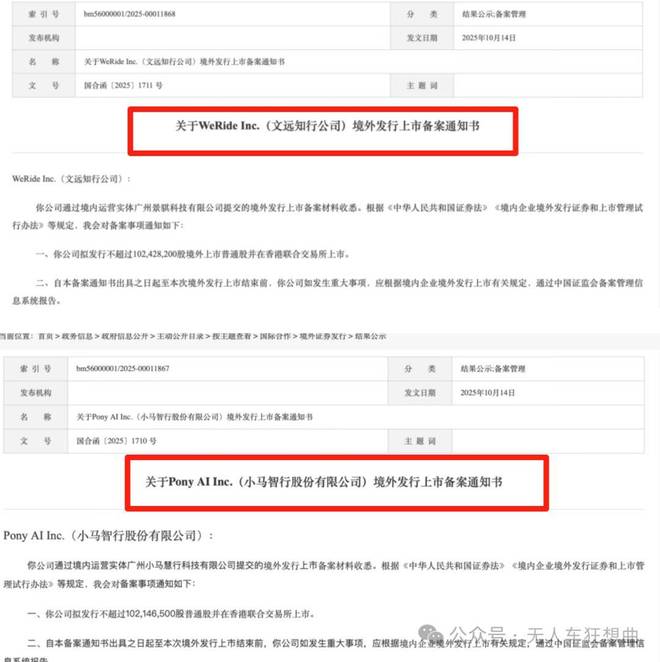
Core Viewpoint - The competition for the title of "Global Robotaxi First Stock" has intensified as both WeRide and Pony.ai received approval for overseas listings, each claiming the title, leading to market confusion regarding their actual standings [1][2]. Group 1: Company Listings and Claims - Both WeRide and Pony.ai have claimed the title of "Global Robotaxi First Stock," with WeRide listing on NASDAQ on October 25, 2024, and Pony.ai following a month later on November 27, 2024 [2]. - The one-month difference in listing dates has significant implications for their claims to the title, as the concept of "first" is inherently singular [2]. Group 2: Global Operations and Market Position - WeRide is the only company globally to have obtained autonomous driving licenses in seven countries, operating in over 30 cities across 11 countries, showcasing a strong global presence [7]. - The partnership between WeRide and Uber in the Middle East has led to the establishment of a significant commercial Robotaxi fleet, with plans to expand operations to 15 major cities globally within five years [9]. Group 3: Business Models and Revenue Generation - WeRide's business model focuses on a light-asset approach, collaborating with local operators to generate revenue through hardware sales, software licensing, and profit-sharing, breaking the cycle of "burning cash" typical in autonomous driving companies [14]. - In contrast, Pony.ai has concentrated its efforts on the domestic market, emphasizing a "first-tier city priority strategy" but faces limitations in scaling due to the inherent constraints of operating in major cities [16]. Group 4: Financial Performance and Commercialization - WeRide reported a revenue of 127 million yuan in Q2, a 60.8% year-on-year increase, with Robotaxi revenue reaching 45.9 million yuan, a staggering 836.7% increase, accounting for 36.1% of total revenue [20]. - Pony.ai's Q2 revenue was higher at 154 million yuan, but its Robotaxi revenue was only 10.9 million yuan, significantly lower than WeRide's, indicating a disparity in their commercial success [20]. Group 5: Long-term Development and Future Prospects - Pony.ai's strategy includes the launch of its seventh-generation Robotaxi, which aims for cost reductions and profitability, with plans to deploy 1,000 units globally by the end of the year [26]. - WeRide has introduced the HPC3.0 high-performance computing platform, significantly reducing the cost of autonomous driving systems, positioning itself for rapid expansion [28]. - The competition in the Hong Kong market between these two companies will not only focus on who lists first but also on whose business model can withstand the test of time [28].