Hyper3D.AI

Search documents
OpenAI点赞转发的冠军项目,背后藏着一个国人3D生成团队
机器之心· 2026-03-06 03:28
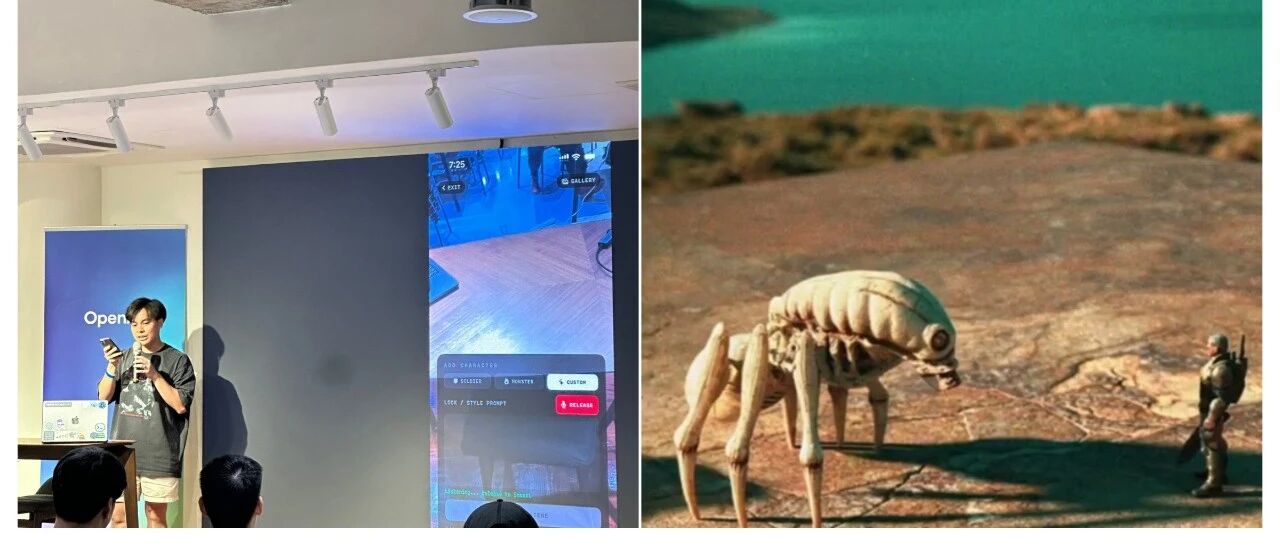
Core Viewpoint - The article discusses the emergence of StoryWorld, an iOS application that allows users to create 3D characters and objects using their mobile camera and voice input, marking a significant shift in 3D generation technology from demonstration tools to production components [1][5][43]. Group 1: 3D Generation Transition - StoryWorld generates complete 3D assets that can be positioned, scaled, and viewed from multiple angles, enabling users to control scene composition like a film director [5][6]. - The application utilizes DeemosTech's Hyper3D Rodin, which provides stability and controllability, making it a key technology for rapid asset production in hackathon environments [6][8]. - The focus of 3D generation is shifting from merely creating visuals to constructing scenes and camera language, thus elevating the requirements for stability and controllability in 3D products [7][8]. Group 2: Engineering and Production Pipeline - Hyper3D Rodin has been integrated into the workflows of top developers, including its use in NVIDIA's keynote production at CES, showcasing its role in high-standard engineering processes [12][15]. - The production pipeline requires maintaining detail and consistency across multiple stages, with Hyper3D Rodin handling 3D model generation effectively [15]. - The integration of Hyper3D into both rapid development and engineering standards indicates a growing emphasis on stability, controllability, and reusability in 3D generation [11][15]. Group 3: From Generation to Editing - Hyper3D has introduced a 3D model editing feature, Rodin Gen-2 Edit, which allows for localized modifications based on natural language input, marking a transition to an editable 3D generation workflow [20][34]. - This editing capability extends beyond Hyper3D's own models, allowing third-party 3D assets to be imported and modified, positioning it as a foundational infrastructure for 3D editing [23][34]. - The ability to edit and iterate on 3D models enhances the workflow for creators, making it easier to adapt and refine assets over time [35][43]. Group 4: Evolution of Multimodal Technology - The development of 3D generation technology follows a clear path from generation to enhanced controllability and ultimately to editing capabilities, moving away from random generation methods [26][30]. - Hyper3D has incorporated 3D ControlNet from its inception, allowing users to define model parameters precisely, thus improving the controllability of 3D generation [30][31]. - The introduction of editing features further solidifies the transition from a random generation approach to a controlled design process, enhancing the overall usability of 3D tools [34][43]. Group 5: Industry Focus Shift - The focus in AI 3D is shifting from mere generation capabilities to editability and reusability, becoming integral components of the creative and production workflow [42][43]. - For developers, 3D assets are evolving from static deliverables to dynamic elements that can be iteratively refined and reused, impacting the positioning of 3D model companies in the global creative chain [42][43]. - The successful application of Hyper3D Rodin in various contexts demonstrates its transition from experimental technology to a practical production tool [43].

95 后团队做 3D 大模型,拿下头部游戏重磅合作,正在定义 3D 生成的新规则
Founder Park· 2025-11-18 11:06
Core Insights - The article highlights the significant advancements made by Yingmou Technology in the field of 3D generation, particularly through their model Rodin and its latest iteration, Rodin Gen-2, which has achieved substantial improvements in generation quality and controllability [2][6][9]. Group 1: Company Achievements - Yingmou Technology's Rodin model was showcased at GDC, capturing the attention of top game developers and leading to the successful application of 3D generation technology in mobile gaming [2]. - The company recently completed a multi-million dollar funding round led by BlueRun Ventures, with participation from ByteDance and Sequoia China, positioning it as a leading startup in the 3D large model sector [2]. - The research paper "CLAY" received nominations for best papers at SIGGRAPH, marking a significant milestone for the young team that has been focused on 3D research since its inception [2][3]. Group 2: Technological Innovations - Rodin Gen-2 has been upgraded to utilize a dataset of millions and billions of parameters, resulting in a qualitative leap in generation quality, including smoother geometric surfaces and reduced post-processing costs [6][9]. - The introduction of the "Bang to Parts" feature allows users to decompose generated models into smaller components, enhancing the controllability of 3D models and streamlining workflows in various applications [9][12]. - The model's ability to generate clean and clear 3D meshes reduces the need for extensive repairs in software like Blender and Unity, making it more production-ready [8]. Group 3: Industry Trends - Major companies are increasingly investing in 3D generation technologies, with Roblox open-sourcing CUBE 3D and ByteDance releasing Seed3D 1.0, indicating a growing trend in the industry [6]. - The demand for rapid and accurate 3D model generation is driving innovations, with Yingmou's technology achieving model generation speeds of under 10 seconds, catering to diverse industry needs [24]. - The team believes that 3D generation will play a crucial role in future applications, serving as a foundational technology for various sectors, including digital content creation, industrial design, and AR/VR interactions [29].

字节、红杉投资的AI公司接入网易《蛋仔派对》,融资数千万美元|早起看早期
36氪· 2025-11-15 01:12
Core Insights - The article discusses the recent funding round of AI 3D generation company Yingmou Technology, which raised tens of millions of dollars in Series A+ financing led by BlueRun Ventures, with participation from existing investors like ByteDance and Red Shirt China Seed Fund. The funds will be used for technology development and market expansion to enhance the usability of 3D generation models and deepen applications in gaming and industrial design [4][5]. Company Overview - Yingmou Technology focuses on the development of AI-native 3D generation models, with its core product Hyper3D.AI providing high-quality, controllable, and usable 3D asset generation solutions for industries such as gaming, film special effects, industrial design, and 3D printing [5][9]. - The company has integrated its technology into NetEase's mobile game "Egg Party," allowing players to create custom scenes without complex modeling tools, thus enhancing user-generated content (UGC) capabilities [5][7]. Technological Innovations - Yingmou Technology has introduced the Rodin Gen-1.5 Zero mode, which optimizes real-time gaming environments while maintaining excellent visual performance under low polygon constraints, addressing the balance between generation quality and UGC gameplay efficiency [7][9]. - The company’s core team, originating from Shanghai University of Science and Technology, has been dedicated to 3D modeling research since 2016, leading to the development of the Hyper3D.AI model, which was recognized at SIGGRAPH as a significant advancement in the field [9][10]. Industry Challenges and Solutions - The 3D generation technology is transitioning from laboratory research to industrial application, facing challenges such as insufficient generation quality and the need for extensive manual adjustments to integrate models into existing production workflows [9][10]. - Yingmou Technology's innovations, such as the BANG feature in Rodin Gen-2, allow for the disassembly of generated 3D models into multiple components, enhancing efficiency in binding, editing, and secondary production, which is crucial for gaming and industrial design [10][11]. Future Plans - The company aims to expand into the industrial design sector, which has a larger market size compared to gaming, aligning with national strategies for new productivity [11]. - Long-term goals include the development of "world models" and embodied intelligence training data generation, integrating 3D content with robotics and general intelligence [11].