Imaavy (nipocalimab)

Search documents
J&J's Pipeline Surge Sets Up Stronger Growth From New Drugs in 2026
ZACKS· 2026-03-26 14:06
Core Insights - Johnson & Johnson (J&J) has a robust R&D pipeline focusing on immunology, oncology, and neuroscience, with significant advancements and approvals expected to drive growth through the latter half of the decade [1][10] R&D and Product Approvals - In 2025, J&J received approvals for Inlexzoh/TAR-200 for high-risk non-muscle invasive bladder cancer and Imaavy (nipocalimab) for generalized myasthenia gravis, marking key milestones in its pipeline [1][10] - The FDA approved Icotyde (icotrokinra), an oral treatment for moderate-to-severe plaque psoriasis, co-developed with Protagonist Therapeutics, enhancing J&J's portfolio [2][4] - Inlexzoh is a novel drug-releasing system for bladder cancer, while nipocalimab is being evaluated for various immune-mediated conditions, indicating its potential as a versatile treatment option [3][5] Market Potential and Sales Growth - J&J's new cancer drugs, including Carvykti, Tecvayli, and Talvey, generated $3 billion in sales in 2025, contributing to overall revenue growth [6][10] - The company anticipates that 10 of its new products could achieve peak sales of $5 billion, with expectations for a more significant impact from new products in 2026 compared to 2025 [7][8] Financial Performance and Valuation - J&J's shares have outperformed the industry, rising 47.1% over the past year compared to the industry's 9.5% increase [11] - The company's shares are currently trading at a price/earnings ratio of 20.42, higher than the industry average of 16.75, indicating a slightly expensive valuation [12] - The Zacks Consensus Estimate for 2026 earnings remains stable at $11.54 per share, with a slight increase for 2027 earnings from $12.33 to $12.44 [13][14]



J&J Stock Trading Above 200- & 50-Day SMA for 8 Months: Time to Buy?
ZACKS· 2026-03-24 16:01
Core Insights - Johnson & Johnson's stock has shown strong performance, remaining above its 50-day and 200-day simple moving averages for over eight months, indicating sustained investor confidence [1] - The stock formed a "golden cross" in July, suggesting a potential for a prolonged bullish trend, supported by improving business performance [1] Sales and Earnings Growth - J&J's share price performance is driven by steady growth in sales and earnings, particularly from the Innovative Medicine and MedTech segments, with an optimistic outlook for 2026 [2] - The Innovative Medicine segment saw a 4.1% organic sales growth in 2025, despite the loss of exclusivity for Stelara, with key drugs like Darzalex, Erleada, and Tremfya contributing significantly [4][5] - The segment achieved over $60 billion in full-year sales in 2025, with 13 brands growing in double digits [5] Pipeline and R&D Investments - J&J invested over $32 billion in R&D and M&A in 2025, including acquisitions that enhance its product portfolio [10] - Significant pipeline advancements were made in 2025, with new product approvals expected to drive growth in 2026 [11][12] - J&J believes that several new products have the potential to deliver peak sales of $5 billion, including Talvey, Tecvayli, and Imaavy [14] MedTech Segment Performance - The MedTech segment improved sales by 4.3% on an organic basis in 2025, driven by acquisitions and advancements in various product lines [15] - J&J anticipates better growth in the MedTech business in 2026, despite facing challenges in the Chinese market due to government cost containment efforts [16][17] Challenges and Risks - The loss of U.S. patent exclusivity for Stelara in 2025 negatively impacted the Innovative Medicines segment's growth by 10.4% [18][19] - J&J faces over 74,000 lawsuits related to its talc-based products, which could pose significant legal and financial challenges [21][22] Stock Performance and Valuation - J&J's stock has outperformed the industry, rising 46.2% over the past year compared to a 7.5% increase in the industry [23] - The stock is currently trading at a price/earnings ratio of 20.05, higher than the industry average of 16.69, indicating a slightly expensive valuation [27] Future Outlook - The Zacks Consensus Estimate for 2026 earnings has increased, reflecting positive sentiment around J&J's growth prospects [30] - J&J aims to generate around $100 billion in revenues in 2026, with expectations for sales growth in both segments to be higher than in 2025 [34] - Despite facing headwinds, J&J remains confident in navigating challenges and maintaining strong momentum [34][35]

J&J Expands New Drug Portfolio With Icotyde's FDA Approval
ZACKS· 2026-03-19 17:15
Core Insights - Johnson & Johnson (JNJ) has made significant advancements in its pipeline, achieving key clinical and regulatory milestones that are expected to drive growth through the latter half of the decade [1] - The company received approvals for new products, including Inlexzoh/TAR-200 for high-risk non-muscle invasive bladder cancer and Imaavy (nipocalimab) for generalized myasthenia gravis [1] Product Approvals and Pipeline - Inlexzoh is a novel drug-releasing system that allows for sustained local delivery of cancer treatment directly into the bladder [2] - Nipocalimab, an FcRn blocker, is under review for multiple immune-mediated conditions, including warm autoimmune hemolytic anemia and systemic lupus erythematosus, with potential for significant market impact [2] - In 2026, J&J and Protagonist Therapeutics received FDA approval for icotrokinra (marketed as Icotyde), an oral targeted peptide inhibitor for moderate-to-severe plaque psoriasis [3][10] - Icotyde's approval was based on data from four phase III studies, demonstrating significant skin clearance and a favorable safety profile [4] - Icotyde is expected to revolutionize plaque psoriasis treatment by offering a once-daily oral option, contrasting with existing injectable treatments [5][6] Market Potential - J&J anticipates that Inlexzoh, Icotyde, and Imaavy are among ten new drugs that could collectively achieve peak sales of $5 billion [7] - The company expects a more pronounced impact from new products in 2026 compared to 2025, highlighting the strength of its late-stage pipeline [8] Financial Performance - JNJ's shares have outperformed the industry, rising 45.6% over the past year compared to an 8.0% increase in the industry [9] - The company's shares currently trade at a price/earnings ratio of 20.23, higher than the industry average of 17.25, indicating a slightly expensive valuation [11] - The Zacks Consensus Estimate for 2026 earnings has increased from $11.46 to $11.54, while the estimate for 2027 has risen from $12.25 to $12.44 [12]

Immunology, Neuroscience Step Up as Key Growth Engines for J&J
ZACKS· 2026-03-03 15:11
Core Insights - Johnson & Johnson (JNJ) is a significant player in the oncology segment, contributing approximately 27% to total revenues and 42% to the Innovative Medicine segment sales [1] - The company is also strengthening its presence in immunology and neuroscience, which are becoming key contributors to revenue growth outside of oncology [1] Immunology Segment - Sales in the Immunology segment declined by around 12% in 2025 due to the loss of exclusivity of Stelara, which saw a 42% drop in sales [3][8] - Tremfya, another key immunology drug, is partially offsetting this decline, with sales increasing by 41% in 2025, surpassing $5 billion for the first time [3][8] - J&J expects Tremfya to exceed $10 billion in peak-year sales, while Simponi/Simponi Aria sales rose by 22% to $2.7 billion [3][8] - New products and pipeline candidates, such as Imaavy (approved for generalized myasthenia gravis) and Icotyde/icotrokinra (pending approval for plaque psoriasis), are expected to drive long-term growth [4][5] Neuroscience Segment - The Neuroscience segment saw a 10% increase in sales in 2025, driven by new products like Caplyta and Spravato [6][8] - Caplyta generated $700 million in sales, while Spravato recorded $1.7 billion, reflecting a 57% year-over-year increase [6][7][8] - Both Caplyta and other pipeline candidates have the potential to achieve peak sales of $5 billion [7] Overall Growth Strategy - Despite the near-term headwind from Stelara's loss of exclusivity, J&J's expanding immunology portfolio and fast-growing neuroscience franchise are helping to rebalance its growth mix [8][9] - The company is well-positioned for long-term growth with multiple late-stage pipeline candidates in both immunology and neuroscience [9] Competitive Landscape - Key competitors in the immunology space include AbbVie, Eli Lilly, Amgen, Sanofi, and Pfizer [10] - In the neuroscience sector, significant competitors are Biogen, Lilly, and Pfizer [10]
J&J Posts Innovative Medicine Growth in 2025 Amid Stelara Patent Loss
ZACKS· 2026-02-09 15:25
Core Insights - Johnson & Johnson (JNJ) has a diverse revenue stream in its Innovative Medicine division, with sales reaching $60.4 billion in 2025, reflecting a 5.3% operational growth and a 4.1% organic growth despite the loss of exclusivity for Stelara [1][10] Group 1: Sales Performance - The Innovative Medicine segment achieved over $15 billion in sales for three consecutive quarters in 2025, marking the first time it surpassed $60 billion in full-year sales [2] - Key products such as Darzalex, Tremfya, and Erleada contributed significantly to growth, with Darzalex sales increasing by 23.0% to $14.35 billion, Erleada by 19.2% to $3.57 billion, and Tremfya by 40.5% to $5.2 billion [6][9] - The decline in Stelara sales by 41.3% to $6.08 billion in 2025 due to its loss of exclusivity negatively impacted the segment's growth by 1110 basis points [4][5] Group 2: Future Outlook - J&J anticipates accelerated growth in the Innovative Medicine segment in 2026, driven by key products and new launches, with expected growth of 5% to 7% from 2025 to 2030 [7][9] - The company expects a more pronounced impact from new products in 2026, including Rybrevant and Caplyta, following approvals in 2025 [7] - However, the impact of generic competition is expected to intensify in 2026, particularly for Stelara, Simponi, and Opsumit as they lose patent protection [8] Group 3: Competitive Landscape - J&J operates in key areas of immunology and oncology, facing competition from major drugmakers such as Novartis, AstraZeneca, AbbVie, and Amgen [10][11] Group 4: Stock Performance and Valuation - J&J's stock has outperformed the industry, rising 55.6% over the past year compared to an 18.0% increase in the industry [12] - The company's shares are currently trading at a price/earnings ratio of 20.63, higher than the industry average of 18.76 and above its five-year mean of 15.65 [14] - The Zacks Consensus Estimate for 2026 earnings has increased from $11.48 to $11.54, indicating positive sentiment [16]

J&J Targets $100B+ Sales in 2026 as Growth Accelerates in Both Units
ZACKS· 2026-01-27 16:55
Core Insights - Johnson & Johnson (J&J) announced a financial outlook for 2026, projecting sales between $100.0 billion and $101.0 billion, surpassing the Zacks Consensus Estimate of $98.5 billion, with adjusted earnings per share expected to be in the range of $11.43 to $11.63 [1][9] Group 1: Innovative Medicine Segment - J&J anticipates accelerated growth in the Innovative Medicine segment in 2026, despite the loss of exclusivity (LOE) for the blockbuster drug Stelara, which negatively impacted growth by 1040 basis points in 2025 [2][3] - Key products such as Darzalex, Tremfya, Spravato, Carvykti, and Erleada, along with new launches like Rybrevant and Caplyta, are expected to drive growth in 2026 [4][5] - The impact of generic competition is expected to increase in 2026 with the introduction of biosimilars for Stelara and generics for Simponi and Opsumit [3][4] Group 2: MedTech Segment - J&J's MedTech business showed improvement with sales rising 4.3% to $33.8 billion in 2025, and stronger growth is expected in 2026 due to increased adoption of new products across various portfolios [6][7] - The company anticipates some challenges from China's volume-based procurement (VBP) program, which is a government-driven cost containment effort [6][7] Group 3: Stock Performance and Valuation - J&J's stock has outperformed the industry, rising 47.3% over the past year compared to a 19.3% increase in the industry [8] - The company's shares are currently trading at a price/earnings ratio of 19.11, higher than the industry average of 18.33 and above its five-year mean of 15.65 [11] - The Zacks Consensus Estimate for 2026 earnings has increased from $11.46 to $11.53, reflecting a positive outlook following J&J's financial projections [13]

首创新药时代:2025年FDA新药全景透视
3 6 Ke· 2026-01-04 04:56
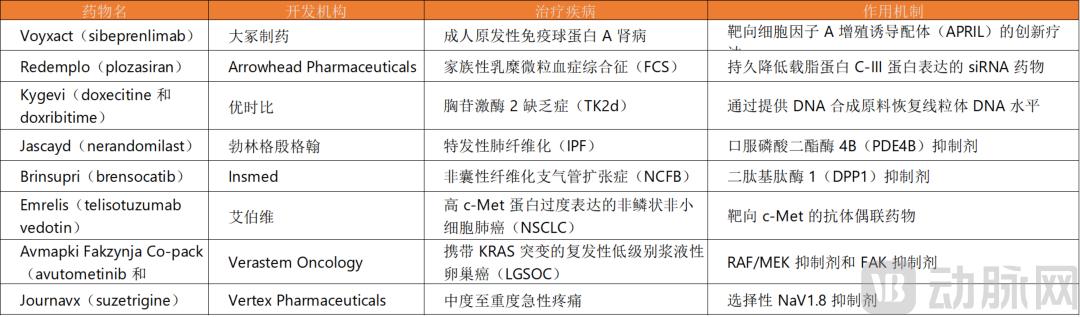
Core Insights - The FDA's CDER approved 44 new drugs by 2025, with over half being "first-in-class" drugs, indicating a shift from "incremental" to "disruptive" treatment paradigms in drug development [1][3][24] - The rise of small molecules continues, but their development is evolving from broad inhibition to precision modulation, enhancing efficacy while reducing side effects [6][7][9][10] First-in-Class Drugs - The approval of "first-in-class" drugs is driven by unmet clinical needs, particularly in rare and complex chronic diseases, where existing treatments are inadequate [3][4] - Brinsupri (brensocatib) is a notable example, targeting Dipeptidyl Peptidase 1 (DPP1) to address non-cystic fibrosis bronchiectasis, providing a new mechanism of action that significantly improves patient outcomes [3][20] - Eight drugs received breakthrough therapy designation, reflecting their innovative mechanisms and potential for substantial clinical improvement [5] Small Molecule Innovations - Small molecules accounted for 66% of new drug approvals, maintaining their central role in drug development while shifting towards precision approaches [6][10] - Aficamten (Myqorzo) exemplifies this trend as a selective allosteric modulator for obstructive hypertrophic cardiomyopathy, demonstrating improved safety and efficacy [7] - Covalent drugs, such as Zegfrovy (sunvozertinib), show promise in overcoming resistance issues by forming stable bonds with targets, enhancing therapeutic effectiveness [8] Peptide and Nucleic Acid Therapies - Peptide and nucleic acid therapies are emerging as significant players, with multiple innovative drugs approved in 2025, marking a shift towards RNA-targeted treatments [10][11] - Qfitlia (fitusiran) offers a revolutionary preventive solution for hemophilia by significantly reducing annual bleeding rates [10][12] - Dawnzera (donidalorsen) provides a long-acting preventive treatment for hereditary angioedema, demonstrating substantial reductions in attack frequency [11] Antibody-Drug Conjugates (ADCs) - ADCs are evolving beyond cancer treatment, with Datroway (datopotamab deruxtecan) showcasing innovative mechanisms and expanding indications [14][15] - Datroway's "bystander effect" allows it to target heterogeneous tumor populations effectively, improving treatment outcomes in breast cancer and non-small cell lung cancer [15][16] Future Directions - The landscape of drug development is shifting towards a broader understanding of drug value, emphasizing patient outcomes and treatment paradigms over traditional sales metrics [19][23] - The integration of advanced technologies like AI and gene editing into drug development processes is expected to yield therapies that fundamentally alter disease progression [24]
Can J&J's Pipeline Progress in 2025 Aid Long-Term Growth?
ZACKS· 2025-12-26 14:26
Core Insights - Johnson & Johnson (J&J) has a strong R&D pipeline focused on immunology, oncology, and neuroscience, with significant advancements in 2025 [1][2][8] Pipeline and Product Approvals - J&J has achieved major clinical and regulatory milestones, including approvals for Inlexzoh/TAR-200 for high-risk non-muscle invasive bladder cancer and Imaavy (nipocalimab) for generalized myasthenia gravis [2][11] - Nipocalimab is being evaluated for various immune-mediated conditions and is considered to have pipeline-in-a-product potential [3] - Regulatory applications for icotrokinra, an oral treatment for moderate-to-severe plaque psoriasis, have been filed in the US and EU [4] - J&J's new cancer drugs, including Carvykti, Tecvayli, and Talvey, generated $2.14 billion in sales in the first nine months of 2025 [5][11] Strategic Acquisitions and Expansions - The acquisition of Intra-Cellular Therapies added Caplyta, an antidepressant, to J&J's neuroscience portfolio [6] - J&J aims to expand the indications of currently marketed products, with recent approvals for Tremfya, Rybrevant, and Caplyta [7] Long-term Growth Potential - J&J's pipeline execution and recent product approvals position the company for sustained growth beyond short-term pressures, with multiple late-stage assets and significant sales potential across its Innovative Medicine portfolio [8] Competitive Landscape - J&J faces competition in the oncology space from major players like Pfizer, AstraZeneca, Merck, and Bristol-Myers, each with strong oncology portfolios and growth in sales [9][10][12][13][14] Financial Performance and Valuation - J&J's shares have outperformed the industry, rising 42.8% over the past year compared to a 17.5% increase for the industry [15] - The company's shares trade at a price/earnings ratio of 18.09, slightly above the industry average of 17.59 and its five-year mean of 15.65 [18] - The Zacks Consensus Estimate for 2025 earnings has increased from $10.86 to $10.87 per share, indicating positive earnings revisions [20]

JNJ Gets EU Nod for Imaavy in Generalized Myasthenia Gravis
ZACKS· 2025-12-02 16:10
Core Insights - Johnson & Johnson (JNJ) received European Commission approval for Imaavy (nipocalimab) as an add-on therapy for generalized myasthenia gravis (gMG) in adults and adolescents aged 12 and above who are antibody-positive [1][10] - Imaavy is the first FcRn blocker approved for both adult and adolescent patients with gMG in the EU, following its approval in the United States in April 2025 [2][8] - The approval was based on pivotal phase III Vivacity-MG3 and phase II/III Vibrance-MG studies, demonstrating superior disease control and sustained symptom relief for up to 20 months [6][7][9] Company Performance - Year-to-date, JNJ shares have increased by 42.2%, outperforming the industry average rise of 17.8% [5] - The safety and tolerability profile of Imaavy aligns with previous studies, indicating a consistent performance in managing gMG [9] Market Impact - The EU approval addresses a significant unmet medical need for an estimated 56,000 to 123,000 individuals living with gMG in Europe [10] - JNJ is exploring nipocalimab in late-stage studies for other immune-mediated conditions, suggesting a strong pipeline potential for the product [11]

Buying J&J Stock Ahead of Q3 Earnings? Here's What You Should Know
ZACKS· 2025-10-10 17:10
Core Viewpoint - Johnson & Johnson (JNJ) is set to report its third-quarter 2025 results on October 14, with expectations for sales of $23.74 billion and earnings of $2.77 per share, indicating a stable outlook for the company in the drug and biotech sector [1] Earnings Estimates - The Zacks Consensus Estimate for JNJ's earnings has remained unchanged at $10.86 per share for 2025, while the estimate for 2026 has slightly increased from $11.36 to $11.38 per share over the past 60 days [1][2] - JNJ's earnings surprise history shows an average surprise of 5.73% over the last four quarters, with a recent surprise of 4.14% [2][3] Sales Performance - Sales growth is anticipated from key products such as Darzalex, Tremfya, and Erleada, along with new drugs like Carvykti and Tecvayli [5][6] - The Zacks Consensus Estimate for Darzalex sales is $3.63 billion, while Tremfya is estimated at $1.3 billion [6] - The Innovative Medicines segment is projected to face challenges due to biosimilar competition for Stelara, which is expected to decline significantly [8][9] MedTech Segment Insights - JNJ's MedTech business is expected to show improvement driven by newly acquired cardiovascular businesses and strong performance in Surgical Vision and wound closure [12][13] - However, the MedTech segment faces challenges in China due to the volume-based procurement (VBP) program, which is likely to continue impacting sales [13] Stock Performance and Valuation - JNJ's stock has outperformed the industry with a year-to-date increase of 32.2%, compared to a 7.8% increase in the industry [16] - The company's shares are currently trading at a forward price/earnings ratio of 16.97, which is higher than the industry average of 15.88 [19] Business Model and Growth Outlook - JNJ's diversified business model focuses on Pharmaceuticals and MedTech following the separation of its Consumer Health segment [23] - The Innovative Medicine unit has shown a growth trend, with a 2.4% increase in sales in the first half of 2025, despite challenges [24] - JNJ is advancing its pipeline and has made acquisitions to strengthen its position in the neurological and psychiatric drug market [26] Future Expectations - JNJ considers 2025 a "catalyst year," expecting operational sales growth to accelerate in the second half of the year, driven by newly launched products [29]