Instinct系列

Search documents
AMD的第三大支柱
半导体芯闻· 2026-01-06 10:30
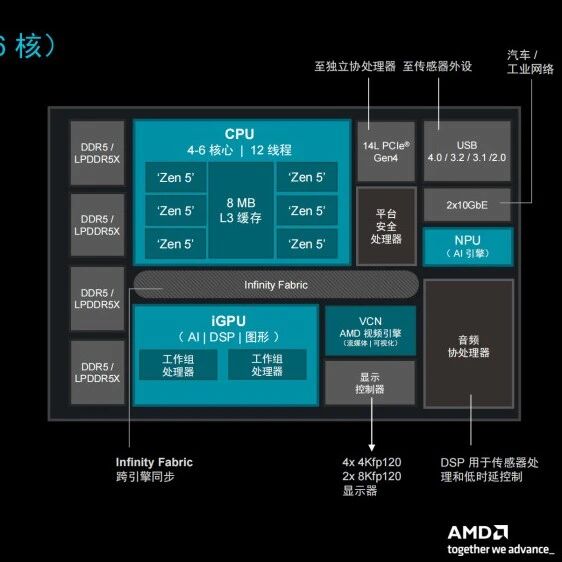
Core Viewpoint - AMD has achieved impressive financial results in Q3 2025, with GAAP revenue exceeding Wall Street expectations at $9.2 billion, driven by strong demand for high-performance computing products. Net profit increased by 61% year-over-year to $1.2 billion, with a gross margin of 52% due to a diverse product portfolio [1]. Group 1: Embedded Market Demand - The embedded systems market is evolving, with increasing demand for high-performance microprocessors driven by changes in end-user requirements, particularly due to the rise of artificial intelligence [3][5]. - AMD's CEO highlighted that active AI users surged from 1 million to 1 billion since the launch of ChatGPT, with projections of 5 billion by 2030, necessitating a 100-fold increase in global computing power [3][5]. Group 2: Challenges in Embedded Systems - Embedded systems face common challenges such as real-time response, mixed workloads, and scalability. These systems must ensure reliability and low latency without relying on cloud services [6][7]. - The complexity of software in embedded systems is unprecedented, requiring high performance, higher frequency, and reliability in hardware [7]. Group 3: AMD's Embedded Processor Offerings - AMD has introduced the Ryzen Embedded processors and EPYC processors, gaining over 7,000 embedded customers. Key features include long product life cycles of at least ten years, strict thermal requirements, fault tolerance, and proprietary connections [9][10]. - The newly launched Ryzen AI Embedded P100 series features high-performance "Zen 5" cores, RDNA 3.5 GPU for real-time graphics, and XDNA 2 NPU for low-latency AI acceleration [12][14]. Group 4: Software and Development Environment - The P100 series offers a unified software stack that includes optimized CPU libraries, open-standard GPU APIs, and native AI runtime through Ryzen AI software, built on an open-source virtualization framework [17][19]. - This framework allows multiple operating systems to run securely in parallel, supporting various applications while reducing costs and accelerating production processes [20]. Group 5: Market Opportunities and Competitive Advantage - The rapidly growing edge AI market presents numerous opportunities, with increasing demand for high-performance AI capabilities, particularly in robotics [23]. - AMD's established roadmap in CPUs, GPUs, NPUs, and custom accelerators provides a competitive edge, allowing the company to integrate high-end products into its embedded offerings to support diverse applications [23].


35%+60%,AMD苏姿丰押上整个AI工厂
3 6 Ke· 2025-11-12 07:42
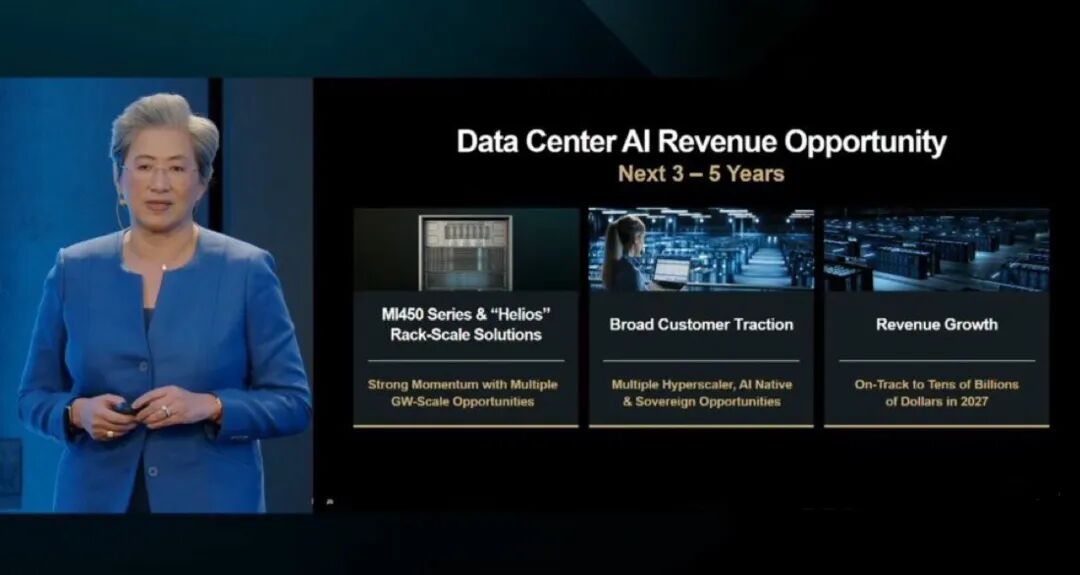
Core Viewpoint - AMD CEO Lisa Su stated that the AI data center market will exceed $1 trillion by 2030, indicating significant growth potential in the computing market driven by AI infrastructure [1][7][9]. Group 1: Company Background - Lisa Su, the current CEO and Chairwoman of AMD, has a strong technical background with a Ph.D. in Electrical Engineering from MIT and has held executive positions at IBM and Freescale Semiconductor [2]. - When Su took over AMD, the company was struggling with a market cap of less than $3 billion and was losing market share to Intel [3][4]. Group 2: Market Potential - The AI data center market is expected to expand significantly, with AMD positioning itself to capture a share of this growth by offering comprehensive computing systems rather than just individual components [10][20]. - AMD aims for a 35% compound annual growth rate (CAGR) over the next 3 to 5 years, which would require revenue to increase approximately 4.5 times, indicating a major shift in the semiconductor industry [12][13]. Group 3: Product Development - AMD is focusing on two main product lines: the Instinct MI350 series, which is designed for AI training and inference, and the upcoming Helios system, set to launch in 2026 [22][28]. - The Instinct MI350 series is noted for its rapid deployment and a 35-fold increase in AI performance compared to its predecessor [23][24]. Group 4: Competitive Strategy - Su emphasized the importance of system-level capabilities, highlighting four key elements: Compute, Memory, Interconnect, and Efficiency, which are crucial for optimizing AI data centers [30][34]. - The company aims to transition from being a "machine supplier" to a "factory builder" in the AI era, focusing on integrated systems that enhance efficiency and performance [19][29]. Group 5: Market Reaction - Following Su's presentation, AMD's stock price showed positive movement, reflecting market optimism regarding the company's ambitious targets and growth narrative [35]. - Analysts have noted that while AMD is a key player in the AI sector, achieving its targets will be challenging due to execution complexities and market valuation pressures [37].
为何Nvidia还是AI芯片之王?这一地位能否持续?
半导体行业观察· 2025-02-26 01:07
Core Viewpoint - Nvidia's stock price surge, which once made it the highest-valued company globally, has stagnated as investors become cautious about further investments, recognizing that the adoption of AI computing will not be a straightforward path and will not solely depend on Nvidia's technology [1]. Group 1: Nvidia's Growth Factors and Challenges - Nvidia's most profitable product is the Hopper H100, an enhanced version of its graphics processing unit (GPU), which is set to be replaced by the Blackwell series [3]. - The Blackwell design is reported to be 2.5 times more effective in training AI compared to Hopper, featuring a high number of transistors that cannot be produced as a single unit using traditional methods [4]. - Nvidia has historically invested in the market since its founding in 1993, betting on the capability of its chips to be valuable beyond gaming applications [3][4]. Group 2: Nvidia's Market Position - Nvidia currently controls approximately 90% of the data center GPU market, with competitors like Amazon, Google Cloud, and Microsoft attempting to develop their own chips [7]. - Despite efforts from competitors, such as AMD and Intel, to develop their own chips, these attempts have not significantly weakened Nvidia's dominance [8]. - AMD's new chip is expected to improve sales by 35 times compared to its previous generation, but Nvidia's annual sales in this category exceed $100 billion, highlighting its market strength [12]. Group 3: AI Chip Demand and Future Outlook - Nvidia's CEO has indicated that the company's order volume exceeds its production capacity, with major companies like Microsoft, Amazon, Meta, and Google planning to invest billions in AI and AI-supporting data centers [10]. - Concerns have arisen regarding the sustainability of the AI data center boom, with reports suggesting that Microsoft has canceled some data center capacity leases, raising questions about whether it has overestimated its AI computing needs [10]. - Nvidia's chips are expected to remain crucial even as AI model construction methods evolve, as they require substantial Nvidia GPUs and high-performance networks [12]. Group 4: Competitive Landscape - Intel has struggled to gain traction in the cloud-based AI data center market, with its Falcon Shores chip failing to receive positive feedback from potential customers [13]. - Nvidia's competitive advantage lies not only in hardware performance but also in its CUDA programming language, which allows for efficient programming of GPUs for AI applications [13].