算力系统

Search documents
1-2月房地产链数据解读
2026-03-18 02:31
Summary of Key Points from the Conference Call Industry Overview - The conference call primarily discusses the **real estate industry** in China, focusing on the performance and trends observed in early 2026, particularly in January and February [1][2]. Core Insights and Arguments 1. **Sales Trends**: Real estate sales are accelerating downward, with both new and second-hand home markets showing weakness. However, first-tier cities like Beijing and Shanghai are experiencing a slight rebound in prices, indicating a potential stabilization [1][4]. 2. **Policy Shift**: The transition from the "14th Five-Year Plan" to the "15th Five-Year Plan" marks a significant change in real estate policy, moving from "housing is for living, not for speculation" to a focus on "high-quality development" and "stabilizing the real estate market" [3]. 3. **Investment Dynamics**: Real estate investment has seen a slight narrowing of decline, attributed to local governments' efforts to release quality land parcels to support the market. This is expected to improve developer sentiment [2][6]. 4. **Infrastructure Investment**: Infrastructure investment has outperformed expectations, growing by 11% year-on-year, driven by government initiatives and fiscal policies aimed at stimulating the economy [6]. 5. **Emerging Investment Themes**: New investment themes include **computing power systems** and **hydrogen energy**, with significant growth expected in these sectors by 2030. Companies like China Power Construction and China Energy Construction are highlighted as key players [7][8]. Additional Important Content 1. **Second-Hand Market Performance**: The second-hand housing market is performing better than the new housing market, driven by favorable policies such as increased coverage of public housing loans for lower-priced assets [2][5]. 2. **Investment Strategy**: The investment strategy emphasizes focusing on large leading companies due to market concentration and improved supply dynamics. The issuance of REITs is expected to enhance cash flow and asset valuation for companies with substantial existing assets [5]. 3. **Material Costs and Pricing**: The construction materials sector is benefiting from rising oil prices, allowing companies to increase prices. Key companies in this sector include Oriental Yuhong and China Liansu [10][11]. 4. **Cement Industry Outlook**: The cement industry saw a 6.8% increase in shipment volume in early 2026, although this may not be indicative of a strong trend due to calendar effects. A more comprehensive view will be available after the first quarter [9]. This summary encapsulates the critical insights and trends discussed in the conference call, providing a comprehensive overview of the current state and future outlook of the real estate and related industries in China.
35%+60%,AMD苏姿丰押上整个AI工厂
3 6 Ke· 2025-11-12 07:42
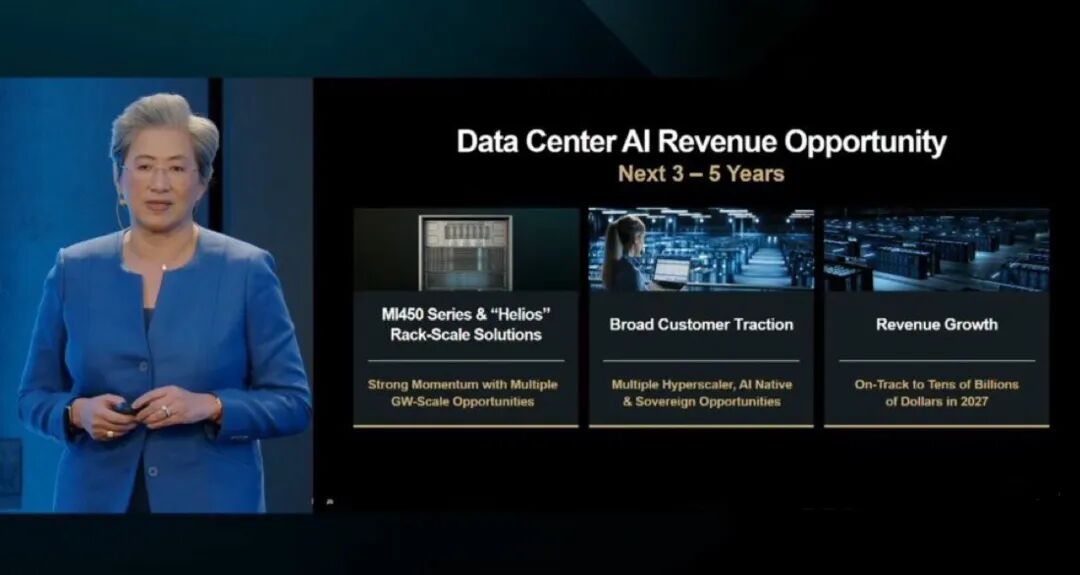
Core Viewpoint - AMD CEO Lisa Su stated that the AI data center market will exceed $1 trillion by 2030, indicating significant growth potential in the computing market driven by AI infrastructure [1][7][9]. Group 1: Company Background - Lisa Su, the current CEO and Chairwoman of AMD, has a strong technical background with a Ph.D. in Electrical Engineering from MIT and has held executive positions at IBM and Freescale Semiconductor [2]. - When Su took over AMD, the company was struggling with a market cap of less than $3 billion and was losing market share to Intel [3][4]. Group 2: Market Potential - The AI data center market is expected to expand significantly, with AMD positioning itself to capture a share of this growth by offering comprehensive computing systems rather than just individual components [10][20]. - AMD aims for a 35% compound annual growth rate (CAGR) over the next 3 to 5 years, which would require revenue to increase approximately 4.5 times, indicating a major shift in the semiconductor industry [12][13]. Group 3: Product Development - AMD is focusing on two main product lines: the Instinct MI350 series, which is designed for AI training and inference, and the upcoming Helios system, set to launch in 2026 [22][28]. - The Instinct MI350 series is noted for its rapid deployment and a 35-fold increase in AI performance compared to its predecessor [23][24]. Group 4: Competitive Strategy - Su emphasized the importance of system-level capabilities, highlighting four key elements: Compute, Memory, Interconnect, and Efficiency, which are crucial for optimizing AI data centers [30][34]. - The company aims to transition from being a "machine supplier" to a "factory builder" in the AI era, focusing on integrated systems that enhance efficiency and performance [19][29]. Group 5: Market Reaction - Following Su's presentation, AMD's stock price showed positive movement, reflecting market optimism regarding the company's ambitious targets and growth narrative [35]. - Analysts have noted that while AMD is a key player in the AI sector, achieving its targets will be challenging due to execution complexities and market valuation pressures [37].