JoyBuilder模型开发平台

Search documents
国产化!京东云破局:渐进式“真替真用”
Zheng Quan Shi Bao· 2025-11-20 10:43
Core Insights - The article emphasizes the successful path taken by JD Cloud in the context of domestic chip and software development, highlighting the shift from policy-driven to market-driven approaches by 2025 [1][14] - JD Cloud's methodology of "gradual true replacement" is gaining traction as a practical model for domestic innovation, focusing on real business scenarios to validate technology [4][6] Group 1: Domestic Chip and Software Development - By 2025, domestic chips are expected to account for 40% of the market, with a notable increase in the performance of domestic software stocks [1] - The AI industry in China is transitioning from "usable" to "usable and effective," with AI workloads projected to dominate cloud computing by 2029 [1][10] Group 2: Challenges in Domesticization - The main challenges in domesticization are categorized into three areas: usability, controllability, and trustworthiness [2][3] - Usability issues arise from the need for stability in high-demand environments, particularly with the coexistence of X86 and ARM architectures [2] - Controllability concerns involve hidden costs related to software restructuring and personnel training, which can delay domesticization efforts [3] - Trustworthiness is critical, as businesses cannot afford the risks associated with complete system overhauls [3] Group 3: JD Cloud's Approach - JD Cloud's strategy includes multi-chip management to ensure system availability despite individual chip failures [5] - The gradual replacement strategy allows for controlled risk and cost management by starting with small-scale pilot projects [5] - JD Cloud leverages real business scenarios to refine its hardware and software solutions, ensuring continuous upgrades [5][9] Group 4: Technological Advancements - JD Cloud's JoyScale AI computing platform integrates various domestic chips, providing efficient computing solutions validated through extensive real-world testing [12] - The JoyBuilder model development platform enhances training and inference speeds while significantly reducing application costs [13][14] - Data security is prioritized through the use of national encryption standards and secure sandbox technologies, ensuring compliance and safety [14] Group 5: Market Perception and Future Outlook - The market's perception of domesticization is shifting from mere availability to the effectiveness and value of solutions [14] - By 2025, the focus will transition from policy-driven initiatives to commercially viable solutions that withstand extreme testing scenarios [14] - Companies like JD Cloud, which continuously enhance their capabilities, are expected to thrive in the competitive landscape of digital sovereignty [14]


国产化!京东云破局:渐进式“真替真用”
证券时报· 2025-11-20 10:40
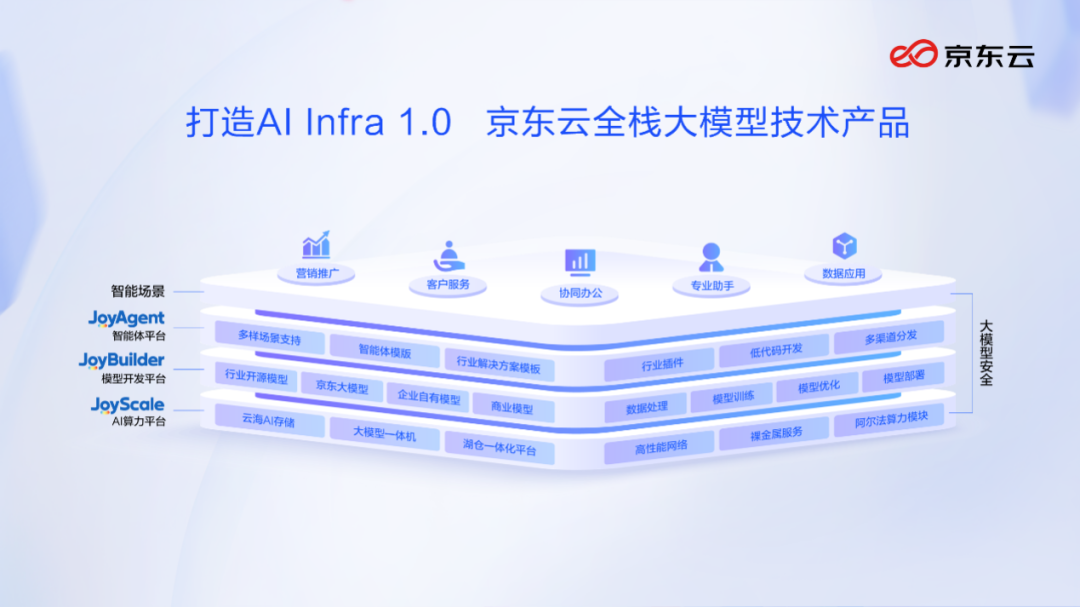
Core Viewpoint - The article emphasizes that JD Cloud is successfully navigating the path of domestic innovation and transformation, focusing on practical applications and real business scenarios to drive its technological advancements [1][3]. Group 1: Domestic Innovation and Market Trends - By 2025, domestic chips are expected to account for 40% of the market, with a shift from policy-driven to market-driven dynamics in the domestic software sector [2]. - The AI industry in China is transitioning from "usable" to "usable and effective," with AI workloads projected to dominate cloud computing by 2029 [2]. - The increasing demand for digital infrastructure is pushing for advancements in computing power and system reliability [2]. Group 2: Challenges in Domesticization - The main bottlenecks in domesticization are not technological gaps but rather ecosystem fragmentation and high migration costs [5]. - The three core challenges identified are: 1. "Usability" issues, where existing domestic solutions need to prove stability under high-demand scenarios [5]. 2. "Controllability" concerns, as full replacement involves significant hidden costs related to software restructuring and training [6]. 3. "Trustworthiness" gaps, where businesses fear the risks associated with overhauling existing systems [7]. Group 3: JD Cloud's Approach - JD Cloud adopts a "gradual true replacement" strategy, which is gaining traction as a practical model for domesticization [10][11]. - The approach includes: 1. Multi-chip management to ensure system resilience against single architecture failures [12]. 2. Gradual replacement through pilot projects to manage risks and costs effectively [12]. 3. Continuous iteration of self-developed hardware and software based on real business scenarios [12]. Group 4: Infrastructure and AI Development - JD Cloud is transitioning to a GPU-centric mixed computing architecture, termed AI Infra 1.0, to support the deep application of large models [16]. - The JoyScale AI computing platform integrates heterogeneous computing resources, ensuring efficient scheduling and stability during peak demand [17]. - The JoyBuilder model development platform enhances training and inference speeds while ensuring data security through comprehensive encryption methods [19]. Group 5: Market Perception and Future Outlook - The market's perception of domesticization is shifting from mere availability to evaluating usability and value [19]. - By 2025, the focus will shift from policy-driven initiatives to commercially viable solutions that have been tested in extreme scenarios [19]. - The ultimate goal of domesticization is to empower Chinese enterprises with genuine choices in the global technology landscape, balancing performance and security [20].

京东11.11:JoyAI大模型跑在超级供应链上
Zhong Jin Zai Xian· 2025-11-12 06:31
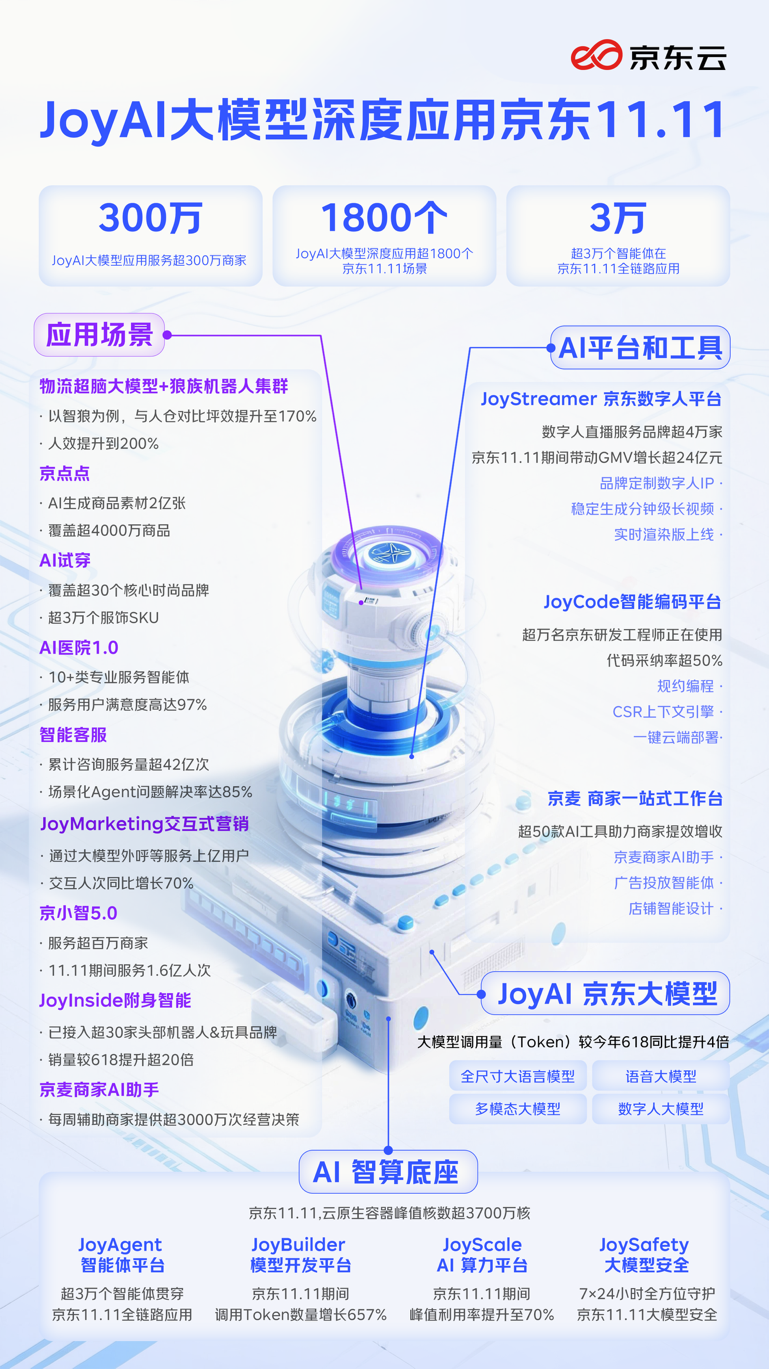
Core Insights - JD.com has experienced significant growth in order volume, logistics efficiency, and merchant revenue during the 2025 11.11 shopping festival, driven by AI innovations centered around JoyAI [1][4][10] Full-Scenario Application - AI applications within JD.com have transitioned from isolated trials to comprehensive coverage, enhancing operational efficiency and reducing costs [4] - The platform "京点点" generated 200 million product images in seconds, covering over 40 million products, aiding merchants in marketing material creation [4] - The "京麦商家AI助手" provided over 30 million operational decisions weekly based on historical data [4] - The logistics model, combined with robotic systems, improved storage efficiency by 200% and labor efficiency by 300% [4] Consumer Experience Enhancement - AI-driven customer service handled over 4.2 billion inquiries during the 11.11 event, achieving an 85% resolution rate for various queries [5] - The "京小智 5.0" assistant served 160 million times, showcasing high emotional intelligence in customer interactions [5] - AI fitting services were implemented for over 30 fashion brands, enhancing user experience with realistic virtual try-ons [6] - The "JoyInside" technology enabled personalized interactions with smart toys, leading to a 20-fold increase in sales compared to previous events [6] Platform Services - JD.com has made its AI capabilities accessible to over 3 million merchants, significantly lowering the barriers to technology adoption [7] - The "JoyStreamer" digital human platform generated over 2.3 billion yuan in GMV during the 11.11 event, with a cost efficiency of 1/10 compared to human hosts [7] - The "JoyBuilder" platform provided up to 4.5 million free tokens to new users, facilitating easier AI application [7] AI Computing Foundation - Over 30,000 "digital employees" based on the JoyAgent 3.0 platform were deployed across various sectors, achieving a 77% accuracy rate in a GAIA evaluation [8][10] - JD.com’s cloud infrastructure demonstrated robust performance with over 37 million peak container cores during the event [9] - The "JoyScale" AI computing platform supported extensive application needs, with a 657% increase in token usage on the "JoyBuilder" platform [10] Conclusion - The 2025 11.11 event signifies a pivotal moment where AI has become integral to industry operations, driving a transformative shift towards a new era of digital intelligence [10]