Kimi Linear架构

Search documents
Kimi创始人杨植麟:未来AI研发将进入AI主导时代
凤凰网财经· 2026-03-29 10:49
Core Insights - The essence of large models is the conversion of energy into intelligence, with scalability being a core foundation for AI development. However, scalability is not merely about brute-force computing power and energy but focuses on upgrading efficiency [1][3]. Group 1: Scalability Strategy - Kimi's scalability strategy is built around three main directions: Token efficiency, long context, and Agent swarm technology, aiming to maximize intelligence with limited resources [1][3]. - Improving Token efficiency involves utilizing better network architectures and optimizers to learn more intelligence from the same amount of data [3]. - Kimi's proprietary Kimi Linear architecture enhances long context capabilities, allowing models to achieve lower loss functions with longer inputs, supporting more complex task execution [3]. Group 2: Evolution of Model Training - The evolution of large model training has three stages: Initially relying on natural internet data with minimal human annotation, moving towards large-scale reinforcement learning systems by 2025, where human-defined tasks are enhanced through reinforcement learning [3]. - In the near future, AI will increasingly lead research and development efforts, with researchers equipped with vast amounts of Tokens, allowing AI to autonomously synthesize new tasks, construct new environments, and define optimal reward functions [3]. - This shift is expected to accelerate the pace of research and development across the AI field [3].

杨植麟讲如何scaled Kimi K2.5完整图文版/压缩版/视频版
理想TOP2· 2026-03-22 12:52
Core Insights - The article emphasizes the importance of advancements in AI models, particularly focusing on the Kimi 2.5 model, which integrates various innovative techniques to enhance token efficiency, context length, and the use of agent swarms for complex tasks [1][2][4]. Token Efficiency - Scaling Law is identified as a fundamental principle for large models, with the Muon optimizer being a key investment that enhances token efficiency by optimizing the way gradient updates are processed, potentially doubling token efficiency [2][24]. - The Muon optimizer, a second-order optimizer, can achieve a twofold increase in token efficiency, allowing for the effective utilization of high-quality tokens [23][24]. - The article discusses the challenges faced when scaling to trillion-parameter models, particularly the issue of logits explosion, which is addressed through the introduction of QK-Clip technology [30][32]. Context Length - The Kimi Linear architecture introduces Kimi Delta Attention, which improves the model's ability to capture long-range dependencies by allowing for fine-grained control over information retention [3][42]. - The article highlights the advantages of transformer models over LSTMs in handling longer context lengths, which is crucial for complex tasks [37][39]. Agent Swarms - The agent swarm paradigm is introduced as a method to overcome the limitations of single agents by coordinating multiple sub-agents to perform tasks in parallel, thereby enhancing task capacity and efficiency [4][59]. - A new three-part reward function is proposed to guide the learning process of agent swarms, focusing on instantiation rewards, completion rewards, and result rewards to ensure meaningful task execution [67][68]. Kimi 2.5 Model Innovations - Kimi 2.5 is presented as the first open-source model with native joint vision-text capabilities, achieved through early fusion of visual and textual training processes [77][78]. - The model demonstrates that visual capabilities can enhance text performance and vice versa, leading to improved outcomes in various tasks without the need for extensive visual fine-tuning data [81][83]. Future Directions - The article concludes with a commitment to continue exploring new dimensions of model expansion, emphasizing the ongoing collaboration with the open-source community to achieve better intelligence [114].
独家|上轮才过几周,Kimi开启新一轮融资!估值直冲48亿美元,机构正疯狂“抢配”月之暗面
Sou Hu Cai Jing· 2026-01-19 21:25
Core Insights - The company "Yue Zhi An Mian," one of China's AI "six little dragons," is currently undergoing a new round of financing with a pre-money valuation nearing $4.8 billion, up from a post-money valuation of $4.3 billion just weeks prior, indicating a $500 million increase in valuation within a month due to market enthusiasm for domestic AI stocks [2] - Following the successful listings of competitors "Zhi Pu" and "MiniMax," investors are showing unprecedented interest in "Yue Zhi An Mian," with many institutions eager to secure allocations in what is perceived as a top-tier non-listed unicorn [2] - The company is not rushing towards an IPO, as it holds over 10 billion RMB in cash reserves, allowing it to maintain its strategic pace without the pressure of short-term financial reporting [3] Company Strategy - The founder, Yang Zhilin, emphasizes the importance of focusing on the development of the next-generation reasoning model (K3 series) and expanding the underlying computing power, rather than rushing to market [3] - The company aims to enhance "Token efficiency" as a core strategy, with two key technological innovations: the "Muon second-order optimizer," which doubles Token efficiency, and the "Kimi Linear architecture," which significantly improves processing speed for long-context tasks [3][4] Market Position - With ongoing restrictions on American AI services in China, domestic AI leaders are experiencing unprecedented "home court advantages," positioning "Yue Zhi An Mian" at the center of this opportunity [4] - The company has not yet commented on the specifics of its $4.8 billion valuation, but it remains a standout entity that has maintained its independent pace amidst market fluctuations [4]

罕见,月之暗面杨植麟、周昕宇、吴育昕回应一切:打假460万美元、调侃OpenAI
3 6 Ke· 2025-11-11 04:25
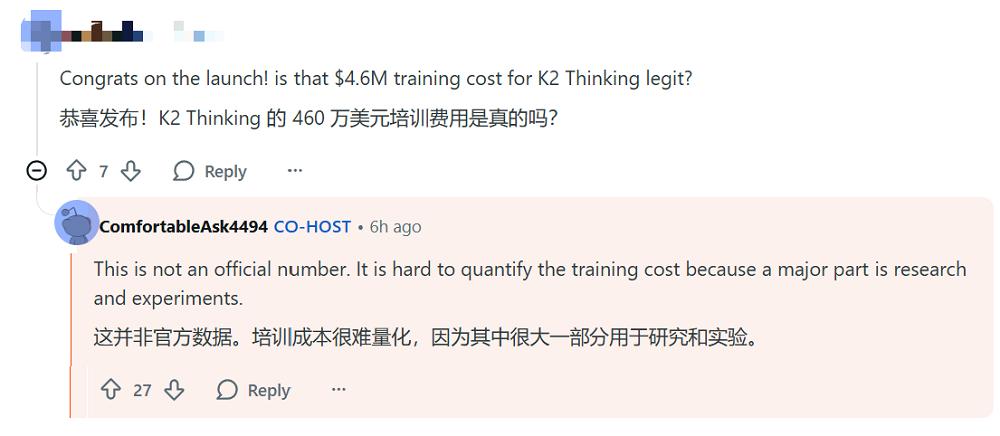
Core Insights - The core discussion revolves around the Kimi K2 Thinking model, its training costs, performance metrics, and the company's future plans for model development and open-source strategies [1][3][13] Group 1: Kimi K2 Thinking Model - The training cost of the Kimi K2 Thinking model is rumored to be $4.6 million, but the CEO clarified that this figure is not official and that training costs are difficult to quantify due to significant research and experimental expenses [1] - The current priority for the Kimi K2 Thinking model is absolute performance rather than token efficiency, with plans to improve token usage in future iterations [3][4] - The model has shown high scores in benchmark tests like HLE, but there are concerns about the gap between its performance in tests and real-world applications [4] Group 2: Open Source and Safety - The company embraces open-source strategies, believing that open safety alignment technology can help researchers maintain safety while fine-tuning models [2][8] - The CEO emphasized the importance of establishing mechanisms to ensure that subsequent work adheres to safety protocols [2] Group 3: Future Developments - The company is exploring a visual-language version of the K2 model and has plans for the K3 model, although no specific release date has been provided [1][2] - There are discussions about expanding the context window of the Kimi K2 Thinking model, with current support for 256K tokens and potential future increases [11] Group 4: Community Engagement - The recent AMA session on Reddit highlighted the global interest in the Kimi series, reflecting a growing recognition of China's AI innovation capabilities [13] - The company is actively responding to community feedback and questions, indicating a commitment to transparency and user engagement [13]
Kimi开源新线性注意力架构,首次超越全注意力模型,推理速度暴涨6倍
量子位· 2025-10-31 06:27
Core Insights - The era of Transformers is being redefined with the introduction of the Kimi Linear architecture, which surpasses traditional attention models under the same training conditions [2][10]. Group 1: Kimi Linear Architecture - Kimi Linear employs a novel attention mechanism that reduces the KV cache requirement by 75% and achieves up to 6 times faster inference in long-context tasks [4][26]. - The architecture introduces Kimi Delta Attention (KDA), which allows for fine-grained control over memory retention, enabling the model to discard redundant information while preserving important data [12][10]. - KDA's state update mechanism is based on an improved Delta Rule, ensuring stability even with sequences of millions of tokens, preventing gradient explosion or vanishing [13][14]. Group 2: Performance and Efficiency - The model utilizes a 3:1 mixed layer design, combining three layers of linear attention followed by one layer of full attention, balancing global semantic modeling with resource efficiency [15]. - Kimi Linear has demonstrated superior performance across multiple benchmark tests, such as MMLU and BBH, outperforming traditional Transformers while maintaining accuracy in mathematical reasoning and code generation tasks [22][26]. - The architecture's deployment is seamless with existing vLLM inference frameworks, allowing for easy upgrades of Transformer-based systems to Kimi Linear [21]. Group 3: Industry Trends - The dominance of Transformers is being challenged, with alternative models like state space models (SSM) showing potential for efficient computation and long sequence modeling [28][30]. - Companies like Apple are exploring SSM architectures for their energy efficiency and lower latency, indicating a shift away from traditional Transformer reliance [30]. - The emergence of Kimi Linear signifies a move towards diverse innovations in AI architecture, suggesting a departure from the conventional Transformer path [32].