Kunlun

Search documents
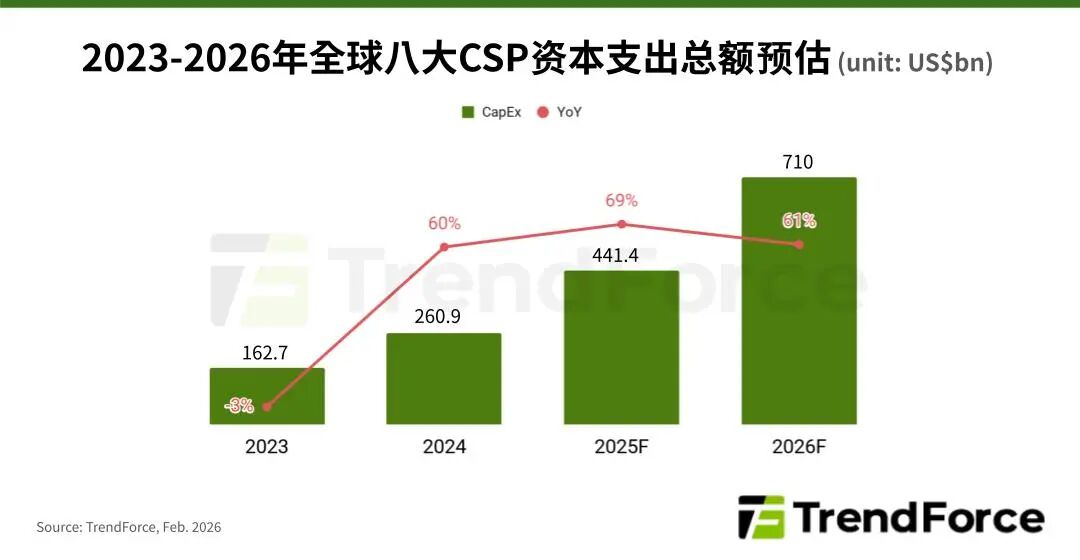
TrendForce:预计2026年八大主要CSP的合计资本支出将超7100亿美元 年增率约61%
智通财经网· 2026-02-25 09:14
Group 1: Industry Overview - Global cloud service providers (CSPs) are significantly increasing investments in AI servers and related infrastructure, with total capital expenditure expected to exceed $710 billion by 2026, reflecting a year-on-year growth rate of approximately 61% [1] - The eight major CSPs include Google, AWS, Meta, Microsoft, Oracle, Tencent, Alibaba, and Baidu [4] Group 2: Company-Specific Insights - Alphabet (Google) is projected to have capital expenditures surpassing $178.3 billion by 2026, with a year-on-year increase of 95%. Google has a significant advantage in self-developed ASICs, with expectations that TPU shipments will account for nearly 78% of its AI server output by 2026 [4] - Amazon is increasing its procurement of NVIDIA GPU systems, with expectations that GPU models will comprise nearly 60% of its AI servers by 2026. The new generation of Trainium ASIC is expected to be launched in the second quarter of 2026 [5] - Meta's capital expenditure is expected to exceed $124.5 billion by 2026, with GPU models expected to account for over 80% of its AI servers. Meta is also working on self-developed ASICs to reduce costs and dependency on single suppliers [5] - Microsoft is focusing on long-term demand for large model training and inference, primarily purchasing NVIDIA solutions for its AI servers. The company has released its self-developed chip, Maia 200, targeting efficient AI inference applications [6] - ByteDance is expected to allocate over half of its capital expenditure towards AI chip procurement, with NVIDIA's H200 being a key solution, contingent on regulatory reviews [6] - Tencent is acquiring NVIDIA GPU solutions to support cloud and generative AI demands while also collaborating with local firms to develop its own ASIC solutions [6] - Alibaba and Baidu are both actively developing their own ASIC AI chips, with Alibaba providing AI application infrastructure and Baidu planning to introduce its Kunlun solutions for large-scale AI training and inference applications [7]




研报 | 预估2026年全球八大CSP合计资本支出将破7,100亿美元,谷歌TPU引领ASIC布局
TrendForce集邦· 2026-02-25 09:01
Core Insights - The global cloud service providers (CSPs) are significantly increasing their capital expenditures on AI servers and related infrastructure, with a projected total exceeding $71 billion in 2026, reflecting a year-on-year growth rate of approximately 61% [2][5][6]. Group 1: Major CSPs and Their Investments - The eight major CSPs include Google, AWS, Meta, Microsoft, Oracle, Tencent, Alibaba, and Baidu [6]. - Google is expected to have a capital expenditure exceeding $1.783 billion in 2026, with a year-on-year increase of 95%. Google has a significant lead in ASIC development, with its TPU shipments projected to account for nearly 78% of its AI server output [6][7]. - Amazon is increasing its procurement of NVIDIA GPU systems, with its GPU models expected to represent nearly 60% of its AI server offerings in 2026. The new generation of its self-developed ASIC, Trainium 3, is anticipated to launch in the second quarter of 2026 [7]. - Meta's capital expenditure is projected to exceed $1.245 billion in 2026, with a year-on-year growth of 77%. Its AI servers will primarily utilize NVIDIA and AMD solutions, with GPU models expected to account for over 80% [8]. Group 2: ASIC Development and Market Dynamics - Microsoft is focusing on long-term demand for large model training and inference, primarily acquiring NVIDIA solutions for its AI servers. The company has released its self-developed chip, Maia 200, aimed at high-efficiency AI inference applications [8]. - Oracle is expanding its GPU solutions in response to AI data center projects, while ByteDance is expected to allocate over half of its capital expenditure to AI chip procurement, with NVIDIA's H200 being a key solution [9]. - Tencent is sourcing NVIDIA GPUs to support cloud and generative AI demands while collaborating with local firms to develop its own ASIC solutions [9]. - Both Alibaba and Baidu are actively developing their own ASIC AI chips, with Alibaba providing AI infrastructure through its subsidiaries and Baidu planning to introduce its Kunlun solutions for large-scale AI training and inference applications [9].



Alibaba's Artificial Intelligence (AI) Push: Could This Be China's Best Answer to Nvidia?
The Motley Fool· 2025-10-11 08:07
Core Insights - Nvidia has established itself as the leading player in the AI hardware market, but competition is emerging from companies like Intel and AMD, as well as domestic players in China like Alibaba [1][2][4] - Alibaba is positioning itself as a significant competitor in the AI hardware space, potentially becoming the "Nvidia of China" [4][17] - The Chinese AI market is projected to grow significantly, with estimates suggesting it could reach $1.4 trillion by 2030, presenting substantial investment opportunities [10][14] Company Overview - Alibaba's revenue is primarily driven by e-commerce, with over 50% of Q2 2025 sales from domestic operations and 15% from international e-commerce [5] - The cloud computing segment, which includes AI, accounts for 15% of total sales and has shown a year-over-year growth of 26%, indicating strong potential for future expansion [6] - Alibaba's T-Head processor has performance specifications comparable to Nvidia's H20 GPU, but at a cost approximately 40% lower, making it an attractive option for Chinese firms [7] Market Dynamics - The Chinese government is increasingly wary of reliance on foreign technology suppliers, prompting a push for domestic AI hardware development [3][4] - Alibaba's AI solutions are designed to be compatible with open-source software, potentially offering greater flexibility compared to Nvidia's CUDA ecosystem [8] - Demand for Alibaba's T-Head processors is already evident, with orders from state-owned telecom China Unicom for a new data center [13] Future Outlook - Analysts predict Alibaba's revenue will continue to grow through 2027, with the potential for accelerated growth in its AI segment [17] - Despite the challenges, Alibaba's stock is expected to remain a strong investment opportunity, even if it does not replicate Nvidia's extraordinary gains [15][16][18]