LaST₀

Search documents
真机RL杀疯了,机器人自学20分钟100分,数字孪生封神
3 6 Ke· 2026-02-13 07:32
Core Insights - TwinRL introduces a digital twin-driven reinforcement learning framework that enhances the exploration capabilities of robots in real-world tasks, achieving a 100% success rate in various operations within approximately 20 minutes, while reducing human intervention by over 50% [1][22][36]. Group 1: Technology and Framework - TwinRL is not a simulator but an exploration amplifier and guide, designed to expand the exploration space for robots beyond the limitations of traditional methods [16][15]. - The framework consists of three main components: exploration space expansion, parallel online reinforcement learning in the digital twin, and sim-to-real guided exploration [32][36]. - The exploration space expansion strategy utilizes high-fidelity digital twin environments to generate synthetic trajectories that exceed human demonstration coverage [25][32]. Group 2: Performance and Efficiency - TwinRL demonstrates a significant improvement in exploration efficiency, achieving at least a 30% acceleration in convergence time compared to existing real-world reinforcement learning methods [22][39]. - In experiments, TwinRL maintained a near 100% success rate in both in-distribution and out-of-distribution areas, showcasing its robustness against environmental changes [39][46]. - The framework effectively bridges the gap between offline training and online learning, allowing for a smoother transition and reducing performance degradation during the learning process [39][34]. Group 3: Research Background and Observations - The research highlights that the effective exploration space in real-world VLA reinforcement learning is heavily constrained by the distribution of supervised fine-tuning (SFT) data [27][30]. - The study reveals that traditional reinforcement learning methods struggle with exploration deadlock in out-of-distribution scenarios, emphasizing the need for a broader exploration strategy [30][31]. - TwinRL addresses these challenges by moving the exploration process to a controllable and expandable digital twin environment, allowing for more effective learning [15][36].


LaST₀:让机器人拥有物理直觉,抛开语言拐杖像人一样思考动作
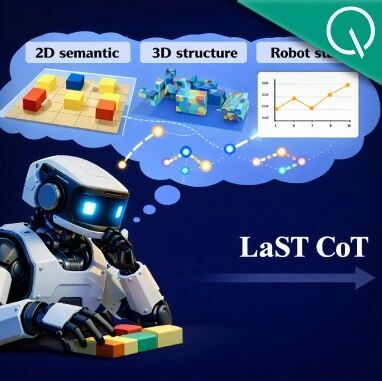
机器人大讲堂· 2026-02-09 04:04
Core Insights - The article discusses the advancements in robotic intelligence through the LaST₀ framework, which allows robots to perform tasks more efficiently by utilizing a latent space for physical simulation rather than relying on explicit language-based instructions [5][8][28]. Group 1: LaST₀ Framework - LaST₀ enables robots to predict and encode future states directly in a compact latent space, focusing on visual dynamics, 3D geometric structures, and the robot's own bodily awareness [6][8]. - This framework enhances the efficiency and accuracy of robotic actions by eliminating the need for language translation, allowing for a more natural and fluid interaction with the physical environment [8][28]. Group 2: Dual Expert System - The LaST₀ framework incorporates a "dual expert" mixed Transformer architecture, consisting of a slow-thinking "reasoning expert" and a fast-reacting "action expert" [10][12]. - This design allows for real-time knowledge synchronization between the two experts, enabling robots to think and act simultaneously without delays [12][22]. Group 3: Performance Metrics - In rigorous testing across various simulated and real-world tasks, LaST₀ achieved an average success rate of 82% in the RLBench simulation, significantly outperforming previous models [14][16]. - The overall reasoning speed of LaST₀ reached 15.4 Hz, nearly 14 times faster than the language-based CoT method, which operated at 1.1 Hz [14][15]. Group 4: Generalization and Versatility - LaST₀ demonstrates remarkable generalization capabilities, allowing it to adapt to various robotic forms, from industrial arms to humanoid robots, by simply adjusting the end-effector's action dimensions [23][24]. - This adaptability indicates that the latent space physical reasoning ability is a universal skill, independent of specific robot configurations [24][28]. Group 5: Future Implications - The advancements presented by LaST₀ are expected to significantly impact industrial applications, enabling robots to handle tasks like assembly and sorting with greater fluidity and adaptability [28][30]. - In domestic and service sectors, robots will be able to perform complex household chores more safely and naturally, while in specialized fields like surgery and space exploration, they will operate independently in challenging environments [30][31].
具身大模型LaST₀:双臂/移动/灵巧手全面新SOTA,首次引入隐空间时空思维链
量子位· 2026-02-07 07:02
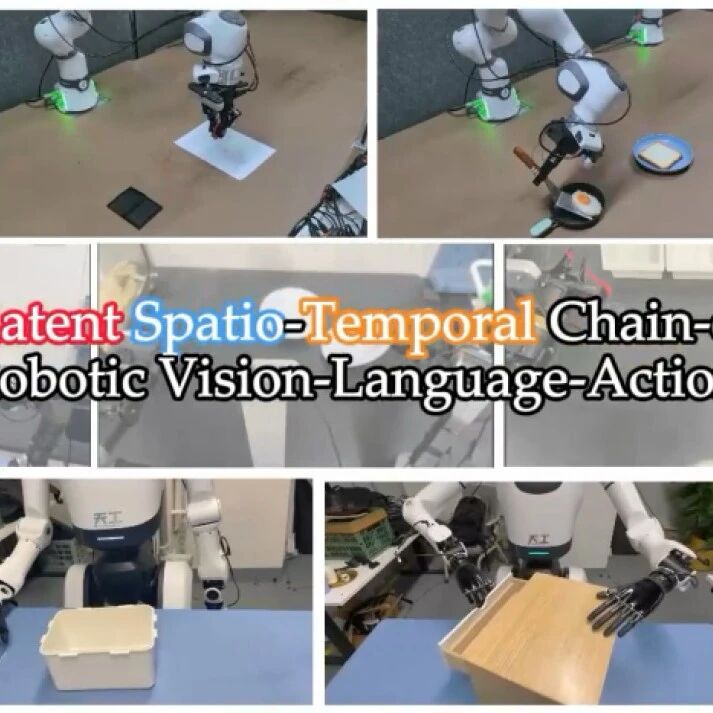
Core Insights - The article introduces LaST₀, a novel VLA model that utilizes Latent Spatio-Temporal CoT for efficient reasoning in robotics, achieving state-of-the-art performance in various tasks [1][2][4]. Group 1: Model Overview - LaST₀ integrates high-efficiency latent space reasoning into embodied large models, surpassing previous methods like Pi0.5 in dual-arm and humanoid dexterous hand tasks [2][4]. - The model employs a Mixture-of-Transformers (MoT) architecture, featuring a slow reasoning expert for low-frequency latent space reasoning and a fast action expert for high-frequency action generation [5][11]. Group 2: Technical Innovations - LaST₀ introduces a compact latent space to model future visual dynamics, 3D structural information, and robot proprioceptive states, enabling a coherent temporal reasoning process [4][10]. - The model's architecture allows for asynchronous frequency coordination between the slow reasoning expert and the fast execution expert, optimizing real-time robotic operations [23]. Group 3: Performance Metrics - In simulations, LaST₀ achieved an average success rate of 82% across 10 RLBench tasks, outperforming existing state-of-the-art methods by 8% to 21% [24]. - In real-world tasks, LaST₀ demonstrated a 72% average success rate on the Franka platform, significantly exceeding competitors like SpatialVLA (41%) and CoT-VLA (50%) [27]. Group 4: Implications for Robotics - The model's ability to capture intricate physical and dynamic features through latent space reasoning enhances its performance in complex robotic tasks, indicating its potential for broader applications in dynamic environments [9][28]. - LaST₀'s design allows for effective interaction with the physical world, crucial for robust robotic operations in various settings [9][12].