LightGen芯片

Search documents
光芯片,已成AI算力答案?
半导体行业观察· 2026-01-31 03:49
Core Viewpoint - The article discusses the advancements in photonic chips as a potential solution to the energy consumption issues associated with generative artificial intelligence models, highlighting China's leading position in this field [2][3]. Group 1: Photonic Chip Development - Photonic chips, also known as optoelectronic chips, are expected to address the energy consumption challenges of generative AI models, although they are still years away from being integrated into consumer-grade computers [2]. - Research on photonic chips has accelerated significantly over the past five years, with China emerging as a global leader, evidenced by a ninefold increase in related publications from 2017 to 2025 [2][3]. - In 2022, Chinese researchers published 476 papers on photonic chips, the highest globally, while the U.S. saw a doubling of its publication count during the same period [2]. Group 2: Impact of U.S. Policies - U.S. policies restricting China's access to advanced electronic chips have intensified China's focus on developing photonic computing technologies [3]. - The Chinese government has included photonic technology in its "14th Five-Year Plan," providing stable funding support for its development [3]. Group 3: Technical Advantages and Challenges - Photonic chips transmit information using photons instead of electrons, offering superior performance and lower energy loss compared to electronic systems [4]. - Current applications of photonic chips include sensors, data communication systems, and biomedical devices, but challenges remain in adapting them for complex computational tasks, particularly in generative AI [4]. - The LightGen chip, developed by a team at Shanghai Jiao Tong University, can perform advanced generative AI tasks, surpassing the performance of high-end processors like NVIDIA's A100 [5]. Group 4: Engineering Bottlenecks - Despite their advantages, photonic chips face engineering challenges, including the energy consumption of supporting components like lasers and detectors, which may offset the energy savings of the chips themselves [7]. - Scalability is another critical issue, as photonic chip architectures require specific adjustments for different applications, making the development of a general-purpose photonic processor a significant challenge [7]. - The likelihood of photonic chips completely replacing multifunctional electronic processors is low; instead, they are expected to serve as specialized components within a broader hybrid computing ecosystem [7].


上交团队实现新一代光计算芯片突破开辟算力芯片新路径
Xin Lang Cai Jing· 2025-12-30 04:38
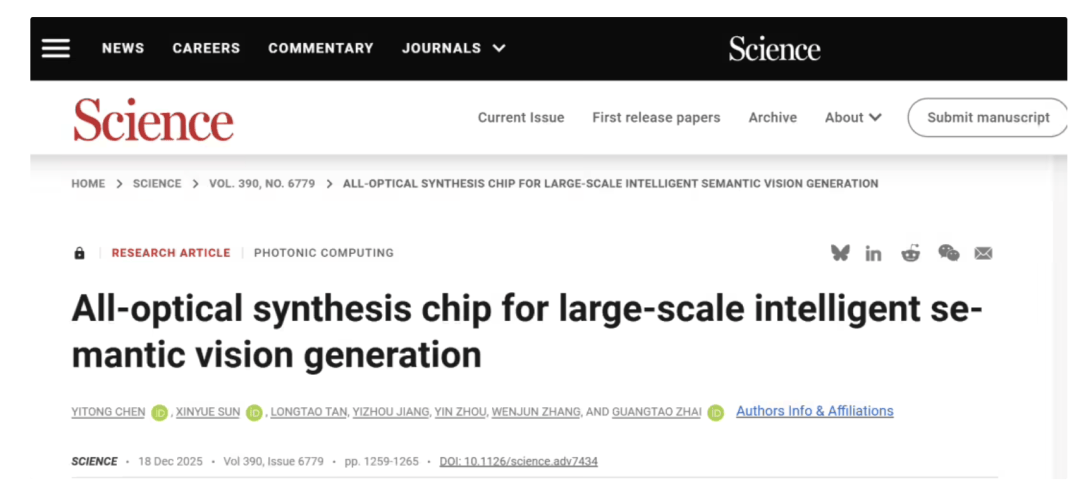
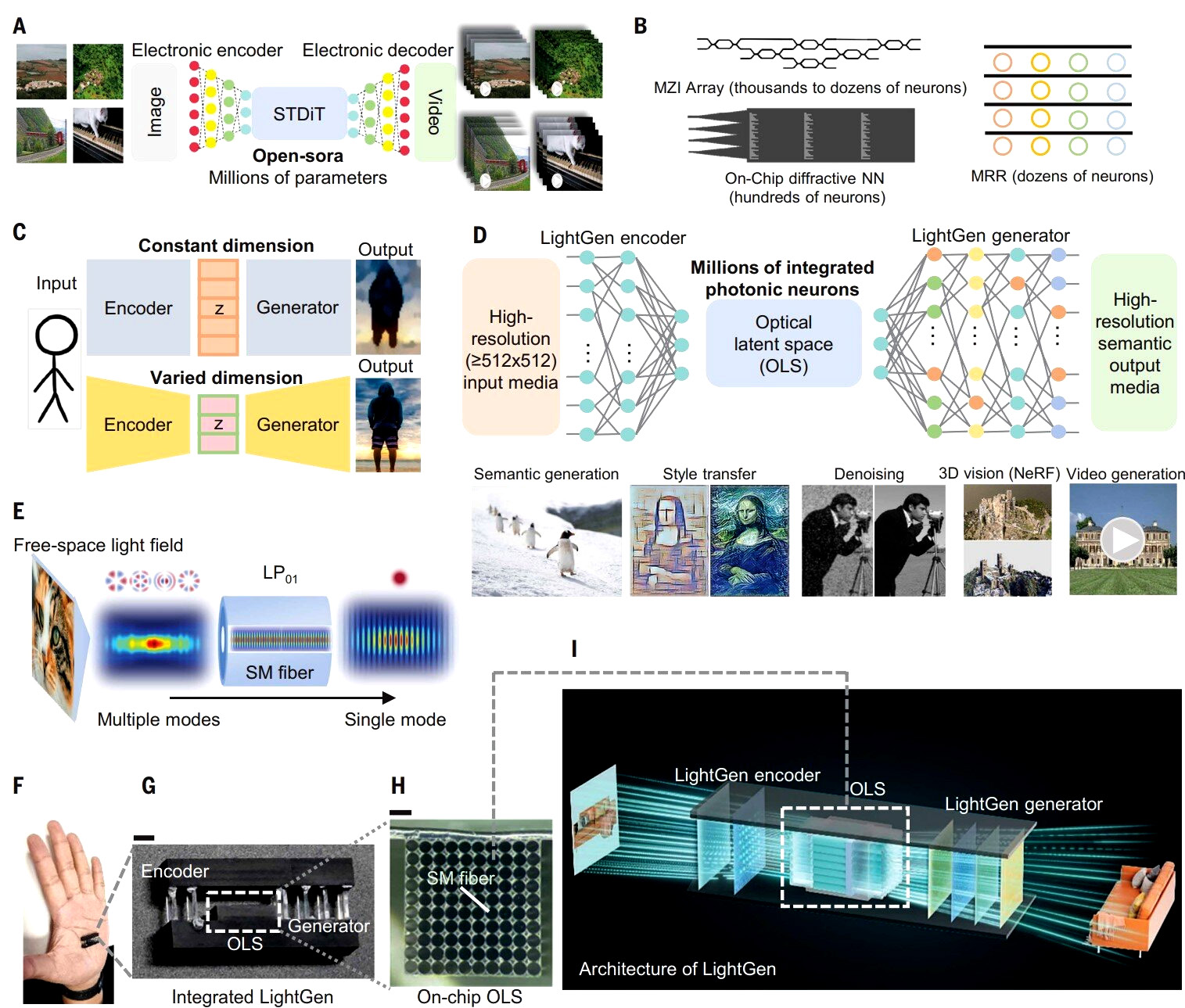
Core Insights - The article discusses the development of the all-optical computing chip LightGen by a team from Shanghai Jiao Tong University, which significantly enhances the capabilities of large-scale generative AI models, enabling high-resolution image generation, 3D generation, and video generation with improved speed and energy efficiency [1][2] Group 1: Technological Advancements - LightGen achieves a two-order-of-magnitude improvement in computational power and energy efficiency compared to leading digital chips, making real-time generative tasks feasible [1] - The chip supports various large-scale generative tasks, including denoising and feature transfer, while maintaining quality comparable to advanced electronic neural networks [1] - The theoretical computational power of LightGen could increase by seven orders of magnitude with the use of cutting-edge input devices, addressing the computational gap in deploying generative AI [1] Group 2: Research and Development - The research team has overcome significant challenges, including the integration of millions of optical neurons, all-optical dimension transformation, and the development of a no-true-value training algorithm, which are crucial for generative tasks [2] - LightGen represents a qualitative leap in optical computing, moving from decision-making tasks to semantic generation, and is not merely an enhancement of existing optical chips [2] - The team aims to commercialize LightGen for content production processes, enabling real-time previews and significantly reducing rendering times from hours to seconds or even sub-second levels [2] Group 3: Future Prospects - The transition of LightGen from laboratory research to a usable technology product will require the establishment of standardized processes and mass production testing standards [2] - The research team is actively collaborating with industry partners to facilitate the practical application of LightGen [2]
光计算芯片,我国重大突破
半导体行业观察· 2025-12-21 03:58
Core Viewpoint - The article discusses the significant advancements in optical computing technology, specifically the LightGen chip developed by Shanghai Jiao Tong University, which addresses the growing demand for computational power and energy efficiency in large-scale generative AI models [5][12]. Group 1: Breakthroughs in Optical Computing - The LightGen chip represents a major breakthrough in the field of optical computing, enabling the support of large-scale semantic visual generation models [5]. - It integrates over a million optical neurons on a single chip and employs all-optical dimension conversion, which are recognized as key bottlenecks in the industry [9]. - The chip achieves a closed-loop process of "input-understanding-semantic manipulation-generation," allowing it to "understand" and "cognize" semantics [9]. Group 2: Performance Evaluation - LightGen chip demonstrates a significant performance leap, achieving two orders of magnitude improvement in computational power and energy efficiency compared to leading digital chips, even with less advanced input devices [11]. - Theoretical calculations suggest that with cutting-edge input devices, the chip could achieve a seven-fold increase in computational power and an eight-fold increase in energy efficiency [11]. Group 3: Implications for AI Development - The advancements in LightGen are crucial for the practical application of next-generation computing chips in modern AI, particularly for high-latency and energy-intensive tasks like large-scale generative models [12]. - This development opens new pathways for exploring faster and more energy-efficient generative intelligent computing [12].
传字节跳动今年利润将破 500 亿美元;Faker 回应马斯克英雄联盟AI挑战;《阿凡达 3》豆瓣开分系列最低 | 极客早知道
Sou Hu Cai Jing· 2025-12-20 01:44
Group 1: Breakthroughs in Technology - Shanghai Jiao Tong University has achieved a significant breakthrough in the field of optical computing chips, realizing the world's first all-optical computing chip capable of supporting large-scale semantic media generation models, named LightGen [1][2] - The LightGen chip demonstrates a theoretical performance increase of 7 orders of magnitude in computing power and 8 orders of magnitude in energy efficiency when using advanced input devices [2] Group 2: Financial Performance of ByteDance - ByteDance is expected to achieve a record profit of approximately $50 billion (about 352.5 billion RMB) this year, driven by its expansion in e-commerce and new markets [4] - In the first three quarters of this year, ByteDance has already realized a net profit of about $40 billion, surpassing its internal target set for 2025 [4] Group 3: IPO and Growth of Zhipu Technology - Zhipu Technology has disclosed its IPO prospectus, aiming to become the first global public company focused on AGI foundational models, with projected revenues of 57.4 million RMB in 2022, 124.5 million in 2023, and 312.4 million in 2024, reflecting a compound annual growth rate of 130% [4][5][6] - The company, founded in 2019, has developed a comprehensive model matrix covering language, code, multimodal, and intelligent agents, maintaining technological parity with global leaders [5] Group 4: Automotive Developments - Xiaomi has obtained an L3 level road testing license for its automotive division, indicating its active participation in the autonomous driving sector [8] - The license allows Xiaomi to conduct conditional autonomous driving tests on designated high-speed roads in Beijing, contributing to the exploration of safer and smarter personal transportation services [8] Group 5: Advancements in Semiconductor Technology - A secret laboratory in China has reportedly assembled the first prototype of an EUV lithography machine through reverse engineering of ASML's existing products, marking a significant technological leap [16] - This prototype is expected to undergo testing and aims for trial production of prototype chips by 2028, indicating rapid advancements in China's semiconductor capabilities [16]