Llama 系列

Search documents
AI竞赛的终局不是技术,而是现金流:Anthropic的隐藏优势
美股研究社· 2026-03-27 11:29
Core Viewpoint - The investment landscape in the AI sector is shifting from a focus on technological capabilities to a more pragmatic evaluation of cash flow and profitability, indicating a transition from "tech narrative" to "business narrative" [1][2][4]. Group 1: Investment Trends - Major tech companies like Google and Amazon are investing billions into Anthropic, signaling a shift in survival logic away from OpenAI's model [2]. - The current market resembles the pre-burst internet bubble, where the focus is on sustainable business models rather than just technological prowess [2][5]. Group 2: Competitive Landscape - The AI industry has been dominated by a "arms race" mentality, but by 2026, the focus will shift from technical superiority to commercial viability [5]. - OpenAI, despite its prominence, faces challenges with high operational costs and dependency on Microsoft, which complicates its revenue model [5][6]. Group 3: Anthropic's Positioning - Anthropic has strategically focused on enterprise AI, avoiding the pitfalls of consumer applications that lead to high user acquisition costs [9]. - The partnership with Amazon provides Anthropic with structural advantages in cost control and distribution, enhancing its competitive edge [9][10]. - Anthropic emphasizes "controllable and safe" AI models, which are essential for enterprise clients, particularly in high-stakes industries [10]. Group 4: Future Outlook - For Anthropic to enter the top tier of global companies by 2030, it must establish itself as a foundational infrastructure in enterprise AI, create dependency in key industries, and reduce operational costs significantly [11][12]. - The AI industry is expected to follow a trajectory similar to early cloud computing, moving from high investment and low profit to explosive revenue growth and profit release [12]. Group 5: Conclusion - The narrative around AI is evolving from a magical solution to a focus on practical business applications, where cash flow and profitability will determine the leaders in the industry [15][16].

千问 3.5 发布,四成参数超越万亿模型,大模型的竞赛逻辑变了
Sou Hu Cai Jing· 2026-02-16 16:07
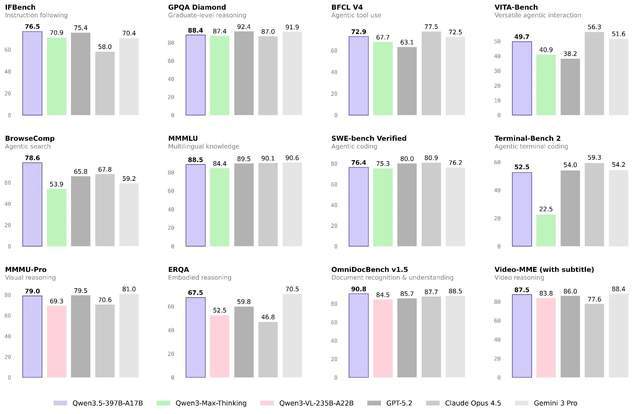
Core Insights - The main theme in the large model industry over the past two years has been "scaling up," but this has led to increased deployment costs, making it harder for companies to afford these models. The performance curve and adoption curve are diverging [1] - Alibaba's release of the Qwen 3.5-Plus model, with 397 billion total parameters and only 17 billion activated, demonstrates a shift in focus from merely increasing parameters to enhancing model efficiency and cost-effectiveness [1][3] Model Performance and Efficiency - Qwen 3.5-Plus surpasses the previous generation Qwen 3-Max and competes favorably with models like GPT-5.2 and Gemini 3 pro in various benchmarks, achieving scores such as 87.8 in MMLU-Pro and 88.4 in GPQA [1][3] - The model's API pricing is significantly lower, at 0.8 yuan per million tokens, which is 1/18 of Gemini 3 pro's price, indicating a new cost structure in the industry [1][8] Architectural Innovation - The industry is experiencing a shift from parameter accumulation to architectural innovation, similar to the transition in the chip industry from single-core to multi-core architectures [3] - Qwen 3.5 achieves efficiency by using only 17 billion parameters for inference, resulting in an 8.6 times increase in throughput for 32K context scenarios and up to 19 times for 256K context scenarios, while reducing deployment memory usage by 60% [3][4] Multi-Modal Capabilities - Qwen 3.5 represents a generational leap to a native multi-modal model, integrating text and visual data from the start, which enhances its capabilities compared to models that assemble components separately [4][7] - The model supports direct input of 2-hour videos and can convert hand-drawn sketches into executable front-end code, showcasing its advanced multi-modal functionalities [7] Strategic Implications - Alibaba's commitment to native multi-modal capabilities positions Qwen as a foundational model for enterprise applications, which inherently require multi-modal functionalities [8] - The collaboration between model architecture, chip optimization, and cloud infrastructure results in a sustainable cost structure, challenging closed-source competitors who rely on performance exclusivity [8][9] Market Position and Growth - Qwen is ranked first in the Chinese enterprise-level large model market, with Alibaba Cloud's market share reaching 35.8% in the AI cloud market, surpassing the combined share of the second to fourth competitors [11][12] - The open-source model ecosystem is rapidly expanding, with over 400 models released and more than 200,000 derivative models created, indicating strong developer engagement and market traction [12] Future Considerations - The competition in the large model industry is transitioning from a parameter race to an architecture race, where efficiency and cost become the core competitive dimensions [12][13] - Questions remain about the sustainability of closed-source models in light of open-source alternatives that match performance and cost, as well as the viability of current assembly methods in multi-modal training [13]

Meta 大逃杀!扎克伯格「地狱模式」曝光,不拼命搞 AI 就滚蛋
Xin Lang Cai Jing· 2025-12-29 01:48
这是一场被 AI 逼出来的「极限压力测试」。对于 Meta 来说,这是一场「输不起」的战斗。假如 OpenAI、Google 能够率先打造出 10 亿用户级别的个人 智能体,将牢牢占据 AI 时代的超级入口。 Meta 过去多年苦心经营的平台优势、网络效应所形成的护城河,将可能面临彻底瓦解的风险。留给 Meta 抢夺「个人超级智能」平台级入口的窗口期可能 只有这一两年。 Meta CEO 扎克伯格 这也是为什么小扎会在全员会议上说:「这是马拉松,但对我来说,今年更像短跑。」 在「高强度之年」的号召之下,Meta 在过去一年进入了全面冲刺状态。小扎不仅在 AI 上投入数百亿美金,成立 MSL(超级智能实验室,Meta Superintelligence Labs),还收缩了对元宇宙的投入,全力以赴其「个人超级智能」愿景。甚至连小扎的领导语气也发生了明显变化,开始公开推崇他所 说的「更偏阳刚的能量」。 自上而下的「高强度」转变,也带来了 Meta 内部管理风格的变化 —— 公司的 DEI(多元、公平与包容)文化开始回撤;绩效考核拉满,数千名被标记为 低绩效的员工遭到裁员,员工压力激增…… 过去一年,小扎用「战时模 ...


Meta回应AI部门暂停招聘:仅为组织架构调整
Sou Hu Cai Jing· 2025-08-21 05:20
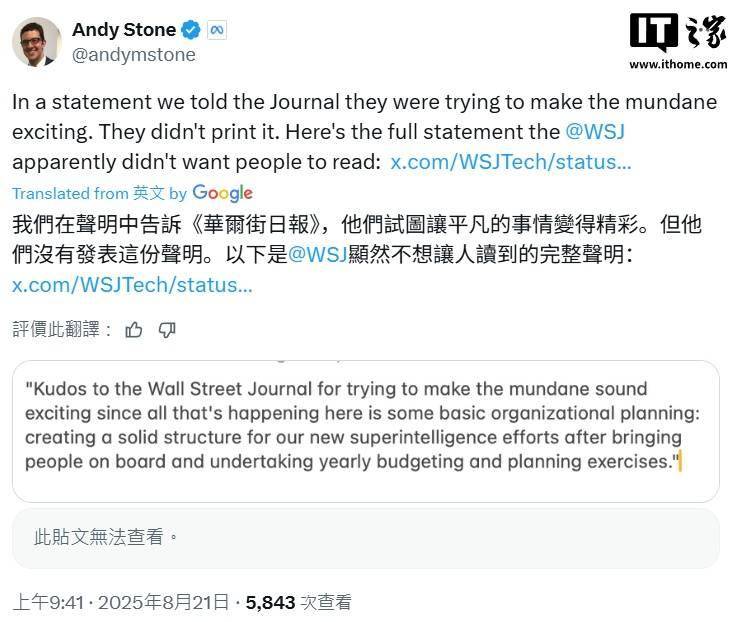
Core Insights - Meta's AI department is not halting recruitment but is undergoing organizational adjustments to establish a solid framework for new AI projects [1][2] - The company has introduced several new members to its team prior to the recruitment pause [2] - Meta has made significant changes to its AI organizational structure, creating the "Meta Super Intelligence Lab" with four teams focusing on foundational model research and infrastructure [4] Recruitment and Talent Acquisition - Meta has been actively recruiting AI talent since late June, reportedly offering salaries up to $20 million (approximately 144 million RMB) to attract employees from companies like OpenAI, xAI, and Anthropic [6] - The company has previously engaged in a "talent war," indicating a competitive approach to securing top AI professionals [6] Organizational Changes - The new "Meta Super Intelligence Lab" will consist of four teams, with the core team focusing on foundational models such as the Llama series [4] - The restructuring aims to enhance the company's capabilities in AI research, product integration, and infrastructure development [4]
2025 大模型“国战”:从百模混战到五强争锋
佩妮Penny的世界· 2025-05-13 10:24
Core Viewpoint - The article discusses the evolution of the AI foundational model landscape in China, emphasizing the rapid growth and valuation of key players in the industry, particularly following the emergence of ChatGPT. It highlights the competitive dynamics and future trends in the AI sector, particularly focusing on the "AI Six Tigers" and the impact of new entrants like Deepseek. Group 1: AI Six Tigers - The "AI Six Tigers" includes companies that have emerged rapidly since the launch of ChatGPT, with valuations exceeding 10 billion RMB, and the leading company, Zhipu, valued at over 25 billion RMB [1][6]. - Most of these companies were founded in 2023, indicating a swift response to market opportunities created by advancements in AI technology [1]. - The user base and revenue of these companies are still relatively low compared to their valuations, raising questions about their business models and sustainability [1][6]. Group 2: Key Players and Investment Dynamics - The key players in the AI sector include industry leaders, senior executives, and technical experts, many of whom have invested in multiple companies within the "AI Six Tigers" [2]. - Investment in these companies is often based on the founders' reputations and networks, reflecting a trend of "club deals" in venture capital [3]. - Recent strategic shifts among these companies include a focus on specific applications, such as healthcare for Baichuan Intelligence and multi-modal models for Minimax and Yuezhianmian [5]. Group 3: Challenges and Market Dynamics - Some companies within the "AI Six Tigers" may face financing difficulties due to high valuations, unproven business models, and questions about the scalability of their technologies [6]. - The AI industry is expected to see significant developments in 2024-2025, particularly with the emergence of major players like Deepseek [7]. Group 4: Deepseek's Impact - Deepseek has gained significant attention as a leading open-source inference model, prompting a renewed focus on foundational model research and competition in the AI sector [9]. - The success of Deepseek has encouraged more companies to open-source their foundational models, leading to advancements in multi-modal understanding and reasoning capabilities [9][10]. Group 5: Competitive Landscape - The competitive landscape for foundational models is narrowing, with key players including OpenAI, Google, and several domestic companies like Alibaba and ByteDance [12][18]. - Major companies are heavily investing in AI, with Alibaba planning to invest 380 billion RMB over three years and ByteDance over 150 billion RMB annually [12][18]. Group 6: Future Directions - The future of foundational models is expected to focus on multi-modal inputs and outputs, automation, and vertical industry applications, moving beyond simple parameter and data accumulation [22][23]. - The article suggests that the competition in AI should not be framed as a geopolitical race but rather as an opportunity for diverse innovation benefiting humanity [24].