Looker

Search documents
2025年对话式分析如何成为企业智能增长的加速器报告-谷歌云
Sou Hu Cai Jing· 2026-01-29 17:27
在数据量激增且多样化的当下,企业对数据高效利用的需求愈发迫切,而对话式分析的出现成为企业智能增长的关键加速器,标志着企业运营模式的战略转 折点。 传统业务中,数据分析存在诸多瓶颈。数据分析师资源有限,依赖其解答所有问题导致需求积压,且传统 BI 工具掌握在少数技术专家手中,普通员工难以 触及,同时还面临统一可信数据源缺失、新工具信任危机、数据民主化与安全合规平衡等挑战,严重阻碍了数据价值的释放。 对话式分析重塑了行业新格局,它基于 Looker 平台并融合 Google 的 Gemini 大模型能力,将静态数据转化为全员可交互的战略资源。用户以自然语言即可 进行数据探索与分析,无需专业技术知识。其核心优势在于 Looker 的语义层,能将复杂数据转化为直观业务术语,确保数据一致性与准确性,降低 AI 生成 SQL 的错误率,同时通过双向管控实现数据治理与安全保障。 对话式分析助力企业跨越数据成熟度三阶段:第一阶段让数据洞见惠及全员,将 BI 工具普及化,集成于日常工作软件,实现零延迟实时数据查看;第二阶 段突破瓶颈,解放分析师于繁琐日常工作,使其转向战略型工作,成为企业数据素养提升的战略伙伴;第三阶段激活全员 ...


数据战略终极指南:框架、最佳实践和示例极指南
3 6 Ke· 2025-10-20 09:08
Core Insights - Data is a key driver of growth for modern enterprises, with companies having strong data strategies being 23 times more likely to acquire customers and 19 times more likely to achieve profitability [1] Group 1: What is Data Strategy - Data strategy is a structured approach that outlines how a business collects, organizes, and utilizes data to achieve its goals, ensuring data quality, accessibility, and security [2][3] - It transforms data into a practical tool for informed decision-making, operational improvement, and value creation [2] Group 2: Key Components of Data Strategy - Data governance establishes rules and responsibilities for data handling throughout its lifecycle, ensuring data consistency and compliance [4][5] - Data architecture defines how data is collected, stored, organized, and accessed, facilitating timely decision-making and analysis [6][8] - Data management focuses on maintaining data accuracy, consistency, and accessibility, ensuring reliable information for reporting and analysis [9][10] - Analytics and business intelligence convert raw data into actionable insights, guiding business strategy and improving performance [11][12] Group 3: Steps to Develop an Effective Data Strategy - Step 1: Assess current data capabilities to identify gaps and areas for improvement [14][15] - Step 2: Define business and data goals to ensure alignment with organizational priorities [16][17] - Step 3: Plan for data collection and integration to ensure comprehensive and accurate data availability [18][19] - Step 4: Implement data governance and security measures to protect sensitive information [20][21] - Step 5: Establish analytics and reporting systems to generate insights that support decision-making [22][23] - Step 6: Create a data strategy roadmap to prioritize initiatives and allocate resources effectively [24][25] Group 4: Data Strategy Templates and Frameworks - Data strategy templates provide a structured approach for planning and executing data strategies, ensuring consistency and clarity [27][28] - A data strategy framework defines the principles, processes, and tools necessary for effective data management and utilization [30][31] Group 5: Best Practices for Successful Data Strategy - Align data strategy with business objectives to ensure measurable outcomes [34][36] - Ensure data quality and consistency through regular monitoring and validation processes [37][38] - Foster a data-driven culture by training teams to interpret data insights and make informed decisions [39][40] - Leverage technology and automation to enhance data strategy efficiency and accuracy [41][42] Group 6: Common Challenges in Data Strategy - Data silos and integration issues can hinder comprehensive access and analysis of data [44][45] - Data security and compliance challenges require robust measures to protect sensitive information [46][47] - Resistance to data-driven decision-making can impede the implementation of data strategies [48][49] Group 7: Tools and Technologies for Data Strategy - Data strategy tools support planning, execution, and monitoring of data initiatives, ensuring alignment with business goals [52][53] - Data management platforms help collect, organize, and maintain large volumes of data, ensuring accuracy and accessibility [54][55] - Business intelligence and analytics tools transform raw data into actionable insights through visualization and reporting [56][57] - Cloud and big data solutions enable efficient storage and processing of large datasets, providing scalability and advanced capabilities [58][60] Group 8: Real-World Examples of Effective Data Strategy - A retail chain improved customer experience by integrating online and in-store data, leading to personalized marketing and better inventory management [62][63] - A healthcare institution enhanced patient care and operational efficiency through centralized patient record management and analytics [64][65] - A financial institution strengthened risk management and fraud detection by combining transaction data with analytics and machine learning [66][67] Group 9: Measuring ROI of Data Strategy - Identify key performance indicators (KPIs) that reflect the impact of data strategy on business objectives [70][71] - Assess the business impact of data strategy by comparing performance before and after implementation [72][73] - Utilize dashboards and reporting tools for real-time visibility into performance metrics [74][75] - Emphasize continuous improvement to maximize the value of data strategy [78][79]
数据的三体问题:为何分析、决策和运营无法协调一致
3 6 Ke· 2025-07-25 00:21
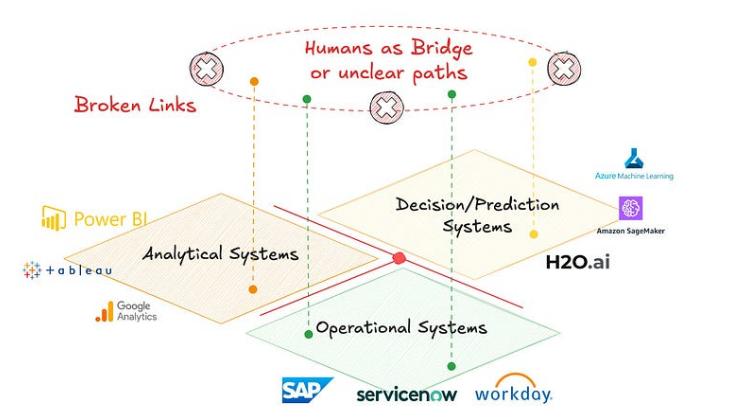
Group 1 - The core issue is not the failure of tools but the lack of trust and timing in systems, leading to a disconnect between insights and actions taken [2][3][10] - Companies operate in three distinct data worlds: analysis, prediction, and operations, which often do not communicate effectively with each other [3][5][7] - The analysis world focuses on historical data and visualization but fails to drive actionable outcomes [5][6][30] Group 2 - The prediction systems aim to forecast future events but rely on human intervention to act on those predictions, creating a gap in execution [6][12][13] - Operational systems prioritize immediate responses and do not integrate insights from analysis or predictions, leading to a reactive rather than proactive approach [7][11][30] - A lack of integration between these three worlds results in missed opportunities for timely action, causing inefficiencies in business operations [8][12][20] Group 3 - Companies often rely on Excel for critical operations due to its flexibility and control, despite its limitations in handling complex data [14][15][19] - The concept of an "action layer" is introduced, which integrates analysis, prediction, and operations into a unified system that drives action rather than just reporting [30][38] - The ideal scenario involves autonomous systems that not only identify issues but also take corrective actions without human intervention, enhancing operational efficiency [21][29][38]