MI308 AI芯片

Search documents
华尔街见闻早餐FM-Radio|2025年12月24日
Sou Hu Cai Jing· 2025-12-23 23:30
Market Overview - Technology stocks supported the market, with major US indices opening lower but closing higher, marking four consecutive days of gains, and the S&P 500 reaching a record high [1] - Nvidia shares surged by 3% following news about chip tariffs, while Tesla fell over 0.6%, being the only tech giant to decline [1] - The approval of an oral weight-loss drug in the US led Novo Nordisk's stock to rise over 9%, contributing to European indices hitting historical highs [1] - The US GDP grew by 4.3% in Q3, the fastest growth in two years, impacting interest rate expectations and causing US Treasury prices to fall [2][10] - Bitcoin dropped over 2% during the day, falling below $87,000 [1] Company News - Novo Nordisk's oral GLP-1 weight-loss drug received FDA approval, with a monthly price of $149, showing potential for a 16.6% weight reduction and cardiovascular risk reduction [22] - Smart driving technology advanced as Beijing issued the first L3-level autonomous driving vehicle licenses, marking a significant step in China's autonomous vehicle industry [9][26] - Zhizhu AI launched its flagship model GLM-4.7, outperforming leading models in several benchmarks, indicating a competitive edge in the AI market [9] Industry Developments - The US added "untrusted supplier lists" for the drone sector, prompting China's Ministry of Commerce to call for the immediate withdrawal of such measures [8] - The real estate market in China is set to stabilize by 2026, focusing on controlling supply and inventory through city-specific policies and enhancing project financing [2][7] - The copper market reached a historic high of over $12,000 per ton, driven by supply shortages and increased demand due to tariff expectations [13] - The global AI infrastructure spending is expected to surpass office building investments, with Oracle signing a significant leasing deal worth $248 billion [23][24]


中美芯片博弈:英伟达被抽成H20芯片收入的15%,全新特供版AI芯片或将在中国销售
Tai Mei Ti A P P· 2025-08-12 02:56
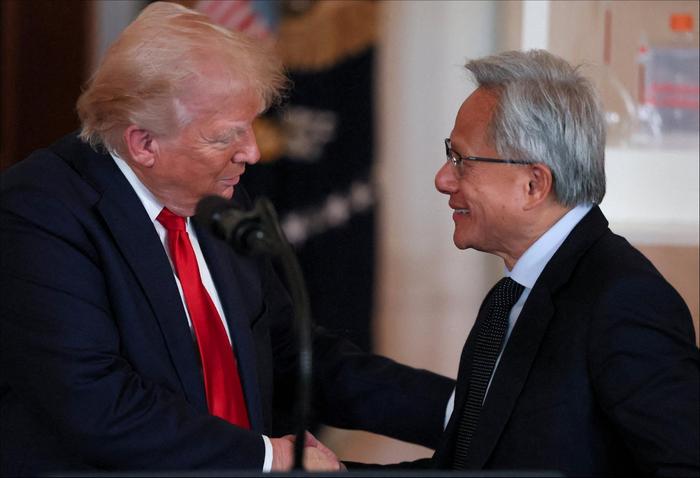
Core Viewpoint - The U.S. government is considering allowing NVIDIA to sell its latest AI chips in China, with a 15% revenue share from sales going to the U.S. government, indicating a shift in policy towards semiconductor exports to China [2][3]. Group 1: NVIDIA and AMD's Agreements - NVIDIA's CEO Jensen Huang has reached an agreement with President Trump to allow the sale of the H20 AI chip in China, which is a modified version of an older chip [2][3]. - AMD has also confirmed a similar revenue-sharing agreement with the U.S. government, allowing it to sell the MI308 AI chip in China, with both companies agreeing to pay 15% of their sales to the U.S. government [3][4]. - If approved, these agreements could open up hundreds of billions of dollars in sales opportunities for NVIDIA and AMD in the Chinese market [3][4]. Group 2: Chip Specifications and Market Demand - The H20 chip, designed for the Chinese market, has performance capabilities reduced to about 20% of the H100 chip's performance, but still outperforms most domestic Chinese AI chips [4][5]. - As of April, NVIDIA reportedly received around $18 billion in orders for the H20 chip, indicating strong demand from Chinese internet companies [5]. Group 3: Security Concerns and Market Reactions - There are ongoing concerns regarding the security of NVIDIA's chips, with allegations of potential backdoor vulnerabilities leading to scrutiny from Chinese authorities [7][8]. - Following Trump's announcement of the revenue-sharing arrangement, NVIDIA's stock experienced volatility, with a slight decline in share price, while Intel's stock saw an increase in after-hours trading [9].