
Meta雷朋眼镜

Search documents
2026年,AI将深度嵌入日常生活
Huan Qiu Wang Zi Xun· 2026-01-13 04:39
Group 1 - Generative AI is transforming human-machine interactions, moving from experimental technology to an integral part of daily life, with applications ranging from intelligent companions to autonomous vehicles [1] - The emergence of AI models like ChatGPT has shifted the paradigm of interaction, allowing users to engage in meaningful conversations with AI, which are now perceived as empathetic "digital souls" rather than mere search engine extensions [2] - Companies like CivAI and Sesame AI are advancing human-like voice simulations, enhancing the warmth of interactions but raising ethical concerns regarding dependency on virtual companionship [2] Group 2 - The rapid development of AI technology is paving the way for the next generation of personal computing devices, with companies investing in smart glasses that integrate AI features for enhanced user experience [3] - Apple is reportedly set to release its first foldable phone, which could revolutionize the market by combining portability with a large screen experience, potentially triggering a new wave of device upgrades [4] - AI is becoming deeply embedded in digital life, as seen in Google's AI-enhanced search engine and applications like Gmail, which aim to streamline user interactions and improve productivity [5][6] Group 3 - The deployment of autonomous taxis is marking a significant shift in transportation, with companies like Waymo operating over 2,500 self-driving cars in major cities, indicating a move towards point-to-point automated travel [7] - Despite challenges such as technical failures, public sentiment towards autonomous vehicles is gradually improving, with industry consensus suggesting that 2026 may be a pivotal year for widespread adoption of self-driving technology [7]

苹果智能眼镜最新爆料,与Meta正面交锋?
Huan Qiu Wang Zi Xun· 2025-10-13 07:11
Core Insights - Apple's second-generation smart glasses are expected to feature two unique modes that can switch based on the connected device [1][3] - When paired with a Mac, the smart glasses will run the full version of the visionOS operating system, providing a rich and powerful user experience similar to that of a computer [3] - When connected to an iPhone, the interface will switch to a lighter version suitable for mobile use, facilitating quick and convenient operations for daily activities and social interactions [3] Product Features - The first-generation smart glasses will not include an embedded display but will still offer several notable features, such as speakers for high-quality music playback, a camera for capturing photos and videos, and voice control for easier operation [3] - Potential health-related functionalities may also be included to assist users in managing their health [3] Market Position - The design of Apple's smart glasses is expected to give the company a competitive edge in the market, particularly against Meta's Ray-Ban glasses, which already offer an embedded display starting at $799 in the U.S. [3] - The anticipated announcement for the first-generation smart glasses could occur as early as 2026, with a potential market launch in 2027 [3]



苹果2026年智能眼镜前瞻:五大关键功能值得期待
Huan Qiu Wang Zi Xun· 2025-10-03 03:51
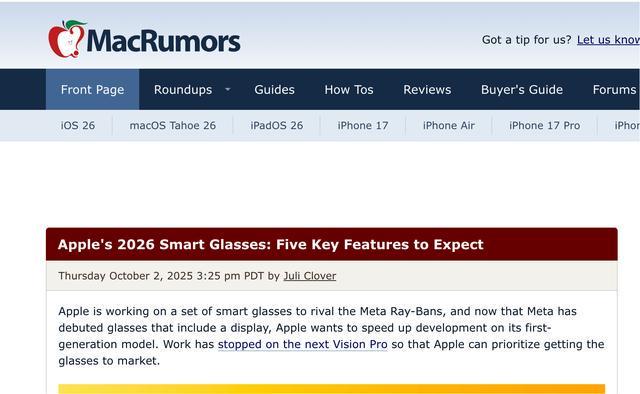
Core Insights - Apple is accelerating the development of smart glasses to compete with Meta's Ray-Ban series, even pausing some work on the next-generation Vision Pro to prioritize the glasses' market launch [1]. Group 1: Product Positioning - The smart glasses will initially be positioned as a fashion accessory, similar to the first-generation Apple Watch, offering various frame and arm material options for personalized aesthetics [4]. - Despite the need to accommodate a battery, chips, and multiple cameras, the final thickness of the glasses remains unclear, but Apple plans to offer different colors, sizes, and shapes [4]. Group 2: Role of Siri - Siri will play a central role in the glasses, relying on voice control, with a more intelligent version set to launch in Spring 2026, based on large language models [5]. - Users will be able to interact with Siri for various tasks, including providing feedback on surroundings, searching for information, translating languages, and more, aiming to match Meta's AI capabilities [5]. Group 3: Expected Features - The first-generation glasses will not have a display like Meta's latest models but will feature AI capabilities, cameras, and audio functions comparable to Meta's basic Ray-Ban glasses [6]. - Rumored functionalities include taking photos, recording videos, playing audio, providing navigation, answering questions, and identifying objects in the environment [6][7]. Group 4: Dependency on iPhone - The glasses will use a custom Apple chip based on the Apple Watch chip but will not operate independently, requiring an iPhone for full functionality, which may help extend battery life [7]. Group 5: Launch Timeline - Apple is pushing for a potential showcase of the smart glasses by the end of 2026, with a possible market launch in early 2027, although pricing details remain unconfirmed [7].
入局“百镜大战” 小米AI眼镜今晚亮相
Mei Ri Shang Bao· 2025-06-25 23:00
Core Viewpoint - Xiaomi is set to unveil its first AI smart glasses, which are expected to drive significant interest and investment in the AI eyewear market, alongside other tech giants like Samsung and Amazon [1][5]. Group 1: Product Launch and Market Reaction - Xiaomi announced the launch of its AI smart glasses, which will be revealed at an event on June 26 [1]. - Following the announcement, Xiaomi's stock saw a strong increase, with a closing rise of 1.55% and 295 stocks in the sector experiencing gains [4]. - The AI index on the Shanghai Stock Exchange rose by 3.03%, and the AI ETF saw a 3.20% increase, indicating a broader market enthusiasm for AI-related products [5]. Group 2: Technical Features and Competitive Positioning - The Xiaomi AI glasses will utilize a dual-chip architecture, featuring Qualcomm AR1 and Hengxuan BES2700 chips, enhancing audio and image processing capabilities [2]. - Weighing approximately 30 grams, the glasses are designed to be lighter than competitors, with a focus on ergonomic design [2]. - The glasses will integrate AI visual algorithms to provide real-time information based on user interactions with their environment, positioning them as a next-generation interactive device [2][3]. Group 3: Industry Trends and Future Outlook - Analysts predict that the second half of the year will see a surge in new eyewear products from major tech companies, driven by advancements in AI technology [5]. - The AI glasses market is viewed as a promising application for AI models, with potential for rapid adoption as a new mobile terminal [3]. - Recent regulatory changes support the listing of innovative tech companies, particularly in the AI sector, which may lead to increased investment and innovation in the industry [6].