Mini 4 PRO

Search documents
大疆市场策略转舵 多线出击打响价格阻击战
Zhong Guo Jing Ying Bao· 2025-12-05 20:20
Core Insights - DJI Agriculture has launched three new agricultural drones with improved performance and reduced prices, interpreted as a competitive move against XAG Technology's upcoming IPO [3][4][5] - DJI's aggressive pricing strategy across various sectors, including smart imaging and consumer drones, has raised concerns about a price war in the industry [3][8] - The shift in DJI's strategy reflects a dynamic evolution in its business approach, moving from a focus on technological superiority to a combination of technology innovation and aggressive pricing to expand market share [3][12] Agricultural Drone Pricing Strategy - The new agricultural drones T100S, T70S, and T55 are priced at 48,999 yuan, 43,999 yuan, and 36,999 yuan respectively, with discounts of up to 8,000 yuan for early orders [4][5] - The flagship T100S has a maximum takeoff weight of 149.9 kg and a payload capacity of 95 kg, featuring significant technological upgrades [4] - The market share for agricultural drones is dominated by DJI and XAG, with DJI holding 59% and XAG 17.1% as of 2024 [5] Market Dynamics and Competition - DJI's pricing strategy is seen as a move to solidify its market position ahead of XAG's IPO, indicating a clear intent to maintain dominance in the agricultural sector [5][6] - The trend of decreasing prices has shifted the user demographic from professional agricultural teams to individual farmers, with the ratio of professional users to individual users changing from 9:1 to 5:5 [7] - XAG has also responded with competitive pricing, indicating a mutual recognition of the need to adapt to market pressures [6][7] Broader Price War Context - DJI's price competition extends beyond agricultural drones, impacting the smart imaging market where it faces competition from companies like YI Technology [8][9] - The aggressive pricing tactics have led to significant price reductions across various DJI products, including handheld imaging devices and consumer drones [9][10] - Industry experts suggest that while price competition can expand the market, it may also dilute brand value and innovation potential in the long term [12][14] Strategic Shift and Future Considerations - DJI's historical strategy focused on high margins through technological innovation, but recent actions indicate a shift towards aggressive pricing to capture market share [12][13] - The company aims to balance its pricing strategies with ongoing technological advancements to avoid potential risks associated with over-reliance on price competition [14] - Industry analysts emphasize the importance of maintaining innovation and brand integrity while navigating competitive pricing pressures [14]

大疆降价,影石CEO发微博“致歉”营销
Sou Hu Cai Jing· 2025-10-14 07:16
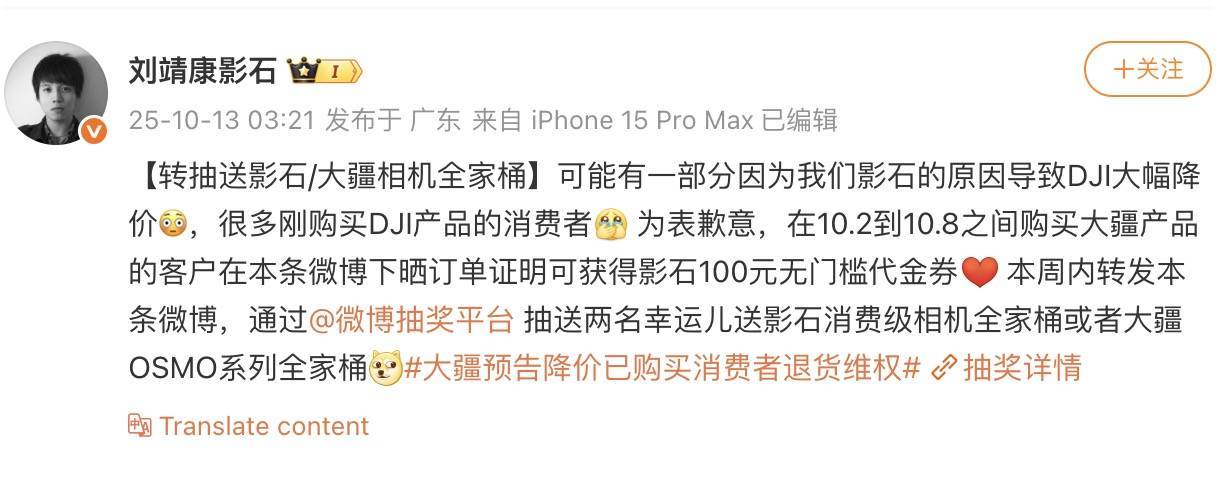
Core Viewpoint - The recent price drop by DJI has been linked to competitive pressures from Insta360, leading to a marketing apology from Insta360's CEO, which has generated significant consumer engagement and discussion on social media [1][3][5]. Group 1: Company Actions and Responses - Insta360's CEO Liu Jingkang issued an apology on Weibo, acknowledging that the company's actions may have contributed to DJI's price reduction, and offered a 100 yuan voucher to customers who purchased DJI products during a specific period [1][3]. - DJI announced a price adjustment as part of its regular promotional activities for the upcoming Double Eleven shopping festival, with significant discounts on various popular products [3][5]. - Consumers who purchased DJI products during the promotional period have expressed intentions to return items or seek refunds, with some successfully obtaining refunds [5]. Group 2: Market Dynamics and Competition - The competitive landscape between Insta360 and DJI is intensifying, as evidenced by the recent marketing strategies and consumer reactions [5][6]. - Insta360 has been expanding its product offerings, including entering the drone market with a new panoramic drone, indicating a strategic move to compete directly with DJI [6]. - Market share data shows that Insta360's share has increased from 28.4% in 2023 to 35.6% in 2024, while DJI's share has decreased from 19.1% to 13.2%, highlighting a shift in competitive positioning [7]. Group 3: Financial Performance - Insta360 reported a revenue of 3.671 billion yuan for the first half of the year, reflecting a year-on-year growth of 51.17%, while net profit increased slightly by 0.25% to 520 million yuan [7].

没货了!大疆降价首日探店,退货维权有多难?
新浪财经· 2025-10-09 09:48
Core Viewpoint - DJI's recent price reduction on several products has led to significant consumer dissatisfaction, with many feeling "betrayed" after purchasing items shortly before the price drop. This situation has sparked discussions on social media regarding refund and price adjustment rights [3][4][12]. Group 1: Price Reduction Details - DJI has announced price cuts on various products, including the Osmo Pocket 3, which saw a reduction of 700 yuan, and the Mini 4 PRO drone, which dropped by 1478 yuan. Other products like the Action 4 camera also experienced significant price cuts [5][12]. - The Osmo Pocket 3 standard version is currently out of stock both online and in physical stores, indicating high demand following the price drop [6][7]. Group 2: Consumer Reactions and Rights - Many consumers who purchased products before the price drop are seeking refunds or price adjustments, with some successfully obtaining refunds. However, returning items purchased in-store is more challenging compared to online purchases [11][12]. - DJI's official response to the price adjustment states that it is part of a regular promotional strategy for the upcoming Double Eleven shopping festival, and they have communicated this to consumers [4][13]. Group 3: Market Implications and Future Products - Industry analysts speculate that the price reduction may be aimed at clearing inventory for the upcoming Pocket 4, which is expected to launch in 2026. This suggests a strategy to manage product lifecycle and competition [8][12]. - The rapid iteration and frequent price changes in the consumer electronics market necessitate a balance between promotional efficiency and consumer rights, highlighting the need for companies to provide clear communication regarding price changes [13].