MuZero

Search documents
DeepMind强化学习掌门人David Silver离职创业,Alpha系列AI缔造者,哈萨比斯左膀右臂
3 6 Ke· 2026-02-02 08:21
Core Insights - David Silver, a prominent researcher in reinforcement learning, has left DeepMind after 15 years to establish his own AI company, Ineffable Intelligence [1][5]. Company Formation - Ineffable Intelligence was quietly founded in November 2025, with Silver officially appointed as a director on January 16, 2026 [2]. - The company is headquartered in London and is actively recruiting AI research talent while seeking venture capital [3]. Contributions at DeepMind - Silver was a key figure in the development of DeepMind's "Alpha series," leading or significantly contributing to major projects such as AlphaGo, AlphaZero, MuZero, and AlphaStar [7][9]. - His work on AlphaGo, which defeated world champion Lee Sedol in 2016, marked a significant milestone in AI history [9]. - Silver has received multiple accolades, including the ACM Prize in Computing in 2019 and the Royal Academy of Engineering Silver Medal in 2017 [10]. Academic and Research Impact - Silver is one of the most published authors among DeepMind employees, with over 280,000 citations and an h-index of 104 according to Google Scholar [11]. - His research has focused on advancing AI capabilities beyond human knowledge, advocating for a new "Age of Experience" where AI learns from its own experiences [17][19]. Vision for AI - Silver aims to tackle the challenge of creating superintelligent AI that can learn independently from first principles, moving away from reliance on human knowledge [17][19].




AlphaGo之父David Silver离职创业,目标超级智能
机器之心· 2026-01-31 02:34
Core Viewpoint - David Silver, a prominent AI researcher from Google DeepMind, has left the company to establish a new startup named Ineffable Intelligence, focusing on solving complex AI challenges and pursuing superintelligence [1][3][4]. Group 1: Company Formation and Background - Ineffable Intelligence is being founded in London, with active recruitment for AI researchers and seeking venture capital [3]. - Silver was a key figure at Google DeepMind, contributing to significant achievements such as AlphaGo, AlphaStar, and AlphaZero, which demonstrated the capabilities of AI in complex games [9][12][14]. - The company was officially registered in November 2025, with Silver appointed as a director in January 2026 [4]. Group 2: Silver's Contributions and Vision - Silver's work includes developing AI systems that surpassed human capabilities in games, showcasing the potential of AI to learn and adapt [12][14]. - He emphasizes the need for AI to explore and discover knowledge independently, moving beyond human limitations and biases [18][23]. - The vision for Ineffable Intelligence is to create a self-learning superintelligence that can autonomously uncover foundational knowledge [23]. Group 3: Industry Context and Trends - Silver's departure follows a trend where notable AI researchers are leaving established labs to pursue startups focused on superintelligence, with significant funding being raised in the sector [15]. - Other notable figures, such as Ilya Sutskever and Yann LeCun, are also venturing into similar domains, indicating a growing interest in the pursuit of advanced AI capabilities [15][16].
DeepMind强化学习掌门人David Silver离职创业!Alpha系列AI缔造者,哈萨比斯左膀右臂
量子位· 2026-01-31 01:34
Core Viewpoint - David Silver, a prominent figure in reinforcement learning and a key researcher at DeepMind for 15 years, has left the company to establish his own AI startup, Ineffable Intelligence, aiming to tackle the challenges of achieving superintelligence in AI [2][21]. Group 1: Departure from DeepMind - David Silver has officially left DeepMind and has been appointed as the director of his new company, Ineffable Intelligence, which was quietly established in November 2025 [3][2]. - Silver had been on leave for several months prior to his departure from DeepMind [4]. - Google DeepMind confirmed Silver's departure and expressed gratitude for his contributions during his tenure [9]. Group 2: Achievements at DeepMind - Silver was instrumental in the development of several landmark AI projects at DeepMind, including AlphaGo, which defeated world champion Lee Sedol in 2016, marking a significant milestone in AI history [14]. - He also led the development of AlphaZero, which achieved superhuman performance in Go, chess, and shogi without relying on human game data [14]. - Silver contributed to the creation of MuZero, which learns to play games without being informed of the rules, and AlphaStar, which defeated top players in StarCraft II [15][16]. - He has received numerous accolades, including the ACM Prize in Computing in 2019 and the Royal Academy of Engineering Silver Medal in 2017 [18]. Group 3: Vision for the Future - Silver's motivation for founding Ineffable Intelligence is to return to the awe and wonder of solving the most challenging problems in AI, with a focus on creating a superintelligent AI that can learn endlessly [21]. - He advocates for a new "Age of Experience" in AI, where systems learn from experiences through reinforcement learning, moving beyond reliance on human knowledge [24]. - Silver believes that achieving true superintelligence requires AI to learn from first principles, independent of human intuition and knowledge [25].

AI被严重低估,AlphaGo缔造者罕见发声:2026年AI自主上岗8小时
3 6 Ke· 2025-11-04 12:11
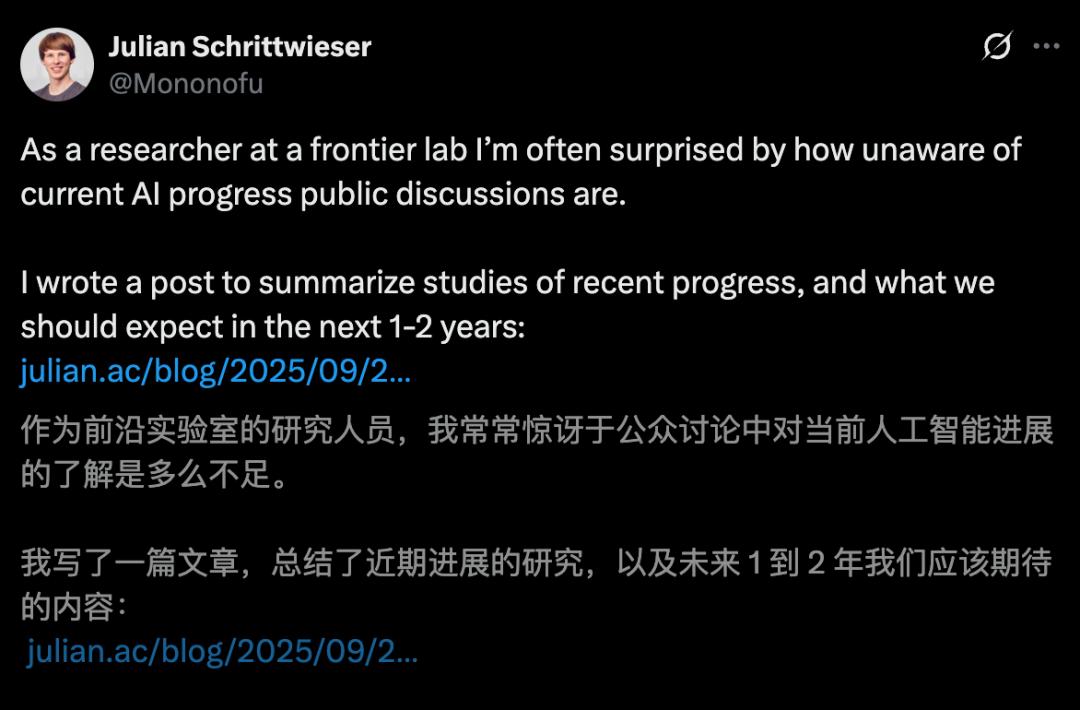
Core Insights - The public's perception of AI is significantly lagging behind its actual advancements, with a gap of at least one generation [2][5][41] - AI is evolving at an exponential rate, with predictions indicating that by mid-2026, AI models could autonomously complete tasks for up to 8 hours, potentially surpassing human experts in various fields by 2027 [9][33][43] Group 1: AI Progress and Public Perception - Researchers have observed that AI can now independently complete complex tasks for several hours, contrary to the public's focus on its mistakes [2][5] - Julian Schrittwieser, a key figure in AI development, argues that the current public discourse underestimates AI's capabilities and progress [5][41] - The METR study indicates that AI models are achieving a 50% success rate in software engineering tasks lasting about one hour, with an exponential growth trend observed every seven months [6][9] Group 2: Cross-Industry Evaluation - The OpenAI GDPval study assessed AI performance across 44 professions and 9 industries, revealing that AI models are nearing human-level performance [12][20] - Claude Opus 4.1 has shown superior performance compared to GPT-5 in various tasks, indicating that AI is not just a theoretical concept but is increasingly applicable in real-world scenarios [19][20] - The evaluation results suggest that AI is approaching the average level of human experts, with implications for various sectors including law, finance, and healthcare [20][25] Group 3: Future Predictions and Implications - By the end of 2026, it is anticipated that AI models will perform at the level of human experts in multiple industry tasks, with the potential to frequently exceed expert performance in specific areas by 2027 [33][39] - The envisioned future includes a collaborative environment where humans work alongside AI, enhancing productivity significantly rather than leading to mass unemployment [36][39] - The potential transformation of industries due to AI advancements is profound, with the possibility of AI becoming a powerful tool rather than a competitor [39][40]