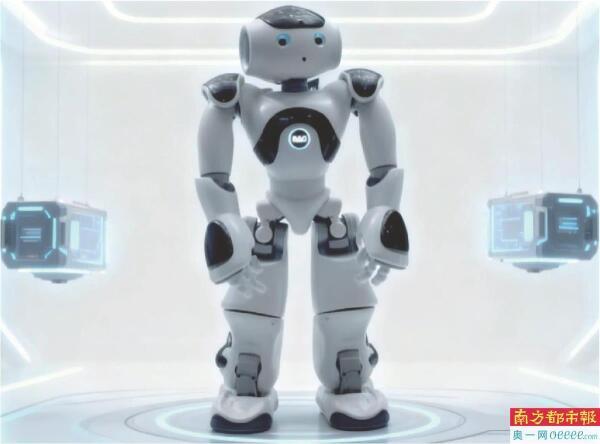
NAO机器人

Search documents
盛视科技(002990) - 2025年11月20日投资者关系活动记录表
2025-11-20 12:34
Group 1: Company Strategy and Product Development - The company is actively optimizing the layout of humanoid robots in education, rehabilitation, and companionship applications, aiming for a full lifecycle service from childhood to elderly care [2][3][7]. - The new generation NAO7 robot is expected to be launched soon, featuring a comprehensive upgrade in perception, computation, and interaction capabilities, enhancing environmental adaptability and understanding of the physical world [3][7][9]. - The company has acquired relevant assets of the NAO robot from Aldebaran and is establishing a subsidiary in France to operate these assets, integrating the original core team to enhance supply chain and R&D mechanisms [6][7]. Group 2: Financial Performance and Accounts Receivable - The company has faced delays in accounts receivable due to extended settlement cycles, leading to significant asset impairment provisions that impact net profit [5][9]. - A special team has been established to enhance the collection of accounts receivable, with the potential to reverse previous impairment provisions, thereby increasing current profits [5][9]. - The company is listed on multiple local government debt relief lists, indicating ongoing efforts to manage financial obligations effectively [5]. Group 3: Market Opportunities and Future Plans - The company has successfully completed major information technology projects in Hainan, which are crucial for the region's free trade zone operations, and will continue to follow up on related projects [8][10]. - There are plans to disclose new large contracts or milestones in humanoid robot production in Q4 2025, contingent on meeting disclosure standards [5][8]. - The company is exploring collaborations with its invested companies, such as Yizhu Technology and Shishi Technology, to enhance product development and market reach [3][9]. Group 4: Product Line and Market Position - The company has established a diverse product line, including inspection robots, collaborative robots, and temperature measurement robots, with applications in port scenarios [10]. - The company holds a 0.9525% stake in Beijing Nanwei Technology, which focuses on advanced AI chips for data centers and cloud computing [9]. - The company is committed to expanding its business scope, including investments in embodied and toy robots, despite potential short-term impacts on profit margins [9].
用机器狗“打CS”与机器人“比舞功”
Nan Fang Du Shi Bao· 2025-11-12 23:07
Core Insights - The 27th China International High-tech Achievements Fair (referred to as "High-tech Fair") will take place in Shenzhen, with Futian District showcasing its technological innovations and developments [4][5]. Group 1: Futian Exhibition Highlights - The Futian exhibition area will feature over 50 companies, creating an interactive "Future Life Pavilion" that allows visitors to engage with cutting-edge technology [4]. - The exhibition will include eight interactive points covering various dimensions such as audio-visual experiences, competitive gaming, medical technology, and emotional engagement [5]. - Notable interactive experiences include controlling robotic dogs in a "CS battle," dancing with the "NAO" robot, and experiencing AI portable ultrasound devices for smart medical transformations [5][6]. Group 2: Technological Innovations - The exhibition will showcase a full chain of research capabilities, focusing on basic research, technological breakthroughs, and achievement transformation [6]. - The He Tao Shenzhen-Hong Kong Technology Innovation Cooperation Zone will present innovations in fields such as basic research, biomedicine, and quantum technology [6]. - Highlighted innovations include a holographic projection of cardiac organ models by Xig Bio, superconducting quantum chips, and nano-infrared spectrometers from various tech firms [6]. Group 3: New Product Launches - The Futian exhibition will host its first technology innovation achievement release conference, featuring a "New Product Showcase" that includes both cutting-edge technologies and market-validated star products [6].


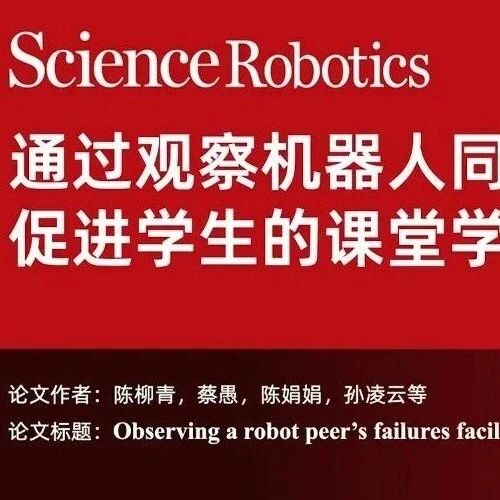
《Sci.Robot.》顶刊发表浙大陈柳青团队提出“机器人同伴有效失败教学法”让学习效率更高!
机器人大讲堂· 2025-10-19 04:03
Core Insights - The article discusses the "Productive Failure" educational theory, which suggests that students learn better by first attempting to solve challenging problems and then receiving instruction, rather than direct teaching [4] - A research team from Zhejiang University has implemented a method where students observe a robot making mistakes, which enhances learning outcomes and reduces classroom pressure [3][4] - The study's findings were published in the journal "Science Robotics" on September 10, 2025 [3] Group 1: Educational Theory and Methodology - The concept of "Productive Failure" posits that experiencing failure can activate prior knowledge and clarify knowledge gaps, leading to deeper understanding [4] - The research team proposed using a robot to demonstrate failure instead of students, thereby alleviating the psychological pressure associated with failure [4][5] - The robot's mistakes are designed based on common errors made by students, ensuring relevance and relatability [22] Group 2: Experimental Findings - Two classroom experiments were conducted with 135 and 110 eighth-grade students, focusing on the topics of "standard deviation" and "derivatives" [5][21] - In the first experiment, students who observed the robot's mistakes (RF group) outperformed those in traditional teaching (DI group) in conceptual understanding and reported lower classroom stress [15][21] - The second experiment confirmed that the benefits of observing the robot persisted even after the novelty of the robot wore off, with RF group students still showing superior understanding and knowledge transfer [21] Group 3: Robot's Role and Design - The robot is not merely a teaching tool but is positioned as a learning companion that can make mistakes, reflect, and grow [26] - The design of the robot's errors follows a structured narrative, helping students understand the reasoning behind the mistakes [22] - The robot's social behaviors, such as showing confusion or asking for input, enhance its relatability and effectiveness as a learning partner [25] Group 4: Future Implications - The research suggests potential for robots to become personalized learning companions that adapt to students' needs in real-time [27] - The approach reduces the psychological barriers associated with making mistakes in a classroom setting, fostering a more supportive learning environment [26][27] - The ultimate goal is to leverage technology to create a more effective and friendly educational atmosphere, where robots and students can collaboratively engage in learning [28]