NVIDIA DGX SuperPOD

Search documents
NVIDIA BioNeMo Platform Adopted by Life Sciences Leaders to Accelerate AI-Driven Drug Discovery
Globenewswire· 2026-01-12 15:00
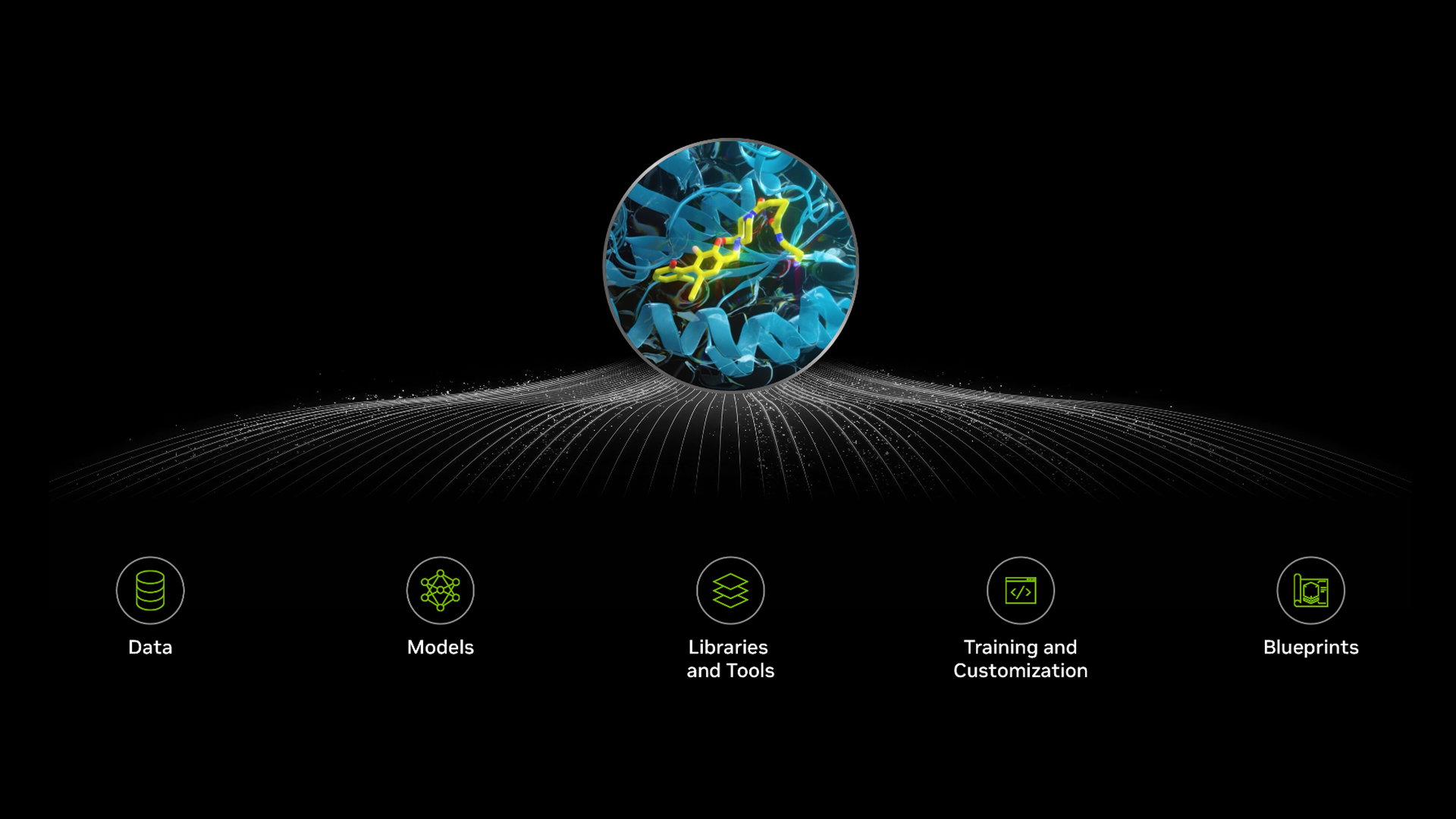
Core Insights - NVIDIA announced a significant expansion of its BioNeMo platform, aimed at enhancing AI-driven biology and drug discovery workflows [1][2] - The life sciences industry, facing $300 billion in annual R&D costs, can leverage BioNeMo to optimize data processing and model deployment, thereby increasing the probability of successful discoveries [2] - Collaborations with major companies like Lilly and Thermo Fisher are set to transform drug discovery and laboratory automation through AI integration [3][4][7] Group 1: NVIDIA BioNeMo Expansion - BioNeMo serves as an open development platform that facilitates lab-in-the-loop workflows, enabling breakthroughs in AI-driven biology and drug discovery [1][10] - The platform allows for the generation and processing of vast scientific data, training, optimizing, and deploying models to maximize discovery success while minimizing costs [2] - NVIDIA's collaboration with leading life sciences organizations aims to integrate BioNeMo with laboratory experiments, creating a continuous learning cycle that accelerates discovery [2] Group 2: Collaborations and Innovations - Lilly and NVIDIA have launched a co-innovation lab to address challenges in drug discovery, combining NVIDIA's AI and computing expertise with Lilly's drug development capabilities [3][4] - The collaboration is expected to harness investments of up to $1 billion over five years in talent, infrastructure, and computing resources [5] - Thermo Fisher's partnership with NVIDIA aims to create autonomous lab infrastructure, enhancing the efficiency and scalability of scientific research [7] Group 3: AI-Driven Drug Discovery Ecosystem - The BioNeMo platform is being utilized by various innovators globally to adopt an industrial-scale, AI-driven approach to drug discovery [8] - Companies like Chai Discovery, Basecamp Research, and Boltz are leveraging BioNeMo for model training and development in drug design [12][14] - The integration of AI with laboratory automation is expected to significantly improve the speed and accuracy of scientific experiments, ultimately accelerating discoveries with substantial human impact [7]


AI、半导体:英伟达发布VeraRubin平台
Huajin Securities· 2026-01-10 13:01
Investment Rating - The industry investment rating is "Outperform the Market" (maintained) [2][41]. Core Insights - The report highlights significant advancements in AI and semiconductor sectors, particularly with NVIDIA's launch of the Vera Rubin platform, which includes various high-performance computing products designed to meet advanced model requirements and reduce computing costs [4][7]. - Samsung Electronics reported a substantial increase in Q4 2025 operating profit, reaching 20 trillion KRW, a year-on-year growth of 208.2%, driven by surging AI demand and rising global memory chip prices [8][9]. - TSMC's revenue for December 2025 was approximately 335 billion TWD, marking a year-on-year increase of 20.4%, benefiting from strong AI demand for advanced processes and packaging [9]. Summary by Sections Industry Dynamics - NVIDIA introduced several new products at CES 2026, including the Vera Rubin POD AI supercomputer and Spectrum-X Ethernet co-packaged optical devices, which are designed to enhance performance and efficiency in AI applications [7][8]. - Samsung's strategy has shifted towards high-margin products like HBM and DDR5, leading to significant price increases in memory products, with DDR5 prices rising by 307% since September 2025 [9][22]. Market Review - The electronic industry saw a weekly increase of 7.74% from January 5 to January 9, 2026, with all sub-sectors in the electronics industry showing positive performance [10][13]. High-Frequency Data Tracking - Memory prices have shown an upward trend, with DDR5 16G prices increasing from $30.544 to $31.781 between January 5 and January 9, 2026 [22]. - Panel prices for TVs are expected to see a mild increase in January 2026 due to supply constraints and rising material costs [17][19]. Investment Recommendations - The report suggests a positive outlook for the semiconductor industry driven by AI advancements, recommending a focus on the entire semiconductor supply chain, including key companies like SMIC and Huahong [37]. - It also highlights the storage industry, recommending companies such as Zhaoyi Innovation and Demingli, as well as AI PCB industry players like Shenghong Technology and Huitian Technology [37].

东方证券:英伟达推出推理上下文内存存储平台 AI存储需求持续扩张
智通财经网· 2026-01-07 07:38
Core Viewpoint - NVIDIA has launched a context memory storage platform at CES 2026, aimed at creating a new memory layer optimized for AI inference, bridging GPU memory and traditional storage [1][2]. Group 1: NVIDIA's New Platform - The context memory storage platform is a POD-level AI-native storage infrastructure designed to support long-term AI operations by optimizing data management and access [2]. - The platform includes hardware and software components such as BlueField-4 for data management, Spectrum-X Ethernet for high-performance networking, and various software tools to enhance system efficiency [2]. Group 2: Shift in AI Inference Bottlenecks - The bottleneck in AI inference is shifting from computation to context storage, necessitating a restructured AI storage architecture to handle increased context data from complex tasks [3]. - There is an anticipated significant growth in demand for storage chips as AI evolves from simple chatbots to intelligent collaborative agents requiring extensive context capacity [3]. Group 3: Domestic Storage Industry Opportunities - The ongoing shortage of storage capacity presents a historic opportunity for domestic storage manufacturers, especially as international competitors may face limitations in expanding production [4]. - Companies like Changxin Technology and Yangtze Memory Technologies are making strides in DRAM and NAND technologies, respectively, which could lead to substantial production increases following their IPOs [4]. Group 4: Related Companies - Key semiconductor equipment companies include Zhongwei Company, Jingzhida, and Beifang Huachuang, while notable packaging and testing firms are Deep Technology and Huicheng Shares [5][6]. - Companies involved in AI storage solutions and benefiting from storage technology iterations include Zhaoyi Innovation and Jiangbolong [6].

Lilly partners with NVIDIA to build the industry's most powerful AI supercomputer, supercharging medicine discovery and delivery for patients
Prnewswire· 2025-10-28 18:30
Core Insights - Eli Lilly and Company is developing the most powerful supercomputer in the pharmaceutical industry in collaboration with NVIDIA, aimed at enhancing drug discovery and development processes [1][2][3] Group 1: Supercomputer and AI Factory - The supercomputer will serve as an "AI factory," managing the entire AI lifecycle from data ingestion to high-volume inference, utilizing over 1,000 B300 GPUs on a unified networking fabric [1][2] - This initiative is expected to enable rapid learning and iteration, allowing scientists to train AI models on millions of experiments, significantly expanding drug discovery capabilities [3][4] Group 2: Applications and Benefits - Beyond drug discovery, the supercomputer will help shorten development cycles, improve medical imaging, and enhance manufacturing processes through digital twins and robotic technologies [4][5] - The AI models developed will be accessible via Lilly TuneLab, a collaborative platform aimed at expanding access to advanced discovery tools across the biopharma ecosystem [3][4] Group 3: Strategic Vision - Lilly aims to shift from using AI as a tool to embracing it as a scientific collaborator, embedding intelligence into workflows to deepen understanding of diseases and improve patient outcomes [5] - The company is committed to sustainability, ensuring the supercomputer operates on 100% renewable electricity and utilizes existing infrastructure for cooling [5]


NVIDIA and Partners Build America's AI Infrastructure and Create Blueprint to Power the Next Industrial Revolution
Globenewswire· 2025-10-28 16:43
Core Insights - NVIDIA is collaborating with the U.S. Department of Energy and leading companies to develop AI infrastructure aimed at scientific discovery and economic growth, marking a pivotal moment in the AI industrial revolution [2][3] - The company is accelerating the deployment of seven new AI systems at Argonne National Laboratory and Los Alamos National Laboratory to enhance scientific research capabilities [4][10] AI Infrastructure Development - NVIDIA is partnering with Oracle to create the largest AI supercomputer for the Department of Energy, named Solstice, which will utilize 100,000 NVIDIA Blackwell GPUs [5] - Another system, Equinox, will feature 10,000 NVIDIA Blackwell GPUs and is expected to be operational in 2026, with both systems delivering a combined performance of 2,200 exaflops [6] Advancements in Scientific Research - Argonne National Laboratory is introducing three new NVIDIA-based systems—Tara, Minerva, and Janus—to expand AI-driven computing access for researchers [7] - Los Alamos National Laboratory is integrating the NVIDIA Vera Rubin platform and Quantum-X800 InfiniBand networking for its next-generation systems, enhancing capabilities for complex simulations [8][9] AI Factory Research Center - NVIDIA is establishing an AI Factory Research Center in Virginia, which will focus on generative AI, scientific computing, and advanced manufacturing [12] - The center will serve as a foundation for the NVIDIA Omniverse DSX, a blueprint for large-scale AI infrastructure [13] Collaborations and Partnerships - Major U.S. companies, including Cisco, Dell Technologies, and HPE, are collaborating with NVIDIA to build secure and scalable AI infrastructure [15] - Engineering and construction firms like Bechtel and Jacobs are working with NVIDIA to integrate advanced digital twins into complex system designs [19] Industry Applications - Lilly is developing a powerful AI factory for drug discovery using NVIDIA technology, while Mayo Clinic is leveraging NVIDIA's infrastructure for healthcare applications [21][22] - Cloud providers and model builders are investing in AI infrastructure to ensure the U.S. remains a leader in AI advancements across various industries [18]

Can Cadence's Strong Free Cash Flow Keep Fueling Shareholder Returns?
ZACKS· 2025-10-01 14:31
Core Insights - Cadence Design Systems Inc. (CDNS) is experiencing strong cash flow momentum driven by robust demand for its AI-driven solutions in the electronic design automation (EDA) sector [1][4] Financial Performance - In the last reported quarter, CDNS generated revenues of $1.275 billion, reflecting a year-over-year increase of 20.3% [2][10] - Non-GAAP operating margin expanded by 270 basis points year-over-year to 42.8%, despite non-GAAP costs and expenses rising by 14.8% to $729 million [2] - The company reported an operating cash flow of $378 million and free cash flow of $334 million in the last quarter [2][10] - As of June 30, 2025, CDNS had cash and cash equivalents totaling $2.823 billion [2] Share Repurchase Program - The strong balance sheet and free cash flow generation have enabled CDNS to maintain an active share repurchase program, repurchasing shares worth $175 million in the second quarter and $550 million in 2024 [3][10] - CDNS plans to utilize at least 50% of its free cash flow for share repurchases in 2025 [6] Growth Drivers - Future top-line expansion is expected to benefit from trends such as 5G, hyperscale computing, and autonomous driving, which are driving design activity in semiconductor and systems companies [4] - The focus on Generative AI, Agentic AI, and Physical AI is leading to increased computing demand and semiconductor innovation [4] Collaborations - CDNS is collaborating with major tech companies like Qualcomm and NVIDIA on next-generation AI designs, enhancing its capabilities in both training and inference [5] - The company has expanded its Cadence Reality Digital Twin Platform, adding a digital twin of NVIDIA DGX SuperPOD with DGX GB200 systems [5] 2025 Outlook - Revenue estimates for 2025 are projected to be between $5.21 billion and $5.27 billion, an increase from the previous guidance of $5.15 billion to $5.23 billion [6] - Operating cash flow for 2025 is expected to be between $1.65 billion and $1.75 billion, up from earlier estimates of $1.6 billion to $1.7 billion [6]


Cadence and TSMC Extend Partnership to Drive Next-Generation Innovation
ZACKS· 2025-10-01 14:30
Core Insights - Cadence Design Systems, Inc. (CDNS) has a long-standing and strengthening partnership with Taiwan Semiconductor Manufacturing Company (TSMC) to enhance chip design and verification processes [1][2] - The collaboration focuses on AI-driven advanced-node designs and 3D-ICs, addressing the increasing demand for sophisticated silicon solutions [2][4] - Recent advancements in chip design automation and IP highlight the impact of the collaboration, particularly in AI and high-performance computing (HPC) [3][4] Partnership Expansion - In April 2025, Cadence announced an expansion of its partnership with TSMC to accelerate time-to-silicon for advanced-node and 3D-IC technologies, integrating certified design flows and silicon-proven IP [2][9] - The collaboration is set to include the upcoming A14 process, with the first Process Design Kit (PDK) expected to be released later this year [5] Technological Advancements - Cadence's AI-driven design solutions enhance power, performance, and area (PPA) optimization, with tools like the JedAI platform and Cerebrus Intelligent Chip Explorer integrated with TSMC's N2 process [6][7] - Innovations in 3D-IC design include bump connection automation and multi-chiplet implementation, complementing TSMC's 3DFabric technology [7] IP Development - Cadence is delivering advanced solutions on TSMC's N3P technology, including the industry's first HBM4 IP and high-speed memory interfaces, addressing critical bottlenecks in AI compute systems [8][10] - The company has expanded its IP portfolio through acquisitions, including Secure-IC and Arm's Artisan foundation IP business, enhancing its offerings for advanced process nodes [10] Competitive Landscape - Cadence faces competition from other EDA companies like Synopsys, ANSYS, and Siemens AG, as customers focus on cost efficiencies and supplier relationships [12]
Cadence (CDNS) Stock Jumps 4.8%: Will It Continue to Soar?
ZACKS· 2025-09-12 08:36
Core Viewpoint - Cadence Design Systems (CDNS) is experiencing a positive stock performance driven by its growing influence in the EDA space amid the AI boom and strategic collaborations with major tech companies [2][3]. Group 1: Stock Performance - CDNS shares increased by 4.8% to close at $354.7, following a notable trading volume compared to typical sessions, despite a 3% loss over the past four weeks [1]. - The consensus EPS estimate for the upcoming quarter is $1.79, reflecting a year-over-year increase of 9.2%, with expected revenues of $1.32 billion, up 9% from the previous year [6]. Group 2: Market Trends and Opportunities - The company's product portfolio is gaining traction due to trends such as 5G, hyperscale computing, and autonomous driving, which are driving demand for semiconductor innovation [2]. - The focus on Generative AI, Agentic AI, and Physical AI is leading to an exponential rise in computing demand, positively impacting Cadence's growth prospects [2]. Group 3: Strategic Collaborations and Acquisitions - CDNS is collaborating with tech giants like Qualcomm and NVIDIA, recently expanding its Cadence Reality Digital Twin Platform to include a digital twin of NVIDIA's DGX SuperPOD [3]. - In September 2025, CDNS signed an agreement to acquire Hexagon AB's Design & Engineering division for €2.7 billion, which will enhance its System Design & Analysis portfolio and expand its presence in the structural analysis market [4][5]. Group 4: Financial Outlook - Management has upgraded its revenue outlook for 2025 to a range of $5.21-$5.27 billion, compared to the previous guidance of $5.15-$5.23 billion, driven by strong results and a healthy pipeline [5]. - A positive trend in earnings estimate revisions for CDNS suggests potential price appreciation, indicating a favorable outlook for the stock [8].
Cadence Expands Digital Twin Platform With NVIDIA DGX SuperPOD Model
ZACKS· 2025-09-10 16:06
Core Insights - Cadence Design Systems, Inc. (CDNS) has expanded its Cadence Reality Digital Twin Platform by adding a digital twin of NVIDIA DGX SuperPOD with DGX GB200 systems, enhancing capabilities for AI factory development [1][4][5] Group 1: Digital Twin Platform Features - The Digital Twin platform allows designers to create high-fidelity digital twins by dragging and dropping vendor-provided models, enabling precise design of data centers [2][3] - The platform includes over 14,000 items from more than 750 vendors, ensuring comprehensive coverage of data center components [3] Group 2: Collaboration and Market Demand - The expansion signifies ongoing collaboration between Cadence and NVIDIA, aimed at improving AI factory design and operations [4] - Cadence is experiencing rising demand for its AI-driven solutions, with new product launches expected to sustain momentum in the market [6] Group 3: Strategic Acquisition - Cadence has signed a definitive agreement to acquire the Design & Engineering division of Hexagon AB for €2.7 billion, which will enhance its Intelligent System Design strategy [7] Group 4: Stock Performance - CDNS shares have increased by 28.3% over the past year, outperforming the Zacks Computer-Software industry's growth of 17.3% [8]
Equinix Reports First-Quarter 2025 Results
Prnewswire· 2025-04-30 20:05
Core Insights - Equinix reported strong financial performance for Q1 2025, with revenues of $2.225 billion, a 5% increase year-over-year, and an 8% increase on a normalized and constant currency basis [5][6] - The company raised its annual guidance for key financial metrics due to robust demand for digital infrastructure and favorable foreign exchange rates [4][12] - Equinix's strategy focuses on enhancing customer service and innovating solutions for AI, cloud, and digital strategies, which is expected to unlock significant value [2][10] Financial Performance - Quarterly revenues reached $2.225 billion, reflecting a 5% increase from the same quarter last year, or an 8% increase on a normalized basis [5][6] - Operating income was $458 million, a 26% increase year-over-year, driven by strong operational performance [6] - Net income attributable to common stockholders was $343 million, a 48% increase from the previous year, resulting in earnings per share of $3.50, a 44% increase [6][34] - Adjusted EBITDA was $1.067 billion, with an adjusted EBITDA margin of 48%, marking an 8% increase year-over-year [6] Annual Guidance - For 2025, total revenues are expected to range between $9.175 billion and $9.275 billion, representing a 5-6% increase year-over-year [12] - Adjusted EBITDA is projected to be between $4.471 billion and $4.551 billion, with an adjusted EBITDA margin of approximately 49% [12] - AFFO is anticipated to range from $3.675 billion to $3.755 billion, indicating a 9-12% increase over the previous year [12] Business Highlights - Equinix is expanding its global data center footprint with 56 major projects underway in 33 metros across 24 countries, including 12 xScale projects [10] - The company has partnered with NVIDIA to offer advanced AI infrastructure solutions, enhancing its service offerings in the AI and cloud sectors [10] - Equinix's interconnection services saw a revenue increase of 7% year-over-year, driven by strong adoption of its Fabric Cloud Router service [10] Sustainability Initiatives - Equinix issued S$500 million in green bonds, marking its commitment to sustainability and operational efficiency [10] - The company signed its first renewable energy power purchase agreement in Japan, securing 30 MW of renewable electricity capacity scheduled to commence in 2028 [10]