
OIO

Search documents
光模块设备行业深度:AI发展带动光模块需求爆发,看好封装测试设备商充分受益
Soochow Securities· 2026-03-16 05:24
Investment Rating - The report maintains a positive investment outlook on the optical module equipment industry, highlighting significant growth potential driven by AI developments and technological upgrades in packaging and testing equipment [2]. Core Insights - The demand for optical modules is experiencing explosive growth due to the expansion of AI computing power, with a shift from 400G to 800G and accelerating towards 1.6T, indicating a high demand cycle for equipment [2][23]. - The core value segments in the optical module packaging process are die bonding, coupling, and testing, which together account for over 60% of the value, with increasing precision and automation requirements [2][58]. - Domestic substitution, automation upgrades, and the introduction of advanced packaging present structural opportunities for equipment manufacturers, particularly in high-precision areas still dominated by foreign suppliers [2][32]. Summary by Sections Section 1: AI Development and Optical Module Demand - AI advancements are driving a surge in optical module demand, with a transition towards higher specifications like CPO and OIO expected to shape future trends [4][23]. - The optical module market is projected to see significant growth, with 800G and 1.6T modules expected to reach over 52 million units shipped by 2026 [24][26]. Section 2: Core Packaging and Testing Equipment - The main processes in optical module packaging include die bonding, coupling, and testing, which are critical for ensuring high performance and reliability [53][55]. - The report emphasizes the importance of high-precision die bonding and coupling processes, which are essential for achieving optimal optical performance [70][74]. Section 3: Key Companies and Investment Recommendations - The report recommends focusing on companies such as Robotech (coupling equipment), Keri Technology (die bonding), and others that are well-positioned to benefit from the industry's growth [2][32]. - It highlights the potential of companies like Lumentum and Coherent, which are expanding their production capacities to meet rising demand [33][32].




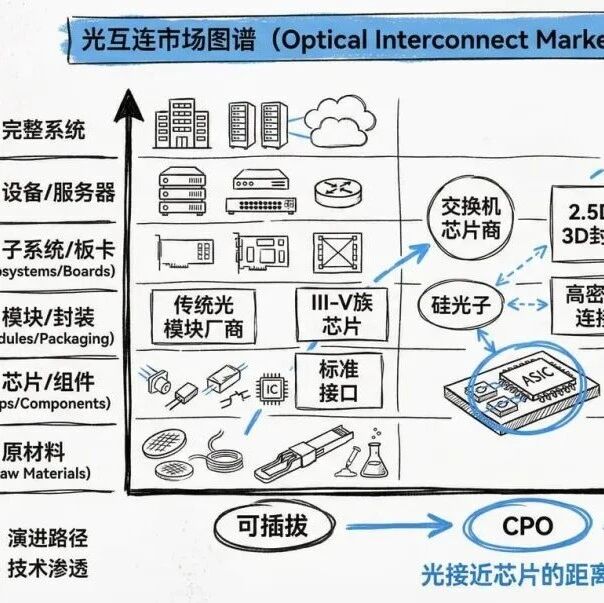
光互联的市场图谱
傅里叶的猫· 2026-02-21 14:13
Core Insights - The article discusses the evolution of optical interconnect technology, highlighting three key structural patterns in the market: vertical integration vs. specialization, the scarcity of light generation, and the rise of SiPho foundries [5][6][10]. Group 1: Market Structure - Vertical integration offers structural advantages during technological transitions, as companies that can design across multiple layers can optimize the entire tech stack [9]. - Companies like Broadcom exemplify vertical integration, appearing across multiple layers of the value chain, while most others focus on specific segments [8]. - The semiconductor industry has historically shown that such advantages may not be permanent, as standardization can lead to the emergence of fabless models [9]. Group 2: Scarcity of Light Generation - The difficulty of producing light sources (Layer 1 and Layer 0) is highlighted, with InP and GaAs materials requiring specialized technology and equipment [12][13]. - Companies capable of mass-producing high-performance InP lasers are few, creating a concentrated market [13][14]. Group 3: Rise of SiPho Foundries - Layer 2, which focuses on SiPho foundries, is gaining attention as traditional semiconductor manufacturers like TSMC and GlobalFoundries enter the photonics space [17]. - TSMC's potential to optimize both AI chips and optical interconnects within the same ecosystem could disrupt existing vertical integration advantages [17]. Group 4: Layer Analysis - Layer 0 involves substrate supply, with companies like AXT benefiting from increased demand for III-V substrates, although geopolitical risks exist due to production in China [21][22]. - Layer 1 is dominated by Coherent and Lumentum, both of which manufacture InP lasers and are expanding production amid high demand [24][25]. - Layer 2 focuses on SiPho foundries, with companies like GlobalFoundries and TSMC leading in manufacturing photonic integrated circuits [27][29]. - Layer 3, represented by DSPs, faces potential obsolescence as CPO technology advances, with companies like Broadcom and Marvell adapting to this shift [33][36]. - Layer 4 sees companies like Innolight and Eoptolink currently leading in the pluggable module market, but their positions may be challenged as the industry shifts towards CPO [40][42]. Group 5: Future Signals - Key indicators to watch include pJ/bit energy consumption metrics, which reflect technological advancements and efficiency [56]. - The ongoing standardization efforts, such as OIF and UCIe, will shape the future market landscape and influence competitive dynamics [57][59]. - Recent mergers and acquisitions signal strategic directions in the industry, with notable deals like Marvell's acquisition of Celestial AI [60][62]. - The choices made by major cloud service providers like Google and AWS regarding their technology partnerships will ultimately determine market trajectories [63][64].




国泰海通:光纤行业涨价趋势明确 关注CPO/OIO从0-1的变化机会
智通财经网· 2026-02-03 22:53
Core Insights - The overall performance expectations for the optical interconnect industry are strong, with differentiation providing insights for 2026 [2] - The trend of price increases in the fiber optic industry is clear, driven by rising demand and new technologies [2] Group 1: Industry Performance and Trends - The optical interconnect sector is expected to benefit from the AI industry chain, leading to upward revisions in market expectations [1] - The appreciation of the RMB impacts the optical interconnect sector, which primarily focuses on overseas exports, with implications for accounting and exchange rates [2] - The market for pluggable modules is anticipated to continue improving in 2026-2027, with new packaging and material technology changes emerging [2] Group 2: Technological Developments - Attention is drawn to the opportunities arising from the transition of CPO/OIO technologies from 0 to 1, with significant growth expected in the coming years [2] - LightCounting forecasts that CPO technology shipments will begin scaling up from 800G and 1.6T ports starting in 2026-2027, primarily for large cloud service providers [2] - By 2029, the penetration rates for CPO technologies are projected to reach 2.9% for 800G, 9.5% for 1.6T, and 50.6% for 3.2T [2] Group 3: Market Dynamics - Recent price increases in fiber optic cables are attributed to heightened demand from telecom operators and pre-holiday inventory buildup, suggesting continued price strength [2] - Major domestic clients are expected to accept price increases, confirming the sector's volatility and pricing power [2] Group 4: Key Industry News - Corning has established a long-term supply agreement worth $6 billion with Meta [3] - NVIDIA has made an additional $2 billion investment in CoreWeave [3] - Microsoft has released its second-generation self-developed AI chip, Maia 200 [3] - The personal AI assistant ClawdBot is gaining global traction [3] - Microsoft and Meta have released their latest financial reports [3]

国泰海通|通信:光纤行业涨价趋势明确,关注cpo和光互联投资机会
国泰海通证券研究· 2026-02-03 14:00
Core Insights - The optical interconnection industry shows strong performance expectations, with a clear trend of price increases in the fiber optic sector and new growth opportunities from hollow core technology [1][2] Group 1: Industry Performance and Trends - The optical interconnection sector is expected to maintain strong performance, with significant differentiation providing insights for 2026 [2] - The appreciation of the RMB impacts the optical interconnection sector, particularly those focused on overseas exports, affecting provisions and exchange rates [2] - The market for pluggable modules is anticipated to continue improving, with new packaging and material technologies transitioning from concept to reality, highlighting marginal change opportunities [2] Group 2: CPO/OIO Opportunities - Attention is drawn to the transition of CPO/OIO technologies from 0 to 1, with LightCounting forecasting that CPO shipments will begin scaling from 800G and 1.6T ports between 2026 and 2027, primarily for large cloud service providers [2] - By 2029, the expected penetration rates for CPO technologies are projected to be 2.9% for 800G, 9.5% for 1.6T, and a significant 50.6% for 3.2T [2] Group 3: Price Trends and Market Dynamics - The price of fiber continues to rise, driven by increased demand from telecom and mobile operators ahead of major procurement events and the upcoming Spring Festival [2] - It is anticipated that major domestic clients will accept price increases, confirming the volatility within the sector [2] Group 4: Industry News and Investment Highlights - Corning has reached a long-term supply agreement worth $60 billion with Meta, while Nvidia has invested an additional $2 billion in CoreWeave [3] - Microsoft has released its second-generation AI chip, Maia 200, and the personal AI assistant ClawdBot is gaining global traction [3] - The AI industry is driving network upgrades, with strong overseas demand benefiting core domestic enterprises amid a new cycle for domestic infrastructure [3]

通信行业周报:光纤行业涨价趋势明确,关注 cpo 和光互联投资机会
GUOTAI HAITONG SECURITIES· 2026-02-03 03:20
Investment Rating - The report assigns an "Overweight" rating for the optical fiber industry, indicating a projected increase of over 15% relative to the CSI 300 index [4][33]. Core Insights - The optical interconnection sector shows strong performance expectations, with a focus on the transition opportunities from CPO/OIO technology. The optical fiber industry is experiencing a clear price increase trend, driven by demand from telecom operators and pre-holiday inventory needs [2][9]. - LightCounting forecasts that CPO technology shipments will begin scaling from 800G and 1.6T ports between 2026 and 2027, primarily for large cloud service providers. By 2029, the penetration rates for 800G, 1.6T, and 3.2T CPOs are expected to be 2.9%, 9.5%, and 50.6% respectively [8][9]. - Recent price increases in fiber optics are anticipated to continue due to heightened demand from telecom operators and upcoming procurement activities [9]. Summary by Sections Industry Overview - The optical interconnection sector is expected to maintain strong performance, with individual company differences but overall manageable conditions projected for 2026 [7]. - The appreciation of the RMB is impacting the optical interconnection sector, particularly for companies focused on overseas exports, with potential profit impacts estimated at under 5% for most, while some may see impacts nearing half of their profits [7]. Investment Highlights - The industry has seen an increase in holding ratios, with valuations at historically elevated levels, reflecting positive expectations driven by the AI industry chain [23]. - AI is driving network upgrades, with strong overseas demand benefiting domestic core enterprises amid a global infrastructure wave [24]. - A new generation of computing infrastructure is emerging in China, with a fully domestic supply chain entering a new cycle [25]. - New connectivity solutions are expected to emerge in 2026, presenting additional investment opportunities [26]. - AI-driven network upgrades are enhancing communication capacity demands, with rapid advancements in network innovation and technology applications [27]. Key Industry News - Corning has signed a long-term supply agreement worth $6 billion with Meta to support its data center expansion in the U.S. [10]. - NVIDIA has invested $2 billion in CoreWeave to enhance AI computing capabilities [12]. - Microsoft has launched its second-generation AI chip, Maia 200, aimed at optimizing AI inference costs [14][15]. - The personal AI assistant ClawdBot has gained significant traction globally, showcasing advanced capabilities [16][17]. - Microsoft and Meta reported substantial increases in capital expenditures, reflecting their commitment to infrastructure growth [18][19].





山西证券给予新易盛“买入”评级,二季度收入环比大幅增长,高端产品上量利好盈利能力
Sou Hu Cai Jing· 2025-09-19 08:24
Group 1 - The core viewpoint of the report is that Shanxi Securities has given a "buy" rating for Xinyi Technology (300502.SZ) based on its strong performance and growth prospects [1] - The company has significantly increased its production capacity in the first half of the year, maintaining excellent delivery capabilities, resulting in both revenue and profit growth [1] - New product outlook includes rapid volume increase of 1.6T products, gradual rise in silicon photonics proportion, and layouts in AEC and CPO [1] Group 2 - The North American ASIC custom chip market is expected to continue growing by 2026, with the company positioned as a core supplier benefiting from major clients [1] - Potential risks include changes in tariff policies or US-China trade tensions leading to lower-than-expected capital expenditures in North America, introduction of new suppliers by downstream major clients affecting shipment volumes, and rising upstream material costs impacting gross margins [1] - The company may face technological risks if it falls behind in the research and development of next-generation optical communications such as CPO and OIO [1]
