OmniScientist

Search documents
清华新研究,Nature+Science双杀
3 6 Ke· 2026-01-15 07:47
Core Insights - The research from Tsinghua University reveals a paradox in the AI for Science field, where AI accelerates individual scientific progress but narrows collective scientific focus, leading to a phenomenon known as "group climbing" [2][4][17] - Despite AI's contributions to scientific advancements, such as the development of AlphaFold, the overall disruptive research outcomes across disciplines have been declining [4][17] Group 1: Research Background - The study aims to address the contradiction of why overall scientific progress has not significantly accelerated despite the empowerment of research by AI [4] - The research culminated in the publication of the paper titled "Artificial Intelligence Tools Expand Scientists' Impact but Contract Science's Focus" [4][5] Group 2: Methodology - The research team utilized a combination of expert annotation and large-scale language model inference to identify AI-augmented research from a dataset of 41.3 million research papers [5][6] - The methodology involved creating a "semantic map" of scientific literature to analyze the impact of AI across six major fields of natural sciences [9][10] Group 3: Findings on Individual vs. Collective Impact - Individual scientists using AI publish 3.02 times more papers and receive 4.84 times more citations, becoming project leaders 1.37 years earlier than their non-AI counterparts [15][16] - However, at the collective level, the knowledge breadth of AI-augmented research decreased by 4.63%, and cross-disciplinary interactions among scientists fell by 22% [15][16] Group 4: Underlying Causes - The decline in collective scientific breadth is attributed to the lack of generalizability in current AI models, which leads researchers to focus on a limited number of popular research areas suitable for AI [17][20] - This "group climbing" effect accelerates solutions to known problems but restricts exploration of unknown areas, resulting in a trade-off where breadth is sacrificed for speed [17][20] Group 5: Future Directions - To address these limitations, the research team introduced the OmniScientist system, designed to provide comprehensive, cross-disciplinary support for scientific research, evolving AI from a mere tool to an "AI scientist" capable of hypothesis generation and experimental design [20]

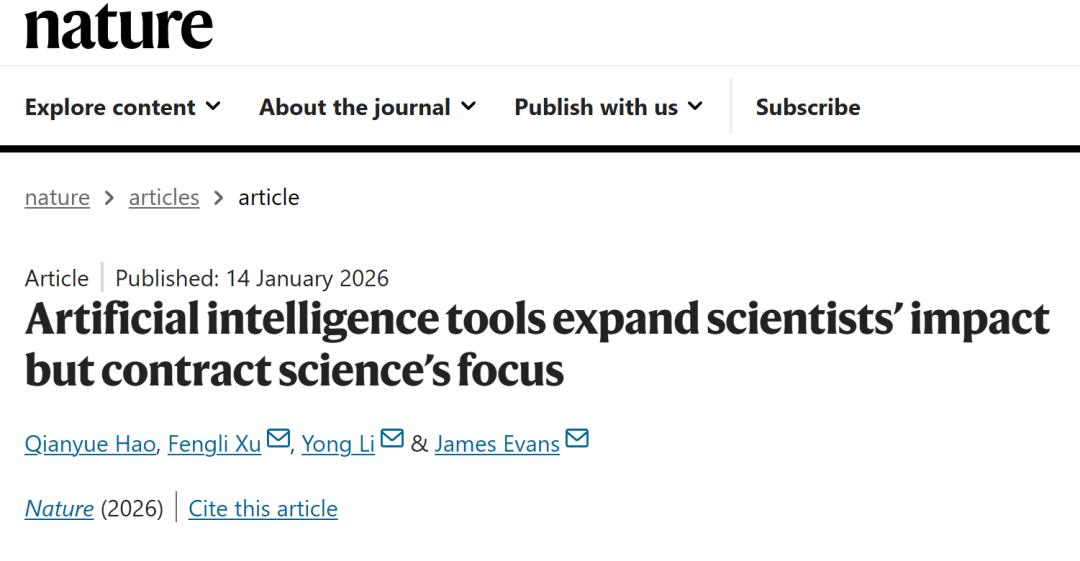
清华新研究,Nature+Science双杀!
量子位· 2026-01-15 01:23
Core Insights - The research from Tsinghua University reveals a paradox in the AI for Science field, where AI accelerates individual scientific productivity but narrows collective scientific focus, leading to a phenomenon known as "group climbing" [3][4][31]. Group 1: Research Findings - The study analyzed 250 million scientific papers and found that while AI tools have enabled scientists to publish 3.02 times more papers and receive 4.84 times more citations, the overall breadth of scientific exploration has decreased by 4.63% [3][26][29]. - The research indicates that the collective interaction among scientists from different fields has reduced by 22%, suggesting a trend towards concentration and a lack of innovative vitality in research [29]. Group 2: Methodology - The research team utilized a combination of expert annotation and large-scale language model inference to identify AI-augmented research, achieving a high accuracy score of 0.875 [12][13]. - A comprehensive dataset covering 41.3 million research papers from 1980 to 2025 was created, serving as a benchmark for understanding the systematic impact of AI on scientific research [14]. Group 3: Implications - The findings suggest that the current AI models lack generalizability, leading to a strong "scientific intelligence gravity" effect that draws researchers towards a few popular research areas, thereby solidifying existing scientific exploration paths [31][32]. - The research concludes that while AI enhances local efficiency, it struggles to drive innovation across the entire research chain and multiple disciplines [35].
2025国际人工智能科学家大会密集发布多项成果和榜单
Zhong Guo Qing Nian Bao· 2025-11-23 10:41
Core Insights - The OmniScientist system, the world's first comprehensive research talent cultivation system, was officially launched at the ICAIS 2025 conference, addressing challenges in research such as information overload and academic-industrial disconnection [1][3] Group 1: OmniScientist System Features - OmniScientist can analyze vast amounts of scientific literature and industry reports, helping researchers establish a demand-driven research focus [3] - The system captures dynamic trends in interdisciplinary scientific networks, promoting knowledge transfer and innovation across fields [3] - It integrates industry knowledge to ensure research questions align with core social and economic issues, providing 24/7 intelligent feedback to optimize research ideas [3][4] Group 2: Future of AI in Science - The conference highlighted the rapid integration of AI into daily life, with experts predicting significant advancements in solving major scientific challenges within five years [3] - The "2025 Frontiers of Science Progress and 2026 Future Major Breakthrough Predictions" list was released, offering strategic guidance for young scholars and researchers [4] - The list was developed using a multi-dimensional evaluation model combining AI analysis and expert insights, covering fields such as information, physics, chemistry, biology, and economics [5] Group 3: Notable Technological Advances - Key advancements in AI include DeepSeek and OpenAI models, which demonstrate significant capabilities in self-reflection and resource allocation for complex problems [5] - In chemistry, notable progress includes solid-state batteries achieving 18-minute fast charging and stable intermittent alkaline seawater hydrogen production for 10,000 hours [5] Group 4: Future of Research and Education - The future of research education and talent development is expected to transition from purely human-driven efforts to a new phase of human-machine collaboration, enhancing both human creativity and machine efficiency [6]