OpenAI模型

Search documents
为AI交易“背书”!OpenAI正敲定新一轮融资:以8300亿美元估值募资高达1000亿美元
Hua Er Jie Jian Wen· 2026-02-19 03:54
Group 1 - OpenAI is finalizing a new funding round that could raise $100 billion, leading to a company valuation of $830 billion after completion [1] - SoftBank is expected to lead this round with an investment of $30 billion, distributed in three phases throughout the year [1] - Amazon, a provider of cloud services to OpenAI, may invest up to $50 billion, while Nvidia, a supplier of model chips, could contribute up to $30 billion [1] Group 2 - OpenAI is seeking support from financial investors after securing initial investment commitments, engaging with existing investors like Thrive Capital, Khosla Ventures, Founders Fund, and Sequoia Capital [2] - Investors in this funding round will receive preferred shares that convert to Class A common stock upon the company's exit, along with a 1x liquidation preference [2] Group 3 - This funding round marks OpenAI's first financing since its corporate restructuring last fall, which allows the issuance of standard equity and is a crucial step towards an IPO [3] - Prior to this round, OpenAI raised approximately $61 billion from investors including Microsoft, Thrive, and SoftBank, with a valuation of $500 billion during a share sale last fall [3] Group 4 - The substantial funding is driven by OpenAI's expectations of soaring operational and training costs for AI, projected to reach around $450 billion between 2025 and 2030 [4] - The valuation of $830 billion represents a significant increase from the $500 billion valuation last fall, reflecting continued investor enthusiasm despite the company's high expenditure pressures [4]
微软(MSFT.US)的“Plan B”:不满OpenAI性能表现,Copilot全面引入Anthropic开启双引擎时代
Zhi Tong Cai Jing· 2026-01-15 01:33
Core Insights - Microsoft has become a top customer of Anthropic, planning to invest approximately $500 million annually to leverage Anthropic's AI for its products [1][2] - Microsoft is incentivizing its Azure sales team to promote Anthropic's AI models, which could lead to increased revenue for both companies [1][2] - Microsoft has previously invested over $13 billion in OpenAI and holds nearly 27% of the company, indicating a strong commitment to AI technologies [2][3] Group 1 - Microsoft is expected to spend over $40 million monthly on Anthropic models, translating to an annual expenditure of about $500 million [3] - The collaboration with Anthropic allows Microsoft to enhance its products like GitHub Copilot and Microsoft 365 Copilot, improving functionalities such as automated presentations [3] - Microsoft is offering sales incentives for Azure sales personnel to promote Anthropic models, similar to those previously provided for OpenAI models [1][2] Group 2 - Anthropic has projected its annual revenue to reach between $7.5 billion and $9 billion by the end of 2025, highlighting its growth potential [3] - Microsoft is competing with other tech giants by utilizing both OpenAI and Anthropic technologies to develop its own AI automation products [2] - Anthropic has committed to investing $30 billion in Microsoft Azure's computing capacity, further solidifying the partnership [2]

微软对Anthropic人工智能的投入有望达到5亿美元
Xin Lang Cai Jing· 2026-01-14 14:14
Core Insights - Microsoft has quietly become a top customer of Anthropic, with annual spending on AI technology expected to reach nearly $500 million [1][4] - Microsoft is actively promoting Anthropic's AI models to cloud service customers, which may lead to increased revenue for both parties [1][4] Group 1: Partnership and Financials - Microsoft has informed its Azure cloud sales team that selling Anthropic's AI models will count towards their sales performance metrics, similar to its own software [1][4] - This sales incentive policy for Anthropic products is set to last until the end of June this year, marking a significant shift in Microsoft's approach to non-proprietary products [1][4] - Microsoft has previously provided similar sales incentives for OpenAI models, indicating a strategic alignment in promoting both AI technologies [1][4] Group 2: Market Strategy and Competition - Microsoft is deepening its collaboration with multiple AI developers to mitigate risks, as these developers can be both revenue-generating partners and potential threats to core business [2][5] - The partnership with Anthropic follows Microsoft's decision to invest up to $5 billion in the company last September, establishing Anthropic as a client of Microsoft's servers [2][5] - Microsoft has invested over $13 billion in OpenAI and holds a 27% stake in the company, with profits from selling OpenAI models being higher than those from Anthropic models [2][5] Group 3: Sales Collaboration and Product Features - Anthropic's revenue primarily comes from direct sales of AI technology to enterprises, and Microsoft is collaborating with Anthropic's sales team to promote their models through Azure [3][6] - Anthropic has a similar sales approach with Amazon and Google, targeting large clients with higher security needs, where major cloud providers claim to have advantages over AI startups [3][6] - Microsoft has emphasized that Anthropic's models can help clients discover new application scenarios, encouraging them to choose Azure over competitors like Google or Amazon [3][6]
Token售卖已无溢价、大模型公司转型“系统商”?记忆张量 CTO 李志宇:智能体能力会拉开差距,长期记忆与状态管理成竞争核心
AI前线· 2026-01-12 11:04
Core Insights - The article discusses the evolution of AI companies and technologies, emphasizing the shift from merely scaling models to developing sustainable systems that incorporate memory and state management capabilities [2][4][17]. Group 1: Industry Trends - In 2025, notable companies like MiniMax and Zhipu have emerged, aiming for IPOs, but face challenges such as severe losses and production ratios [4]. - The pressure on tech companies has intensified, with a focus on system efficiency and sustainable technology accumulation rather than just chasing model parameters [5]. - The competition landscape is shifting from a focus on individual model capabilities to a broader emphasis on system-level capabilities, including memory management and reasoning [17]. Group 2: Technological Developments - The trend of using large-scale synthetic data is growing, but it is not expected to completely replace human-annotated data; high-quality synthetic data must be carefully constructed [9]. - Significant advancements in model capabilities have been observed, particularly in complex instruction understanding and multi-step reasoning stability [10]. - The introduction of Mixture of Experts (MoE) architecture has become mainstream due to its cost-effectiveness, balancing parameter efficiency and inference costs [12]. Group 3: Future Directions - The next major leap in AI models is anticipated to come from advancements in memory management, transitioning from static parameter storage to dynamic memory systems that support long-term tasks [18]. - The competition in AI is expected to focus on the development of intelligent agents, with a need for models to enhance reasoning, state understanding, and collaboration with tools [15]. - Companies are likely to explore value-added services beyond just selling model tokens to maintain profitability amid increasing price competition [16].


2025国际人工智能科学家大会密集发布多项成果和榜单
Zhong Guo Qing Nian Bao· 2025-11-23 10:41
Core Insights - The OmniScientist system, the world's first comprehensive research talent cultivation system, was officially launched at the ICAIS 2025 conference, addressing challenges in research such as information overload and academic-industrial disconnection [1][3] Group 1: OmniScientist System Features - OmniScientist can analyze vast amounts of scientific literature and industry reports, helping researchers establish a demand-driven research focus [3] - The system captures dynamic trends in interdisciplinary scientific networks, promoting knowledge transfer and innovation across fields [3] - It integrates industry knowledge to ensure research questions align with core social and economic issues, providing 24/7 intelligent feedback to optimize research ideas [3][4] Group 2: Future of AI in Science - The conference highlighted the rapid integration of AI into daily life, with experts predicting significant advancements in solving major scientific challenges within five years [3] - The "2025 Frontiers of Science Progress and 2026 Future Major Breakthrough Predictions" list was released, offering strategic guidance for young scholars and researchers [4] - The list was developed using a multi-dimensional evaluation model combining AI analysis and expert insights, covering fields such as information, physics, chemistry, biology, and economics [5] Group 3: Notable Technological Advances - Key advancements in AI include DeepSeek and OpenAI models, which demonstrate significant capabilities in self-reflection and resource allocation for complex problems [5] - In chemistry, notable progress includes solid-state batteries achieving 18-minute fast charging and stable intermittent alkaline seawater hydrogen production for 10,000 hours [5] Group 4: Future of Research and Education - The future of research education and talent development is expected to transition from purely human-driven efforts to a new phase of human-machine collaboration, enhancing both human creativity and machine efficiency [6]

早报(11.12) | 市值一夜蒸发逾1431亿美元!英伟达遭软银清仓;美科技巨头疯狂加码欧洲;“中国巴菲特”出手再捐2.2亿!
Ge Long Hui· 2025-11-12 00:11
Group 1 - China responds to multiple foreign trade issues, emphasizing dialogue with the US to ensure global supply chain stability and criticizing the EU's exclusion of Huawei and ZTE [2] - Notable investor Duan Yongping shares investment insights, advocating for long-term stock investments over short-term trading, highlighting his positions in Kweichow Moutai, Apple, and Tencent [2] - SoftBank sells its Nvidia shares for $5.83 billion to fund additional investments in OpenAI, which contributed significantly to its recent investment gains [6] Group 2 - Major US tech companies, including Microsoft and Google, announce significant investments in AI infrastructure in Europe, with Microsoft planning to invest $10 billion in Portugal and Google committing €5.5 billion in Germany [7] - JD.com reports record sales during the Double 11 shopping festival, with a 40% increase in users and nearly 60% growth in order volume [8] - AMD forecasts the AI data center market will reach $1 trillion by 2030, with expected annual revenue growth rates exceeding 35% [9] Group 3 - Tesla prepares to expand its Texas Gigafactory for the production of humanoid robots, despite reporting a significant drop in vehicle sales in October [12] - Meta's chief AI scientist plans to leave the company amid strategic disagreements, raising concerns about the effectiveness of Meta's AI initiatives [13] - Midea Group announces a cash dividend plan for 2025, distributing 5 yuan per 10 shares, totaling approximately 3.448 billion yuan [14] Group 4 - Henan Energy and Pingmei Shenma Group complete a strategic merger, with combined revenues expected to exceed 280 billion yuan, enhancing risk resilience [16] - Jinglin Asset increases its holdings in Alibaba and Pinduoduo, reflecting confidence in the efficiency of Chinese companies [17] - Saudi Aramco invests $100 billion in natural gas projects, anticipating significant cash flow growth by 2030 [18]


微软的“电力焦虑”:一场97亿美元的算力豪赌
Tai Mei Ti A P P· 2025-11-04 01:01
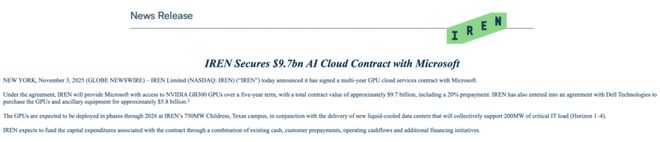
Core Insights - Microsoft has made a significant investment by signing a five-year contract worth $9.7 billion with Iris Energy (IREN) for GPU computing power, leading to a substantial increase in IREN's stock price [1][11] - The deal highlights Microsoft's strategy to address its infrastructure bottlenecks in AI, particularly in power supply and data center capabilities, rather than just focusing on GPU acquisition [2][4] - IREN is transitioning from a Bitcoin mining company to an AI cloud service provider, leveraging its existing infrastructure and clean energy resources [10][15] Investment Rationale - The partnership allows Microsoft to bypass lengthy approval processes and directly utilize IREN's existing facilities and clean energy, which is crucial for scaling AI operations [2][12] - Microsoft’s investment is seen as a response to real demand for computing power, contrasting with other tech companies that are criticized for their unclear spending strategies [6][9] - The collaboration is expected to enhance Microsoft's valuation stability as it focuses on tangible growth rather than speculative investments [9][15] Industry Trends - The energy supply is becoming a critical factor in the tech industry, with major companies like Microsoft, Google, and Amazon racing to secure renewable energy sources [11][14] - The shift towards nuclear energy is emerging as a potential solution to meet the growing power demands of data centers, with Microsoft exploring partnerships to develop nuclear power capabilities [12][14] - The trend indicates a transition from traditional cloud computing models to a more decentralized approach, where tech giants rely on independent operators for energy and computing resources [15][16] Company Positioning - Microsoft is positioning itself as a leader in the AI infrastructure space, moving from a software-centric model to one that integrates energy resources, thereby enhancing its competitive edge [15][16] - The investment in IREN signifies a strategic pivot towards building a self-sufficient energy and computing ecosystem, which could redefine the operational landscape for tech companies [15][16]
马斯克最大对手完成变身,史上最大IPO即将来临
3 6 Ke· 2025-10-30 01:36
Core Insights - OpenAI has successfully completed its transformation from a non-profit organization to a profit-oriented tech giant, paving the way for a potential IPO, expected around 2027, which could set a record for fundraising [1][2][3] Group 1: Transformation and Market Impact - OpenAI's transition has significantly influenced the AI industry and global infrastructure, marking a dramatic shift from its original mission of ensuring AGI benefits all humanity [2][3] - The company has formed strategic partnerships with major tech firms like Microsoft, Oracle, NVIDIA, AMD, and Broadcom, which has tightly bound its interests with the broader AI ecosystem [2][3] - Following the announcement of its transformation, stock prices for NVIDIA and Microsoft surged, reaching new market capitalizations of over $5 trillion and $4 trillion respectively [2] Group 2: Financial Structure and Control - OpenAI's new structure includes a dual-layer system where the non-profit foundation retains control over the profit-oriented entity, OpenAI Group PBC, which is valued at approximately $5 trillion [4][6] - Microsoft remains the largest external investor with a 27% stake, valued at around $135 billion, while the foundation holds about 26% of the equity, valued at approximately $130 billion [4][6] - The restructuring has removed previous financing restrictions, allowing OpenAI to freely raise funds from investors and partners, thus facilitating its path to an IPO [7] Group 3: Strategic Agreements and Investments - OpenAI has committed to significant agreements, including a $500 billion project with Oracle and SoftBank for AI data centers, and a $300 billion cloud computing deal with Oracle [19][21] - The company has also secured a $250 billion cloud service agreement with Microsoft, alongside substantial investments from NVIDIA and AMD for hardware procurement [21][22] - OpenAI's aggressive investment strategy is projected to exceed $1.5 trillion by 2025, with a focus on expanding its AI infrastructure [18][22] Group 4: Competitive Landscape and Challenges - Elon Musk's opposition to OpenAI's transformation has been marked by multiple lawsuits and attempts to undermine its progress, reflecting a personal rivalry stemming from their shared founding of the organization [12][13][14] - OpenAI's financial model faces scrutiny, as its projected expenses significantly outweigh its revenues, leading to anticipated losses of at least $14 billion by 2025 [22][23] - The company's ambitious infrastructure investments are seen as a high-stakes gamble, with the potential to either revolutionize AI or trigger a systemic crisis in the industry [22][23]
AI日报丨英伟达要做 Robotaxi 无人驾驶出租车?技术路线类似特斯拉FSD
美股研究社· 2025-09-18 11:33
Group 1 - BlackRock has doubled its exposure to U.S. stocks and artificial intelligence in its investment outlook report, increasing its stock allocation to 2% in its $185 billion model portfolio, favoring U.S. equities over international developed markets [5] - The model team at BlackRock is shifting from a broad-based U.S. tech ETF to an AI-focused fund, with nearly $1.4 billion flowing into the iShares AI Innovation and Tech Active ETF [5] Group 2 - Reddit is in discussions with Google for a new AI content agreement, with Reddit's stock price decline narrowing from 6.5% to less than 2% [6] - Meta has announced a new generation of Ray-Ban smart glasses starting at $379, showcasing AI features that assist in cooking [6] - NVIDIA is incubating a Robotaxi project, expected to be announced soon, with a focus on a new single-stage technology route using an "end-to-end" neural network, similar to Tesla's FSD approach, with an anticipated investment of $3 billion [7] Group 3 - OpenAI's model has outperformed Google's Gemini 2.5 in the "Programming Olympics," achieving a first-place finish in the ICPC World Finals by solving 12 algorithm problems, with GPT-5 solving 11 of them correctly [9][10] - The ICPC competition promotes excellence in algorithmic thinking, programming, and teamwork, fostering collaboration between academia and industry [11]


OpenAI模型首次登陆AWS云平台
Sou Hu Cai Jing· 2025-08-07 05:50
Core Insights - OpenAI has launched two new open-weight inference models that will be available on AWS, marking the first time OpenAI models are offered through Amazon's cloud services [2][5] - This partnership allows AWS to directly associate with OpenAI, enhancing its competitive stance against rivals like Microsoft and Oracle [3][4] Group 1: OpenAI and AWS Partnership - The new models will be integrated into AWS's AI services, Bedrock and SageMaker, providing users with options to utilize OpenAI's technology [2][5] - This collaboration is seen as a strategic move for AWS to catch up in the AI space, especially after facing criticism regarding its position compared to competitors like Microsoft and Google [4][5] Group 2: Competitive Landscape - AWS was previously known for hosting Anthropic's Claude model, a direct competitor to OpenAI, and now aims to shift its focus towards OpenAI's offerings [3][4] - Oracle has signed a $30 billion annual agreement with OpenAI for data center services, highlighting the competitive pressure on AWS to secure its position in the AI market [4] Group 3: Implications for OpenAI - The partnership with AWS strengthens OpenAI's market position, especially amid reported tensions with Microsoft, its primary cloud partner [5][6] - By collaborating with AWS, OpenAI can expand its reach to a larger base of enterprise customers who utilize AWS for their AI applications [5][6]