
Orin 芯片

Search documents
从 55 万颗芯片到统一架构:蔚来在赌什么?
美股研究社· 2026-03-20 11:09
Core Viewpoint - The automotive industry is undergoing a transformation where companies are shifting from being mere manufacturers to becoming architects of their own systems, indicating a redistribution of control within the industry [1][13]. Group 1: Chip Development and Industry Dynamics - NIO has produced over 550,000 self-developed chips, which, while not large in the context of the global automotive semiconductor market, signifies a strategic shift from merely having chips to controlling the chip ecosystem [2][5]. - The rapid evolution of smart vehicles has led to an explosion in the variety of chips and a fragmented architecture, resulting in increased hidden costs and reduced control for automakers over product definitions [3][5]. - NIO aims to reduce chip specifications to under 400 types, transitioning from a "hardware stacking" approach to a "unified architecture" strategy, which will enhance development efficiency and shorten vehicle iteration cycles [5][10]. Group 2: Challenges and Strategic Responses - The automotive industry faces three main challenges: surging computing power demands, fragmented systems, and supply chain volatility, all pointing to a need for automakers to regain control over computing power [7][8]. - NIO's strategy is not about completely replacing external chips but rather creating a controllable hybrid system through self-developed chips and standardization, allowing for flexibility and cost-effectiveness [8][10]. Group 3: Future Competitiveness and Market Positioning - NIO's goal of achieving a 35%-40% localization rate for automotive semiconductors by 2027 is not just about cost but about building capabilities that integrate chips, operating systems, and vehicle software [10][11]. - The competition will increasingly focus on efficient power management and system coordination rather than just hardware performance, with NIO's SkyOS serving as a core component of this strategy [10][12]. - As NIO transitions towards a platform-based model, the market's perception of automakers may shift from traditional manufacturing to technology-driven companies, potentially leading to higher valuations [11][14].



黄仁勋的“物理 AI 革命”:Alpamayo 让自动驾驶学会 “思考”
3 6 Ke· 2026-01-07 03:48
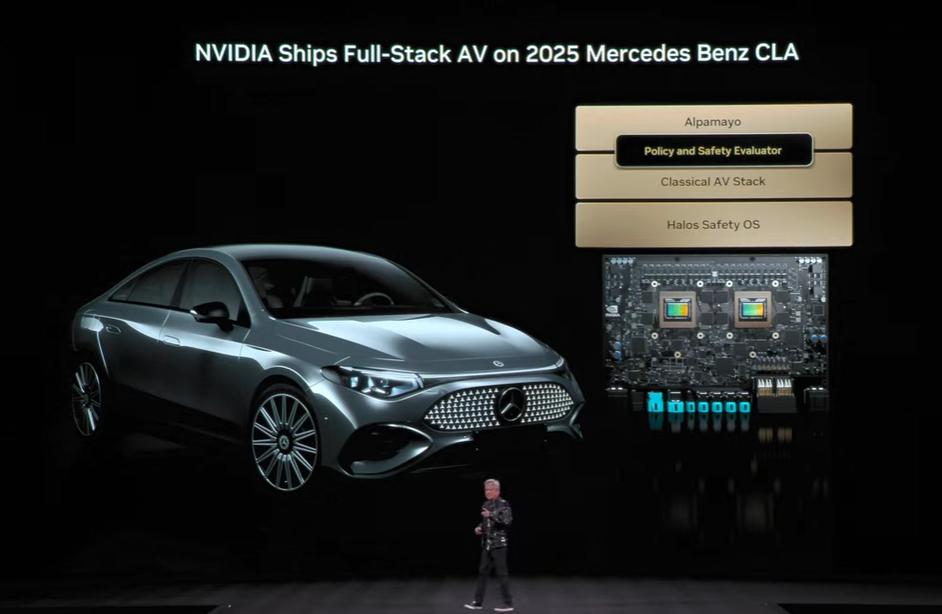
Core Insights - Nvidia's CEO Jensen Huang announced the arrival of "physical AI" at CES 2026, highlighting the transformative potential of the Alpamayo autonomous driving AI system, which signifies a shift from "data-driven" to "reasoning-driven" autonomous driving [1][10] Group 1: Alpamayo's Technological Breakthrough - Alpamayo addresses the "long tail problem" in autonomous driving, where 99% of scenarios can be covered by data, but the remaining 1% poses significant safety risks. Traditional solutions focused on accumulating vast amounts of data, which are costly and insufficient for unprecedented scenarios [2] - Alpamayo is the first visual-language-action (VLA) model that enables autonomous systems to possess "human-like reasoning capabilities." It breaks down problems similarly to human drivers, enhancing decision-making safety and providing clear directions for system optimization [2][3] Group 2: Development Ecosystem and Partnerships - Alpamayo employs a 10 billion parameter architecture and supports trajectory generation and reasoning logic from video inputs. Nvidia has created a comprehensive development ecosystem, including the open-source AlpaSim simulation framework and a dataset of over 1,700 hours of physical AI data [3][5] - The first vehicle equipped with Alpamayo will be launched in the first quarter of 2026 in partnership with luxury car manufacturer Mercedes-Benz, marking a significant step in Nvidia's dominance in the autonomous driving sector [5][7] Group 3: Market Position and Competitive Landscape - Nvidia's strategy combines "hardware dominance" with "algorithmic ecosystem dominance," allowing automakers to quickly access advanced autonomous driving capabilities without starting from scratch [7][10] - The introduction of Alpamayo shifts the competitive focus in the autonomous driving industry from "computational power" and "data volume" to "reasoning capabilities," potentially redefining the competitive landscape [10][11] Group 4: Implications for the Industry - For traditional automakers, Alpamayo presents both opportunities and challenges. The open-source ecosystem lowers the barrier for high-level autonomous driving development, enabling smaller companies to compete without massive R&D investments [11] - Tech companies like Google Waymo and Baidu Apollo must accelerate their reasoning model development to remain competitive, while chip manufacturers need to adapt to the new demands of integrating reasoning models with computational power [11][9]

从“能动”到“灵动”,机器人智能化步入新篇章
2025-05-12 01:48
Summary of Conference Call on Robotics Industry Industry Overview - The humanoid robotics commercialization is still in its early stages, primarily applied in standardized processes within industrial settings, such as material handling in automotive manufacturing, but the actual usable scenarios are limited. Future applications are expected to emerge in standardized processes with high labor costs in hazardous environments [1][4] Key Points and Arguments - **Challenges in Commercialization**: Humanoid robotics face dual challenges in hardware and software. Hardware improvements are needed in actuator precision, sensor accuracy, power density, and battery life. Software improvements are required in human-machine interaction efficiency, multi-modal perception accuracy, visual image processing, and motion control stability [1][5] - **Data Collection Solutions**: To address the scarcity of training datasets, solutions include increasing real data collection (e.g., Zhiyuan's simulated living spaces) and employing physical simulation methods (e.g., NVIDIA's techniques) to enhance data quality and accelerate commercial application expansion [1][6][7] - **Training Data Efficiency**: By adjusting scene parameters or modifying scenarios, a small amount of real-world interaction data can generate hundreds to thousands of data points, significantly improving data acquisition efficiency and reducing costs. The future mainstream approach may combine real data collection with simulated data generation [1][8] - **Trends in Robotics Models**: The development of large models for robotics is trending towards multi-system architectures, such as NVIDIA's Grace Hopper. Future models need to address multi-modal and generalization capabilities, enabling robots to understand visual, linguistic, auditory, and tactile information [1][9] Additional Important Insights - **Technological Progress**: In the past two to three years, significant technological advancements have been observed in the humanoid robotics sector, with companies like UBTECH demonstrating impressive motion capabilities. However, humanoid robots still struggle with executing simple yet complex tasks, indicating that their intelligence level has not yet reached a fluid stage [2] - **Communication Protocols**: The EtherCAT protocol, with its distributed architecture, controls communication latency at the microsecond level, outperforming traditional CAN bus protocols and other real-time industrial Ethernet protocols, positioning it as a potential mainstream communication protocol for robotics [3][12] - **Market Developments**: DRECOM is set to release a new NPU and DMC stacked packaging product, suitable for running large models on the edge, expected to enter the market by 2025 or 2026. This indicates a growing focus on automation and data collection in investment trends [1][14] - **Sensor Technology**: The development direction for mechanical and tactile sensing is towards more precise perception and execution, enabling robots to understand real-world information accurately and perform fine operations [1][11] - **Chip Applications**: The current landscape for edge chips in robotics includes high-performance models from NVIDIA and Tesla for complex tasks, while domestic chips are being utilized for less demanding functions, indicating a growing opportunity for domestic chip performance enhancement [1][13]
