Quizlet

Search documents
“十五五”规划纲要计算机行业解读:智能经济启航,AI Agent主导未来五年AI叙事
Zhong Guo Yin He Zheng Quan· 2026-03-15 03:24
Investment Rating - The report maintains a "Buy" rating for the computer industry [4] Core Insights - The "14th Five-Year Plan" emphasizes the core strategic position of artificial intelligence (AI) in national development, with the term "artificial intelligence" appearing 30 times, compared to only 6 times in the previous plan [6][8] - The next five years will see AI Agents as the driving force for economic transformation, with a focus on high-value AI Agent growth leading to significant value creation [6][10] - The demand for intelligent computing power is expected to rise significantly, with projections indicating that by 2028, intelligent computing power will account for over 95% of total computing power in China [6][12] - The report highlights the emergence of "Token inflation" due to the rapid growth in AI model usage, with a projected annual Token consumption increase from 0.0005 PetaTokens in 2025 to 152,667 PetaTokens by 2030, reflecting a CAGR of 3418% [6][24] - Investment opportunities are identified in AI-native application companies, edge AI technologies, domestic computing power chain replacements, and collaborative infrastructure for computing and electricity [6][38] Summary by Sections Section 1: The "14th Five-Year Plan" as a Key Period for Intelligent Economy - The plan introduces the concept of "intelligent native," suggesting AI may become a new production factor [11] - The intelligent economy will drive the reconstruction of AI factor value [13] Section 2: Outlook for the "14th Five-Year Plan" - The intelligent economy is set to initiate a rapid explosion in Token usage, with AI Agents transitioning from cost centers to profit centers [17][38] - The report anticipates a significant increase in the number of active AI Agents, from approximately 28.6 million in 2025 to 2.216 billion by 2030, with a compound annual growth rate (CAGR) of 139% [24] Section 3: Comprehensive Upgrade of AI Factors During the "14th Five-Year Plan" - The report emphasizes the importance of high-quality data sets as a core barrier for building irreplaceable AI Agents [16] - The demand for high-quality, proprietary data sets is expected to surge, with a focus on transforming data resources into valuable assets [16] Section 4: Investment Recommendations - The report suggests focusing on AI-native application companies capable of generating scalable revenue, as well as companies that integrate AI Agents with vertical industry know-how [6][38] - Specific companies to watch include Horizon Robotics, JingTai Holdings, Meitu, and others [6]


规模沉淀,增长爆发:2026 开年教育AI榜单观察
3 6 Ke· 2026-02-13 08:39
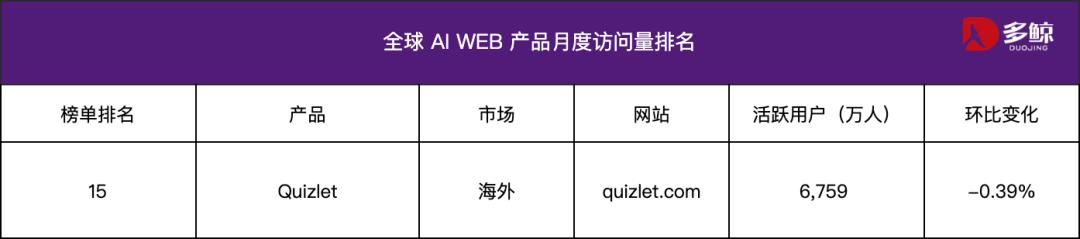
Core Insights - The importance of user-side data is increasing as the AI application ecosystem expands, with metrics like traffic scale, active users, and month-on-month growth becoming key indicators of product adoption and market acceptance [1] - The latest AI WEB100 rankings show that while the number of educational applications is not dominant, they are increasingly appearing across multiple dimensions, indicating a steep growth curve [1] - In January 2026, four educational AI applications were included in the statistics: Quizlet, Speak, Astra AI, and ThetaWave AI, reflecting a transition from "tool enhancement" to "learning system reconstruction" [1] Scale Perspective - Traditional learning tools remain the core representatives of educational AI applications, with Quizlet achieving 67.59 million monthly visits and 20.55 million monthly active users, indicating stable traffic and deep usage [2][3] - Quizlet's performance in both Monthly Visits and MAU rankings highlights its role as a stable entry point for users, despite not appearing in the growth rankings [4] Growth Perspective - The growth rankings reveal the most dynamic new variables in the sector, with ThetaWave AI, Speak, and Astra AI showing month-on-month growth rates of 220.91%, 112.81%, and 106.37% respectively [5][6] - ThetaWave AI's active user growth rate reached 334.83%, indicating a significant shift from trial experiences to deep retention and continuous use [7] Product Pathways and Market Directions - The four educational AI products represent different pathways and market focuses, covering various learning process stages from tool entry to system platforms and tutoring [9] - Quizlet exemplifies the reactivation path of traditional learning tools enhanced by AI, focusing on vocabulary memorization and test practice [10][12] - Speak's growth stems from a paradigm shift in language learning, emphasizing immersive practice environments through speech recognition and dialogue generation [13][15] - Astra AI aims to create a systematic learning process, transitioning from an auxiliary tool to a learning process manager, enhancing user engagement and monetization potential [16][17] - ThetaWave AI focuses on after-school tutoring and knowledge explanation, reflecting AI's accelerated penetration into core educational business areas [18][20] Overall Market Dynamics - The January 2026 AI WEB100 rankings indicate that while educational applications do not dominate in terms of total number and scale, they consistently appear in traffic and active user growth rankings, showcasing a phase of simultaneous scale consolidation and growth dynamics [21] - The presence of both stable user bases represented by Quizlet and the rapid growth of native educational applications like Speak, Astra AI, and ThetaWave AI illustrates the diverse structure of current educational AI applications [22]

“AI家教”火了,哪家大厂领跑?
Tai Mei Ti A P P· 2025-10-16 02:33
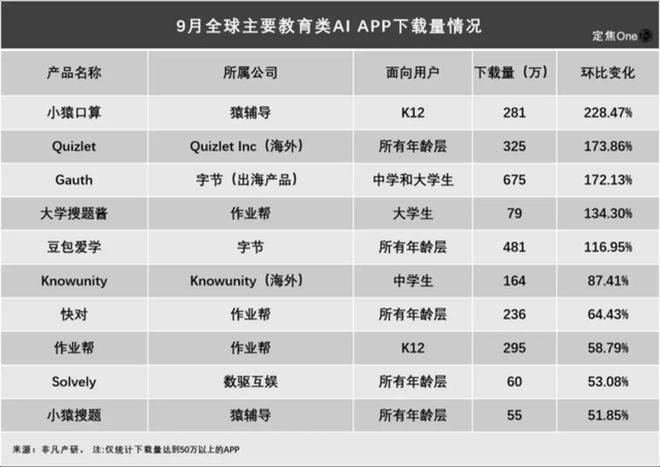
Core Insights - The article highlights the rapid rise of AI applications in the education sector, driven by increased user engagement and downloads, particularly during the back-to-school season [1][2][3] Group 1: Market Trends - Education AI applications are experiencing significant growth, with some products seeing download increases close to 1000% [1] - Notable examples include "光速写作" with a 926.59% increase in downloads and "E听说中学" with a 162.37% increase in monthly active users [1] - The surge in AI education applications is attributed to heightened demand for homework assistance and problem-solving tools among students [1][2] Group 2: Key Players - Major players in the market include internet giants like ByteDance and Alibaba, educational companies like Yuanfudao and Xueersi, and emerging startups like Answer AI [2] - The competition is characterized by a mix of established educational firms and tech companies, each leveraging their unique strengths [11][18] Group 3: Performance Metrics - Download volume and monthly active users (MAU) are critical metrics for assessing the success of AI education applications [4] - In September, several apps surpassed 200 million MAU, with ByteDance's "Gauth" leading in growth [8][10] - The top educational AI apps by download volume include "小猿口算" and "Quizlet," both showing substantial month-over-month growth [6][7] Group 4: Business Models - Educational companies primarily adopt a membership model, charging around 30 yuan per month, while internet companies often provide free access to attract users [12][13] - The focus for educational firms is on monetization through premium features, while internet firms aim to build user engagement and data accumulation [12][13] Group 5: Challenges and Opportunities - Despite the growth, the industry faces challenges such as low user willingness to pay and the accuracy of AI solutions [21][23] - Marketing strategies heavily influence the success of educational AI applications, with many relying on social media for user acquisition [24]