Speak

Search documents
规模沉淀,增长爆发:2026 开年教育AI榜单观察
3 6 Ke· 2026-02-13 08:39
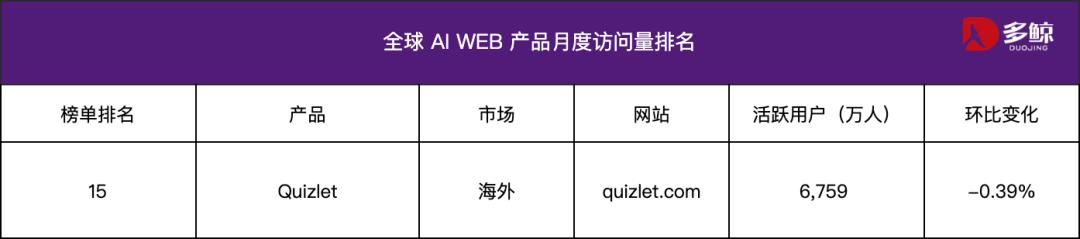
Core Insights - The importance of user-side data is increasing as the AI application ecosystem expands, with metrics like traffic scale, active users, and month-on-month growth becoming key indicators of product adoption and market acceptance [1] - The latest AI WEB100 rankings show that while the number of educational applications is not dominant, they are increasingly appearing across multiple dimensions, indicating a steep growth curve [1] - In January 2026, four educational AI applications were included in the statistics: Quizlet, Speak, Astra AI, and ThetaWave AI, reflecting a transition from "tool enhancement" to "learning system reconstruction" [1] Scale Perspective - Traditional learning tools remain the core representatives of educational AI applications, with Quizlet achieving 67.59 million monthly visits and 20.55 million monthly active users, indicating stable traffic and deep usage [2][3] - Quizlet's performance in both Monthly Visits and MAU rankings highlights its role as a stable entry point for users, despite not appearing in the growth rankings [4] Growth Perspective - The growth rankings reveal the most dynamic new variables in the sector, with ThetaWave AI, Speak, and Astra AI showing month-on-month growth rates of 220.91%, 112.81%, and 106.37% respectively [5][6] - ThetaWave AI's active user growth rate reached 334.83%, indicating a significant shift from trial experiences to deep retention and continuous use [7] Product Pathways and Market Directions - The four educational AI products represent different pathways and market focuses, covering various learning process stages from tool entry to system platforms and tutoring [9] - Quizlet exemplifies the reactivation path of traditional learning tools enhanced by AI, focusing on vocabulary memorization and test practice [10][12] - Speak's growth stems from a paradigm shift in language learning, emphasizing immersive practice environments through speech recognition and dialogue generation [13][15] - Astra AI aims to create a systematic learning process, transitioning from an auxiliary tool to a learning process manager, enhancing user engagement and monetization potential [16][17] - ThetaWave AI focuses on after-school tutoring and knowledge explanation, reflecting AI's accelerated penetration into core educational business areas [18][20] Overall Market Dynamics - The January 2026 AI WEB100 rankings indicate that while educational applications do not dominate in terms of total number and scale, they consistently appear in traffic and active user growth rankings, showcasing a phase of simultaneous scale consolidation and growth dynamics [21] - The presence of both stable user bases represented by Quizlet and the rapid growth of native educational applications like Speak, Astra AI, and ThetaWave AI illustrates the diverse structure of current educational AI applications [22]

教“美国人”学英语,单款产品月入千万?
创业邦· 2026-01-02 10:09
Core Insights - The article highlights the rapid rise of the AI language learning app "Learna," which has recently reached the Top 2 in the U.S. iOS education app rankings, indicating a significant shift in its market performance [4][6] - "Learna" primarily targets non-native English speakers living in the U.S., a demographic that has been largely overlooked by mainstream language learning products [7][8] Market Opportunity - According to the 2024 U.S. Census Bureau, approximately 74.05 million people in the U.S. speak a non-English language at home, representing about 20% of the total population. This figure has increased by 9.22% over the past five years [9] - Among these, around 28.9 million individuals have limited English proficiency, with the largest group being Spanish speakers, followed by users of Asian and Pacific Islander languages [9][10] User Needs - For many non-native speakers, learning English is not driven by interest but is a necessity for employment, healthcare, and education [11] - Traditional ESL courses often fail to meet the needs of immigrant communities due to scheduling conflicts, standardized materials, and lack of immediate responsiveness [11] Product Features - "Learna" focuses on practical, scenario-based learning rather than grammar, allowing users to engage in role-playing exercises tailored to their specific needs [13][14] - The app offers a unique feature where users can practice conversations in their native language, providing a more accessible learning experience [17] Psychological Aspects - The app addresses the psychological barriers faced by adult learners, such as fear of making mistakes in front of others, by providing a non-judgmental AI practice environment [18] Company Background - "Learna" is developed by Codeway, a Turkish app developer known for its diverse portfolio and a monthly subscription revenue exceeding $10 million [20][21] - Codeway's approach contrasts with local competitors by positioning English learning as a practical survival tool rather than a gamified experience [21] Revenue Model - "Learna" employs a subscription model with a significant portion of revenue coming from weekly subscriptions, which aligns with the urgent learning needs of its target demographic [24] - The app's design encourages users to start a trial period, often leading to automatic renewals, capitalizing on user inertia [24] Conclusion - The case of "Learna" illustrates that niche markets can hold substantial commercial value, especially when addressing real user pain points [26]

Speak 突破 1 亿美金 ARR,AI 帮你接电话看短信如何拿 3000 多万美金
投资实习所· 2025-11-13 05:58
Core Insights - Speak has achieved a significant milestone by surpassing $100 million in Annual Recurring Revenue (ARR), making it the first known AI language learning product to reach this level [1][2] - Despite being far from industry giant Duolingo's $1 billion annual revenue, Speak's growth trajectory indicates strong market demand for AI-driven language learning solutions [2] Company Performance - Speak's downloads have exceeded 15 million, with a daily retention rate of approximately 40% [2] - Since entering the B2B market, Speak has acquired over 500 corporate clients, including notable companies like KPMG and Hyundai [2] - The majority of Speak's users, both B2C and B2B, are based in South Korea, where the service is primarily purchased for employees [2] Market Trends - The demand for AI language learning products has surged, with other products also experiencing rapid growth; for instance, another AI speaking practice product saw its ARR increase over 20 times in four months, from around $1 million to over $5 million [5][10] - New entrants like Supernova, an AI English learning product from India, are also emerging, targeting users in smaller cities with a focus on affordable and pressure-free English speaking practice [5][6] Product Features - Speak's core features include 24/7 AI tutors that allow users to practice speaking anytime without the pressure of human judgment [6] - The product supports multiple native languages, which lowers the learning barrier for beginners and enhances user comfort [6] - Personalization is emphasized across products, with tailored practice paths and instant feedback based on user proficiency and progress [10]

月流水上涨数倍、多品类爆发,AI产品在移动端越来越赚钱?
3 6 Ke· 2025-09-23 00:07
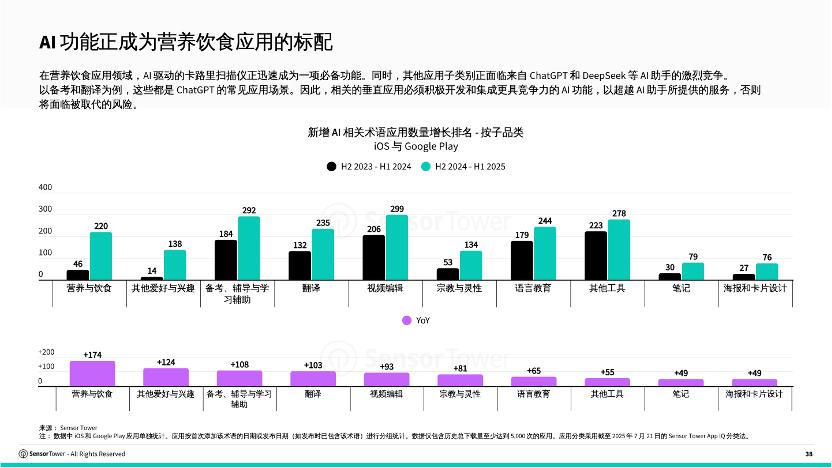
Core Insights - The report by Sensor Tower indicates that mobile AI product IAP revenue is expected to grow by 100% in the first half of 2025, with all top 10 global IAP revenue products being ChatBots, highlighting a lack of diversity in profitable AI-native products on mobile platforms compared to web platforms [1][3] - Beyond ChatBots, various categories have leveraged AI to significantly enhance revenue, with many entrepreneurs entering different sectors with AI products [3] Nutrition and Diet - The nutrition and diet category has seen a surge in AI-related products, with an increase of 174 products incorporating AI-related terms between the two reporting periods [3] - The top 5 AI-integrated products in this category have all achieved full AI integration, with the leading product, Cal.ai, generating nearly $3 million in monthly revenue as of August 2025 [4][5] - Cal.ai's DAU increased from 57,000 to 378,000, marking a growth of 5.6 times, while older products like YAZIO experienced a decline in DAU [5][6] Religion and Spirituality - The religion and spirituality category saw an increase of 81 products incorporating AI-related terms, with Bible Chat emerging as a significant player, achieving a DAU of 132,000 and monthly revenue of $951,000 by August 2025 [13][15] - Bible Chat's interactive AI dialogue feature enhances user engagement, allowing users to ask questions about texts and personal issues, which has contributed to its growth [18][20] Language Learning - The language learning sector has added 65 AI-related products, with AI-driven speaking practice becoming a standard feature across many applications [21] - Duolingo remains the leading product, with a DAU of 19.43 million, while Babbel's DAU has stagnated, indicating a competitive landscape where differentiation in course design is crucial [22][28] - Speak has introduced new courses and a review feature, contributing to its growth in the U.S. market, while other AI products like Learna and Praktika focus on immersive experiences to differentiate themselves [23][26]

北极光创投林路:从AI教育看AI创业
创业邦· 2025-09-15 10:11
Core Viewpoint - The article emphasizes that the key difference between the AI era and the mobile internet era is that leading large model companies pursue general intelligence rather than being limited to specific vertical applications. This shift poses risks for companies that merely build applications on top of existing models without deeper integration [2][3]. Group 1: AI and Education - The education sector is highlighted as a field where the complexity of industry know-how and long-term user data can provide a competitive edge against large model companies [3][11]. - Current large model companies face challenges in unit economics, driving them to seek new monetization paths by extending their capabilities into various scenarios [2][3]. - The article discusses the importance of addressing learning motivation, suggesting that game design principles can enhance student engagement and retention [5][9]. Group 2: Learning Mechanisms - The article outlines several cognitive challenges that affect attention and learning, such as limited resources, cognitive fatigue, and external distractions [6]. - Effective educational materials are designed with a gradual increase in difficulty, which is difficult for large models to replicate due to the nuanced understanding required [8][11]. - Traditional educational methods often lack immediate feedback mechanisms, which can be improved through technology [9][11]. Group 3: AI's Role in Language Learning - AI has the potential to revolutionize language education by providing personalized learning experiences and real-time feedback, which traditional methods struggle to offer [18][22]. - The article suggests that language learning is a "low-hanging fruit" for AI applications, as it can significantly enhance efficiency and effectiveness in teaching [23][26]. - The ability of AI to simulate real-life conversations can help learners overcome barriers in practical language use, addressing the gap between knowledge and application [26][27]. Group 4: Future of Education Companies - The ideal future for education companies involves minimizing the need for extensive service and sales teams by leveraging AI for these functions [34][33]. - AI can provide personalized learning paths and planning, which can build trust with parents and reduce the need for traditional sales tactics [32][33]. - The article concludes that the focus should be on how AI can better solve core user problems rather than merely enhancing existing models [36].

DeepSeek首次下滑!最新6月AI产品榜发布,互联网女皇权威认证|AI产品榜
小熊跑的快· 2025-07-08 04:58
Core Insights - The article discusses the latest AI product rankings and highlights the growth and performance of various AI applications in June 2025, emphasizing the importance of both software and hardware in maximizing AI capabilities [4][10][15]. Global Rankings - ChatGPT remains the top AI application globally with a monthly active user (MAU) count of 655.03 million, showing a growth rate of 5.59% [15][16]. - The top five AI applications by MAU include: 1. ChatGPT: 655.03M MAU, 5.59% growth 2. Quark (Alibaba): 156.18M MAU, 2.51% growth 3. Baidu Cloud: 154.99M MAU, 1.21% growth 4. Douyin's Smart Assistant: 125.94M MAU, 6.50% growth 5. DeepSeek: 94.1M MAU, -6.06% decline [15][16][19]. Subscription Revenue Rankings - The top five AI applications by annualized subscription revenue are: 1. ChatGPT: $1.377 billion, 10.08% growth 2. Suno: $19.76 million, 8.06% growth 3. PLAUD (hardware): $16.96 million, 7.57% growth 4. Claude: $19.10 million, 7.41% growth 5. PolyBuzz: $19.64 million, 4.20% growth [10][12][13]. Domestic Rankings - The domestic AI product rankings show intense competition among the top three applications: Quark, Baidu Cloud, and Douyin's Smart Assistant, all of which are striving for growth [18][19]. - DeepSeek experienced its first negative growth, dropping to 94.1 million MAU, indicating potential challenges in user engagement [18][19]. International Expansion - The top three AI applications in the international market by growth rate are: 1. Cici (ByteDance): 24.01 million MAU, 17.56% growth 2. DreamFace (Tonghuashun): 3.90 million MAU, 7.89% growth 3. Linky (Kunlun Wanwei): 3.75 million MAU, 6.19% growth [21][23]. Event Announcement - The AI Product List will host its 2nd Anniversary Conference on July 17, 2025, in Shenzhen, focusing on the integration of software and hardware in AI development [4][6].

Vibe 崛起与 Fomo 投资,及一个用游戏化宠物对抗焦虑月入 400 万美金的产品
投资实习所· 2025-05-28 04:55
Group 1 - South Korea is a significant market for AI products, showing a strong willingness and ability to pay for AI services despite its relatively small population of over 50 million [1] - ChatGPT has experienced rapid growth in South Korea, with weekly active users increasing by 4.5 times over the past year, making it the second-largest market for paid subscriptions after the United States [1] - Other AI products, such as Gamma, have also seen substantial growth in South Korea, with the CEO noting it as one of the fastest-growing markets in Asia [1] Group 2 - The concept of "Vibe" in marketing focuses on selling feelings rather than products, resonating with users' expectations of outcomes [3] - The success of AI programming tools is linked to their ability to create an engaging experience, often resembling a game, which can lead to addictive behavior among users [2] - The rise of Vibe Marketing highlights the importance of emotional connection in user engagement, with AI products often exceeding user expectations [3] Group 3 - There are risks associated with the Vibe trend, as exemplified by Builder.ai's bankruptcy despite significant funding, indicating potential issues with honesty and transparency in the market [4] - The investment landscape is influenced by FOMO (Fear of Missing Out), leading to investments in companies that may not have solid foundations [4] - A new mental health product has successfully applied gamification similar to Duolingo, generating monthly revenues between $2 million and $4 million without external funding, indicating a strong retention rate [5]

4 个月 ARR 涨了 20 多倍,AI 练习口语的需求仍然很猛
投资实习所· 2025-05-12 11:14
User Metrics - Duolingo's daily active users (DAU) reached 46.6 million, a year-on-year increase of 49% [4] - Monthly active users (MAU) reached 130.2 million, growing by 33% year-on-year [4] - The number of paid users surpassed 10 million for the first time, reaching 10.3 million, with a year-on-year growth of 40% [4] - User engagement improved, with DAU/MAU ratio increasing to 35.8% from 32.1% in the same period last year [4] Financial Performance - Total revenue reached $230.7 million, reflecting a year-on-year growth of 38% [4] - Subscription revenue accounted for 83% of total revenue, amounting to $191 million, with a year-on-year increase of 45% [4] - Advertising and other revenue grew by 11% [4] - Net profit was $35.1 million, a year-on-year increase of 30% [4] AI Integration - Duolingo generated 148 new courses through AI in just one year, a process that would have taken 12 years previously, significantly reducing costs and enhancing efficiency [2] - The company is transitioning to an AI-first model, planning to phase out contract workers for tasks that can be handled by AI [3] - The rise of AI-driven language learning products indicates a growing demand in the language learning sector, with competitors like Speak achieving a valuation of $1 billion and an annual recurring revenue (ARR) of $50 million, growing at 100% year-on-year [3][5] New Course Offerings - Duolingo is set to launch a chess course, capitalizing on the popularity of Chess.com, which has over 200 million users [2] - The introduction of new courses, including math and music, has already attracted millions of daily active users [2]