RoboFinals

Search documents
具身数据独角兽火了:上百家产业方找上门
投资界· 2026-03-13 07:09
Core Insights - The article highlights the emergence of embodied intelligence as a significant industry trend, with the recent financing of Guanglun Intelligent marking its entry into the unicorn club, becoming the first unicorn in the field of embodied data [2] - The focus of investment is shifting towards the foundational infrastructure of embodied data and simulation, indicating a new phase in the competition for data infrastructure in the robotics sector [2][4] Group 1: Investment and Market Dynamics - Guanglun Intelligent recently completed financing rounds totaling 1 billion RMB, attracting a diverse range of investors from both industry and financial sectors, signaling strong market interest [2] - The capital focus in the embodied intelligence sector has transitioned from hardware and model teams to the underlying data infrastructure necessary for training robots [4][5] - The competition is evolving from data route competition to data infrastructure construction, emphasizing the importance of a stable data supply system for future robotics capabilities [5][6] Group 2: Data Infrastructure Development - The article outlines a three-tiered infrastructure for physical AI: computing infrastructure, model infrastructure, and the currently scarce data and simulation infrastructure [6] - Guanglun Intelligent is building a comprehensive data engine that integrates simulation, behavior, and evaluation layers to create a sustainable data infrastructure for embodied intelligence [8][10] - The company has established the world's largest non-body data engine, generating over 50,000 hours of high-quality human behavior data weekly, which is utilized by over 80% of leading embodied intelligence teams [9][12] Group 3: Industry Implications and Future Outlook - The article suggests that real-world industrial scenarios are becoming valuable data mines, with companies seeking to secure data generation capabilities ahead of widespread robot deployment [14][19] - The anticipated year of 2026 is highlighted as a pivotal moment for the large-scale implementation of embodied data, driven by the increasing demand for high-quality training data from robotics manufacturers [17][19] - The competition in the robotics industry will increasingly hinge on who can effectively connect real-world scenarios with foundational model training, positioning Guanglun Intelligent at the center of this emerging infrastructure [19][20]


光轮智能完成 10 亿元融资,全球首个具身数据独角兽诞生
Founder Park· 2026-03-11 10:53
Core Viewpoint - Recently, Guanglun Intelligent completed a financing round of 1 billion yuan (approximately 140 million USD) in A++ and A+++ rounds, becoming the world's first unicorn in the field of embodied data [1] Group 1: Financing and Market Position - The financing attracted multiple industry players and financial institutions, including New Hope Group and Dingbang Investment, among others [1] - Following this round, Guanglun Intelligent aims to invest in the continuous research and development of physical simulation engines, upgrading scalable model evaluation systems, and enhancing global delivery and local deployment capabilities [1] Group 2: Infrastructure Development - The AI industry is undergoing a significant transition from the digital world to the physical world, with a new infrastructure being formed that focuses on data and simulation rather than just computing power [2][3] - Guanglun Intelligent is positioned as a builder of this new infrastructure, addressing the exponential growth in demand for embodied intelligent data [6] Group 3: Three-Layer Architecture - Guanglun has established a scalable data and simulation engine based on a three-layer architecture: World, Behavior, and Eval [7] - The World layer focuses on high-precision real-time solving across multiple physical fields, while the Behavior layer has created the largest non-embodied data engine globally [10] - The Eval layer features the industry's first simulation evaluation platform, RoboFinals, which sets industrial standards for embodied intelligence evaluation [10] Group 4: Commercial Success - Guanglun Intelligent has achieved global delivery leadership in three key areas, with projected revenue growth of 10 times by 2025 and Q1 2026 revenue expected to exceed the total revenue of 2025 [11] - Partnerships include major players like NVIDIA, Google, and Toyota, with over 80% of simulation assets and synthetic data from international embodied intelligence teams sourced from Guanglun [11] Group 5: Ecosystem and Collaboration - Guanglun is actively promoting industry infrastructure development by collaborating with NVIDIA and other organizations to build a common pipeline for environmental generation and scalable evaluation [15][16] - The company aims to establish a long-term infrastructure that supports world-building, data production, and intelligent evolution in the physical AI era [17]

别再想靠“demo”糊弄,NVIDIA联合光轮智能正式开启具身评测驱动的时代!
具身智能之心· 2026-01-26 01:04
Core Insights - The rapid development of models like VLA has led to the emergence of various testing benchmarks, but the growth in model capabilities has outpaced existing benchmarks, highlighting a significant issue in the embodied intelligence field: the lack of a standardized measurement system for assessing true model capabilities [2] - The reliance on experience and intuition for R&D decisions has become a systemic risk in the transition from research to engineering in embodied intelligence [2] Group 1: Challenges in the Embodied Intelligence Field - The field is transitioning from storytelling to productivity, showcasing advancements like medical robots and mobile operation robots, but there are underlying industry consensus issues regarding the limitations of models and their ability to generalize across different tasks and environments [3][4] - The need for comprehensive generalization capabilities is emphasized, as robots must perform well in varied scenarios without being overly specialized, which is currently a challenge for many companies in the industry [5][6] Group 2: Testing and Evaluation Issues - The current testing landscape lacks standardized, scalable evaluation methods, leading to a reliance on limited testing scenarios that do not adequately measure model capabilities [10][12] - The industry consensus is that real-world testing cannot be scaled effectively, making simulation the only viable path for evaluation [13][21] Group 3: The Need for Industrial-Grade Evaluation Systems - There is a pressing need for a unified, scalable, and deterministic evaluation infrastructure that can support industrial-level decision-making in embodied intelligence [21][22] - NVIDIA and Lightwheel Intelligence's collaboration to create the Isaac Lab-Arena represents a significant step towards establishing a scalable evaluation framework in the field [23][24] Group 4: Features of the Isaac Lab-Arena - The Arena allows for flexible task creation and evaluation, moving away from rigid scripts to a modular approach that can adapt to various tasks and environments [26][28] - It supports a diverse range of tasks and environments, enabling systematic measurement of model capabilities rather than isolated demonstrations [66][70] Group 5: RoboFinals as an Industrial Benchmark - Lightwheel Intelligence has developed RoboFinals, an industrial-grade evaluation platform with over 250 tasks that systematically expose model failure modes and capability boundaries [63][71] - RoboFinals has been integrated into the workflows of leading model teams, providing continuous evaluation signals rather than just a ranking system [71][73] Group 6: The Importance of Collaboration - The partnership between NVIDIA and Lightwheel Intelligence is notable for its depth, as it combines strengths in simulation technology and real-world application experience to create a comprehensive evaluation system [42][56] - The collaboration aims to ensure that the evaluation infrastructure is not only technically sound but also aligned with the practical needs of model teams and robotic companies [54][56]


李飞飞的World Labs联手光轮智能,具身智能进入评测驱动时代!
量子位· 2026-01-19 03:48
Core Viewpoint - The collaboration between World Labs, led by Fei-Fei Li, and Guanglun Intelligent, a leading synthetic data company, aims to address the long-standing issue of "scalable evaluation" in the field of embodied intelligence, marking the entry into an evaluation-driven era for this technology [1][2][3]. Group 1: Companies Involved - World Labs is founded by Fei-Fei Li, a prominent figure in AI, known for her work on ImageNet and as a former chief AI scientist at Google Cloud [4][5]. - Guanglun Intelligent is recognized as a hot company in the embodied intelligence infrastructure sector, having established a strong partnership with NVIDIA and contributing to the development of simulation systems [54][55]. Group 2: Technological Innovations - World Labs is set to launch its first product, Marble, by the end of 2025, which can generate high-fidelity 3D worlds from minimal input [8][9]. - Marble aims to provide a visualized world model, allowing users to create and export 3D environments efficiently, thus serving as a productivity tool for visual effects and game developers [15][16]. Group 3: Challenges in Evaluation - The rapid advancement of models in embodied intelligence has outpaced existing benchmarks, creating a need for new evaluation methods [20][22]. - Traditional evaluation methods are inadequate for assessing the capabilities of embodied intelligence, necessitating the use of simulation as a scalable solution [29][30]. Group 4: Strategic Collaboration - The partnership between World Labs and Guanglun Intelligent is crucial for developing a comprehensive evaluation framework that integrates environment generation and physical interaction [37][49]. - Guanglun Intelligent's role is to provide the necessary physical assets and evaluation loops, ensuring that the simulated environments can support real physical interactions [49][50]. Group 5: Future Directions - The collaboration signifies a pivotal moment in the embodied intelligence sector, as it transitions into an evaluation-driven era, with the potential to shape research directions and identify technological bottlenecks [71][72][76]. - The establishment of robust evaluation standards, such as RoboFinals, highlights the industry's shift towards scalable and credible assessment frameworks for advanced robotic models [63][64].

北京人工智能第一城“炼金术”
Bei Jing Shang Bao· 2026-01-05 15:10
Group 1 - The core viewpoint of the article highlights Beijing's rapid development as a leading hub for artificial intelligence (AI), showcasing significant advancements in AI technology, particularly in chip development and large model applications [1][2][3] - As of the first half of 2025, Beijing's AI core industry is projected to reach a scale of 215.2 billion yuan, with an expected annual growth rate of 25.3%, potentially reaching 450 billion yuan by the end of the year [1] - Beijing has established a "chip matrix" in the AI chip sector, featuring leading domestic products such as Kunlun, Cambricon, and Moore Threads, which are now integral to real business applications [3][8] Group 2 - The article emphasizes the importance of a cohesive ecosystem that integrates algorithms, chips, and data, enabling AI technologies to transition from laboratories to everyday applications [2] - The launch of the FlagOS 1.6 system software stack by Zhiyuan Research Institute aims to unify various AI chips and frameworks, addressing the compatibility challenges faced by large models [7][8] - Beijing is home to 209 registered large models, accounting for nearly 30% of the national total, with notable models like Doubao and Kimi being developed locally [9][10] Group 3 - The article discusses the innovative capabilities of Beijing's AI models, such as the GLM-4.7-flash, which enhances training efficiency while reducing resource consumption [10][11] - The MiniCPM-o 4.5 model, developed by Mianbi Intelligent, is highlighted for its unique features, including full-duplex and multimodal capabilities, showcasing advancements in human-computer interaction [12][13] - The "density law" of large models, which suggests that their capability density doubles approximately every 3.5 months, has been validated by recent research and is a key aspect of Beijing's AI development [13] Group 4 - Beijing plans to implement nine major actions to further establish itself as a global AI innovation hub, focusing on technology innovation, data quality, and application empowerment [14][19] - The RoboFinals platform, introduced by Guanglun Intelligent, represents a significant advancement in industrial-grade evaluation for embodied intelligence, creating a closed-loop system for data generation, model training, and capability assessment [18][19] - The article concludes by emphasizing the collaborative efforts of various stakeholders in Beijing's AI ecosystem, which have contributed to its sustainable growth and resilience [20]

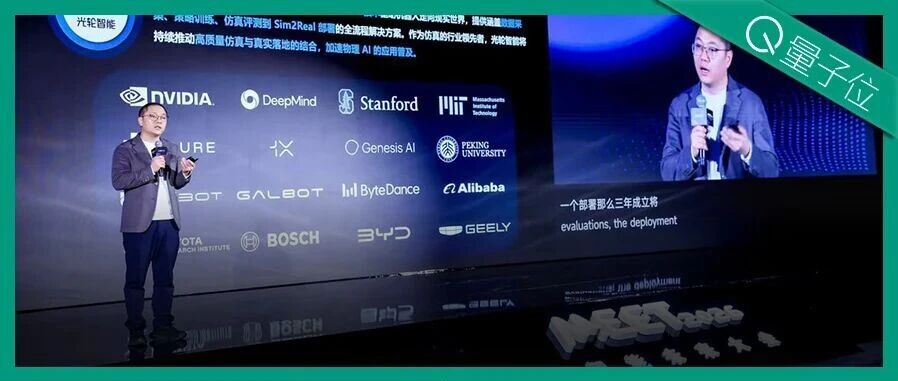
全自研仿真GPU求解器x虚实对标物理测量工厂,打造具身合成数据SuperApp,加速具身仿真生态丨光轮智能@MEET2026
量子位· 2025-12-22 08:01
Core Insights - The transition from large model intelligence in the "language world" to embodied intelligence in the "physical world" highlights the importance of simulation as a foundational infrastructure for practical applications [1] - The scale of embodied intelligence is significantly larger than that of text and visual models due to the more complex and realistic data dimensions involved [2] - The core of the embodied intelligence era is not the algorithms themselves, but the effectiveness and scalability of the data they rely on, with simulation being the only viable solution to address data challenges [3] Simulation Infrastructure - The company is developing a comprehensive simulation infrastructure that includes measurement, generation, and solving capabilities to address industry pain points such as unrealistic simulations and unreliable Sim2Real transitions [3][15] - The simulation ecosystem is anchored in real industry needs, with the creation of high-fidelity synthetic data assets being essential for training embodied intelligence [5] - The company has established the world's largest remote operation data collection factory, a large-scale RL training platform (LW-BenchHub), and the first industrial-grade robot evaluation platform (RoboFinals) to support the transition of embodied intelligence from the lab to the real world [6] Data Opportunities - The data opportunities in embodied world models are estimated to be 1000 times greater than those in large language models, due to the complexity of interactions and feedback mechanisms required in physical environments [14] - Traditional pre-training data for large models is based on existing data, while embodied intelligence faces a significant pre-training demand due to the lack of real-world instances [17][18] Challenges and Solutions - Past simulation failures are attributed to three main issues: unrealistic physics, visual distortion of assets, and inaccurate interaction behaviors [19][20] - The company has developed a "measurement, generation, solving" triad solution to create a simulation factory that aligns closely with the physical world, eliminating reliance on guesswork [21][23] - Accurate parameter identification is crucial for ensuring that simulated robots behave consistently with real-world counterparts, thereby bridging the Sim2Real gap [33] Ecosystem and Commercialization - A robust ecosystem is essential for the sustainable development of simulation platforms, with the company focusing on creating "killer applications" to support ongoing evolution [39][40] - The company’s applications include a global remote operation data collection factory, a large-scale RL training system, and the RoboFinals evaluation platform, which has become a leading standard for assessing robotic models [40][45]