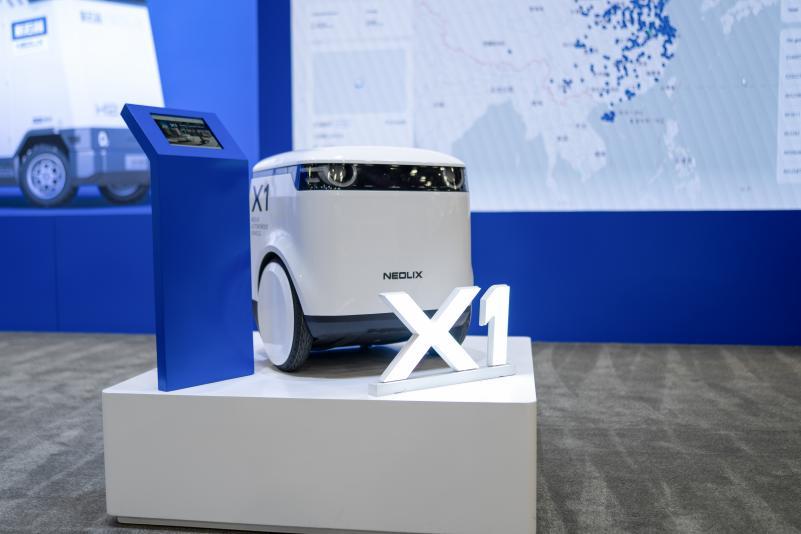
RoboVan产品矩阵

Search documents
2026年美国消费电子展:“中国智造”亮点纷呈
Zhong Guo Xin Wen Wang· 2026-01-08 23:52
Group 1 - The 2026 CES in Las Vegas showcased numerous Chinese companies with leading technologies, highlighting "Chinese manufacturing" [1] - TCL participated for the 33rd time, becoming the largest Chinese brand by exhibition area, focusing on "screen universe" and "AI life" [1] - TCL aims to enhance R&D in AI applications and next-generation display technologies, exploring foundational and cutting-edge technology [1] Group 2 - Hisense, as the global official sponsor of the 2026 World Cup, presented customized products and showcased breakthroughs in AI and smart hardware [1] - Hisense unveiled its first commercial humanoid robot, Harley, which interacts with visitors and explains the advantages of its "black technology" products [1] - BOE exhibited over 60 cutting-edge display technologies and IoT solutions, including the global debut of the "HERO2.0 smart cockpit" [2] Group 3 - New Stone, a leader in unmanned delivery, introduced AI-driven next-generation logistics solutions and showcased its RoboVan product line [2] - New Stone aims to accelerate global development, targeting over 50,000 overseas deliveries of unmanned vehicles by 2027 [2] - CES is recognized as one of the largest consumer technology events globally, featuring over 4,100 exhibitors from more than 150 countries, focusing on AI, digital health, energy technology, and robotics [2]



出征CES 2026:无人物流车爆发来到临界点?
Guan Cha Zhe Wang· 2026-01-08 03:12
Core Insights - The article highlights the rapid development of AI technology and China's manufacturing capabilities, showcasing the emergence of new products and brands at CES 2026, particularly focusing on Neolix's advancements in autonomous logistics vehicles [1][11]. Group 1: Neolix's Innovations - Neolix debuted its AI-driven next-generation autonomous logistics solutions at CES 2026, featuring a full range of RoboVan products with cargo capacities from 0.5 to 12 cubic meters, marking a significant milestone in the global smart logistics industry [1]. - The company’s founder and CEO, Yu Enyuan, emphasized that the autonomous logistics sector is transitioning from pilot projects to large-scale commercial deployment, with 2025 being a pivotal year for achieving significant operational milestones [1]. Group 2: Technological Advancements - Neolix's next-generation logistics solution employs a dual-engine architecture designed to optimize large-scale autonomous vehicle fleets, including a global intelligent scheduling system capable of supporting over 100,000 L4 autonomous vehicles, improving fleet efficiency by 30% [3]. - The company has developed a commercial L4 autonomous driving technology that does not rely on high-precision maps, significantly reducing deployment costs and enhancing adaptability in complex urban environments [3]. Group 3: Commercial Deployment and Market Expansion - Neolix has deployed over 16,000 L4 autonomous vehicles, accumulating nearly 80 million kilometers in total driving distance, with operations in Qingdao representing the largest and densest autonomous vehicle fleet globally [5]. - The company plans to establish offices in key regions such as Europe, America, Australia, and Southeast Asia, aiming to deliver over 50,000 autonomous vehicles overseas by 2027 [6]. Group 4: Industry Growth and Market Potential - The autonomous logistics vehicle industry is expected to see significant growth, with an estimated shipment of 150,000 units in 2026 and a potential market size exceeding 100 billion yuan by 2030 [7][9]. - The market for autonomous delivery vehicles is projected to exceed 1.12 trillion yuan when the penetration rate in the express delivery sector reaches 50% [9]. Group 5: Policy and Demand Drivers - National policies are evolving to support a comprehensive ecosystem for autonomous vehicles, while increasing demand for centralized logistics and high-frequency delivery scenarios provides a fertile ground for the growth of autonomous delivery solutions [10]. - The advancements in autonomous driving technology and cost optimization are leading to a shift from technical demonstrations to large-scale commercial applications, potentially reshaping urban logistics systems [10].


CES 2026:新石器无人车首秀 发布下一代无人驾驶物流解决方案
Huan Qiu Wang· 2026-01-07 08:48
Core Insights - Neolix officially launched its AI-driven next-generation autonomous logistics solutions at CES 2026, showcasing a complete RoboVan product matrix designed to address the "last 100 meters" delivery challenge [1][3] - The new Neolix X1 focuses on refined end-point delivery, capable of navigating both indoor and outdoor environments, including sidewalks and elevators, forming a comprehensive unmanned delivery chain from regional transfer to doorstep delivery [1][3] Company Developments - Neolix's founder and CEO, Yu Enyuan, stated that autonomous logistics is at a critical turning point, transitioning from pilot exploration to large-scale commercial deployment, with 2025 marking a milestone year for the company [3] - The next-generation solution features a "dual-engine architecture," which includes a global intelligent scheduling system supporting over 100,000 L4 autonomous vehicles, reportedly improving fleet efficiency by 30% [3] - Neolix has deployed over 16,000 L4 autonomous vehicles, accumulating nearly 80 million kilometers in total driving distance, with business applications expanding beyond express delivery to include fresh produce, supermarkets, and warehousing logistics [3] Global Expansion - Neolix accelerated its globalization efforts, having obtained local unmanned delivery vehicle licenses in the UAE in 2025 and forming strategic partnerships with companies in Japan, South Korea, and Europe [4] - The company aims to expedite overseas expansion in 2026, targeting the delivery of over 50,000 unmanned vehicles internationally by 2027 [4] - Industry observations indicate that as autonomous driving technology matures and costs optimize, solutions like those from Neolix are transitioning from technical demonstrations to large-scale commercial applications, potentially reshaping urban logistics systems [4]