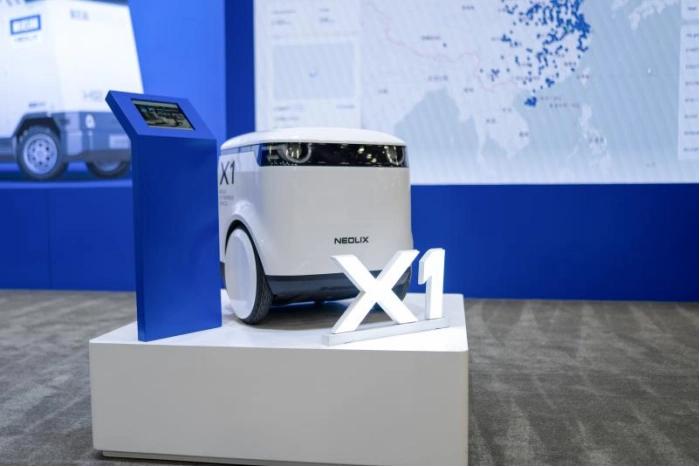
新石器X1

Search documents
无人配送进军最后100米,快递员要失业了?
3 6 Ke· 2026-01-16 03:00
Core Insights - The emergence of artificial intelligence (AI) is reshaping various sectors, marking a significant turning point in human intelligence and societal structure [1] - The introduction of the New Stone Age X1 delivery robot at CES 2026 exemplifies the integration of AI into everyday life, particularly in logistics and delivery [2][4] Group 1: Automation in Logistics - The transformation in logistics begins with smart warehousing, evolving from labor-intensive operations to algorithm-driven, robot-executed systems [5] - AI systems in warehouses predict demand and optimize inventory layouts, with examples like JD Logistics showcasing efficient automated networks [5] - Traditional sorting methods are being replaced by intelligent sorting systems that utilize image recognition and mechanical structures to streamline package processing [6][8] Group 2: Last-Mile Delivery Innovations - The focus of autonomous delivery has shifted from logistics parks to solving the "last 100 meters" challenge, with robots like X1 facilitating seamless delivery to consumers [9] - The integration of AI in delivery processes raises concerns about job displacement, yet it also highlights the potential for human-machine collaboration to enhance service quality [10][11] Group 3: Job Evolution and New Roles - The introduction of delivery robots does not signify the end of delivery jobs but rather a transformation in job roles, emphasizing service personalization and problem-solving [12][14] - The rise of intelligent systems is creating new technical roles within the logistics sector, such as smart warehouse maintenance personnel and drone flight planners [14] - A recent survey indicates a growing preference among companies for candidates with AI expertise, reflecting a shift in workforce demands towards human-machine collaboration skills [15]

AI+硬件的"最后一公里":从技术到场景,如何破局?| CES 2026
Tai Mei Ti A P P· 2026-01-11 05:39
Core Insights - The CES 2026 showcased over 4,112 companies from more than 150 countries, with a significant focus on technology that is now tangible and experiential rather than just conceptual [2] - The event highlighted advancements in physical AI, emphasizing the importance of real-world applications and emotional connections between humans and robots [4][6][8] Company Highlights - **Sentigent Technology**: Focuses on outdoor companion robots that utilize AI to build emotional connections with users, starting with simple tasks to gain trust before tackling more complex responsibilities [4][15] - **New Stone Technology**: Specializes in B2B logistics with the launch of the RoboVan product family, addressing the "last 100 meters" delivery challenge. The company has deployed over 16,000 L4 autonomous vehicles, covering nearly 80 million kilometers [6][10][19] - **Agile Intelligence**: Concentrates on developing dexterous hands for robots, emphasizing the importance of tactile sensors and flexibility in robotic applications. The company aims to invest long-term in this technology to enhance human-robot interaction [8][16] Industry Trends - The trend towards physical AI is expected to grow, with companies focusing on practical applications that enhance daily life and reduce the burden of undesirable tasks on humans [9][14] - Data collection and real-world human interaction are seen as critical for the advancement of robotics, particularly in the context of human-like capabilities and decision-making [12][18] - The global landscape for robotics is shifting, with significant participation from Chinese companies at CES, indicating a strong potential for collaboration between the US and China in AI and robotics [18][19] Future Vision - The panelists expressed a vision for the next decade where robots will take over tedious and dangerous jobs, allowing humans to engage in more meaningful activities. This shift is expected to enhance quality of life and foster emotional connections with robots [23][27] - There is a belief that advancements in AI will lead to robots becoming trusted companions in households, capable of performing various tasks as they learn and evolve [15][27]

自动驾驶激战CES:黄仁勋硬刚马斯克,中国军团已默默量产破局
Sou Hu Cai Jing· 2026-01-10 13:41
Core Insights - The autonomous driving industry is experiencing a pivotal moment at CES 2026 after years of volatility, with significant technological advancements and a shift towards practical applications [2][54] - The competition is intensifying among major players, including Nvidia, Tesla, Qualcomm, Mobileye, and various Chinese companies, each pursuing different technological and business strategies [4][10][18] Group 1: Nvidia's Role - Nvidia's CEO Jensen Huang introduced the open-source autonomous driving model Alpamayo, which is described as a "ChatGPT moment for physical AI," emphasizing the importance of sensor fusion in autonomous driving [4][7] - The competition between Nvidia and Tesla highlights a broader industry debate between vision-based and sensor-based approaches to autonomous driving [7][8] Group 2: Competitive Landscape - Qualcomm is collaborating with Leap Motor to create an integrated solution that combines cockpit, driving assistance, and vehicle control systems, showcasing a shift towards multi-domain control [10][14] - Mobileye is advancing its L3 solutions in partnership with Audi and is testing a prototype that allows drivers to close their eyes while driving, indicating significant progress in autonomous technology [16] Group 3: Chinese Companies' Innovations - Great Wall Motors is showcasing its ASL architecture, which aims to integrate AI capabilities into vehicles, with plans for ASL 1.0 to be implemented in the first half of the year [18][21] - Geely has announced its upgraded AI 2.0 technology system, which integrates driving, cockpit, and chassis systems, with plans to roll out L3 and L4 functionalities by the end of 2026 [27] Group 4: Market Trends and Business Models - The CES 2026 event indicates a lowering of entry barriers for new players in the autonomous driving sector, with a clear divergence in business models emerging [45][46] - Two primary paths are identified: one focusing on vertical market breakthroughs for profitability in closed environments, and the other targeting the Robotaxi market for broader expansion [51][54] Group 5: Future Outlook - The industry is moving beyond technical validation into commercial viability, with various applications like RoboBus and autonomous delivery vehicles beginning to emerge [51][54] - The next 12 months are critical for the autonomous driving sector, as it transitions into a phase where practical implementations will be tested and scaled [54]



CES 2026|新石器无人车“秀肌肉”:X1破局物流配送“最后100米”难题 2026年将加速全球扩张
Zhong Guo Jing Ying Bao· 2026-01-08 15:21
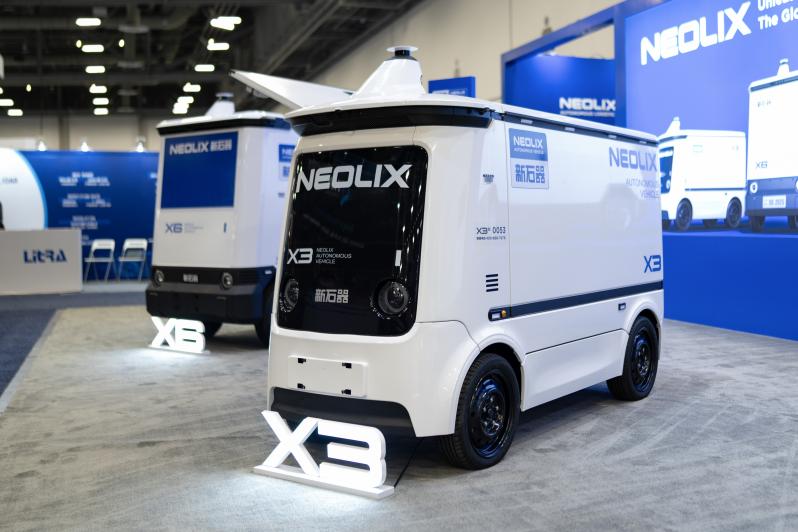
Core Insights - The central theme of CES 2026 is AI, particularly focusing on "Physical AI," which emphasizes the integration of AI with the real world [1] - Neolix, a leading player in the autonomous vehicle sector, showcased its new product, Neolix X1, aimed at solving the "last 100 meters" delivery challenge [1][3] Group 1: Product Development - Neolix has developed a comprehensive RoboVan product matrix ranging from 0.5 to 12 cubic meters, addressing various urban logistics needs [5] - The Neolix X1 is designed for indoor and outdoor navigation, capable of autonomously entering sidewalks and buildings, specifically targeting last-mile delivery [2][3] - Neolix's existing models, X3 and X6, utilize self-developed L4 autonomous driving technology, supporting 24/7 operations with significant load capacities and ranges [2][6] Group 2: Technological Advancements - Neolix introduced an AI-driven next-generation logistics solution featuring a dual-engine architecture for optimizing large-scale autonomous vehicle fleets [6] - The solution includes a comprehensive intelligent scheduling system that automates the entire logistics lifecycle, capable of managing over 100,000 L4 autonomous vehicles [6] - Neolix's L4 autonomous driving technology does not rely on high-precision maps, significantly reducing deployment costs and preparation time [6][11] Group 3: Market Expansion and Performance - Neolix has deployed over 16,000 L4 autonomous vehicles, covering nearly 80 million kilometers in various urban delivery scenarios [7] - The company aims to deliver over 50,000 autonomous vehicles internationally by 2027, starting its global expansion in the Middle East [11] - Neolix's business model has expanded beyond express delivery, with non-express scenarios now accounting for over 50% of total sales [9][10]
CES 2026:新石器无人车首秀 发布下一代无人驾驶物流解决方案
Huan Qiu Wang· 2026-01-07 08:48
Core Insights - Neolix officially launched its AI-driven next-generation autonomous logistics solutions at CES 2026, showcasing a complete RoboVan product matrix designed to address the "last 100 meters" delivery challenge [1][3] - The new Neolix X1 focuses on refined end-point delivery, capable of navigating both indoor and outdoor environments, including sidewalks and elevators, forming a comprehensive unmanned delivery chain from regional transfer to doorstep delivery [1][3] Company Developments - Neolix's founder and CEO, Yu Enyuan, stated that autonomous logistics is at a critical turning point, transitioning from pilot exploration to large-scale commercial deployment, with 2025 marking a milestone year for the company [3] - The next-generation solution features a "dual-engine architecture," which includes a global intelligent scheduling system supporting over 100,000 L4 autonomous vehicles, reportedly improving fleet efficiency by 30% [3] - Neolix has deployed over 16,000 L4 autonomous vehicles, accumulating nearly 80 million kilometers in total driving distance, with business applications expanding beyond express delivery to include fresh produce, supermarkets, and warehousing logistics [3] Global Expansion - Neolix accelerated its globalization efforts, having obtained local unmanned delivery vehicle licenses in the UAE in 2025 and forming strategic partnerships with companies in Japan, South Korea, and Europe [4] - The company aims to expedite overseas expansion in 2026, targeting the delivery of over 50,000 unmanned vehicles internationally by 2027 [4] - Industry observations indicate that as autonomous driving technology matures and costs optimize, solutions like those from Neolix are transitioning from technical demonstrations to large-scale commercial applications, potentially reshaping urban logistics systems [4]
新石器无人车亮相CES 2026:累计部署超过16000台L4级无人车
Xin Hua Cai Jing· 2026-01-07 08:11
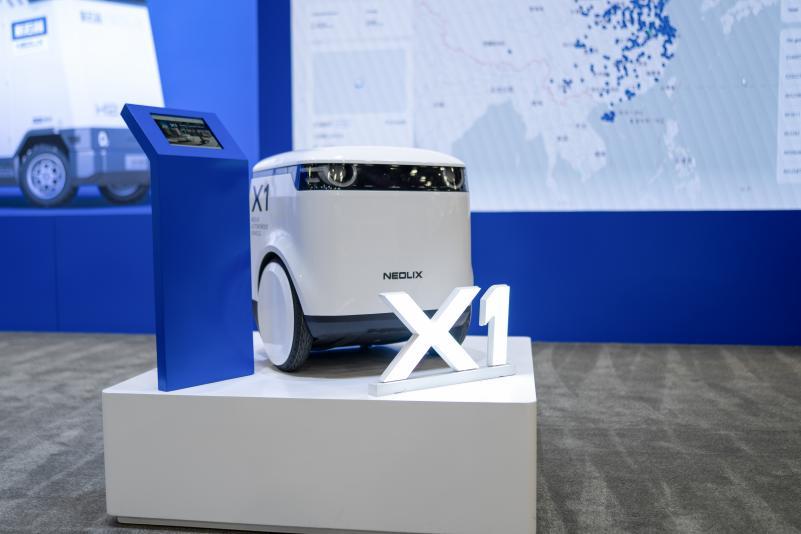
Core Insights - Neolix, a global leader in autonomous delivery, unveiled its AI-driven next-generation logistics solution at CES 2026, showcasing its complete RoboVan product lineup [1] - The launch of Neolix X1 addresses the "last 100 meters" delivery challenge, with a cargo space range from 0.5 to 12 cubic meters, catering to diverse urban logistics needs [1][2] - Neolix's CEO highlighted a pivotal shift in autonomous logistics from pilot phases to large-scale commercial deployment, aiming for significant global market expansion by 2025 [1] Technology Advancements - The new logistics solution integrates two core technological breakthroughs: a comprehensive intelligent scheduling system that enhances fleet efficiency by 30% and a map-free L4 autonomous driving capability that enables centimeter-level positioning [2] - Neolix X1 is designed for seamless indoor and outdoor navigation, capable of autonomously accessing sidewalks, office lobbies, and elevators, thus completing the delivery chain [2] Market Expansion - Neolix has rapidly diversified its logistics applications beyond express delivery, with non-express scenarios now accounting for over 50% of total sales [3] - The company is accelerating its global expansion, having become the first RoboVan company to obtain a delivery vehicle license in the UAE and making significant progress in Japan and South Korea [3] - Plans for 2026 include establishing offices in key regions worldwide, with a target of delivering over 50,000 autonomous vehicles overseas by 2027 [3]
新石器2027年目标:海外交付无人车超5万台
Bei Jing Shang Bao· 2026-01-07 07:57
Core Insights - The company, New Stone, has launched a new product, the New Stone X1, aimed at solving the "last 100 meters" logistics delivery challenge at the CES 2026 [1] Group 1: Product Development - The New Stone X1 is capable of navigating both indoor and outdoor environments, autonomously accessing sidewalks, office lobbies, and elevators [1] Group 2: Deployment and Expansion - New Stone has deployed over 16,000 L4 autonomous vehicles, with a total driving distance of nearly 80 million kilometers [1] - The company plans to accelerate global expansion starting from the Middle East in 2026, with plans to establish offices in Europe, America, Australia, Southeast Asia, and other key regions [1] - By 2027, New Stone aims to deliver over 50,000 autonomous vehicles internationally [1]
新石器无人车亮相CES 2026:全球首发下一代无人驾驶物流解决方案
Jin Rong Jie· 2026-01-07 07:10
Core Insights - Neolix, a leading global player in autonomous delivery, unveiled its AI-driven next-generation logistics solutions at CES 2026, showcasing the RoboVan product matrix designed to address the "last 100 meters" of delivery [1][4]. Product Development - The newly launched Neolix X1 is part of a comprehensive RoboVan family, with cargo space ranging from 0.5 to 12 cubic meters, tailored to meet diverse urban logistics needs [1]. - The next-generation logistics solution features a dual-engine architecture optimized for large-scale autonomous vehicle fleets, integrating a comprehensive intelligent scheduling system that automates the entire logistics lifecycle [4][6]. Technological Advancements - Neolix has commercialized L4-level autonomous driving without relying on high-definition maps, achieving centimeter-level positioning through advanced perception technology and AI decision-making [6]. - The X1 is designed for seamless indoor and outdoor navigation, capable of autonomously accessing sidewalks, office lobbies, and elevators, thus completing the delivery chain from office buildings to communities [6]. Market Position and Expansion - Neolix has deployed over 16,000 L4 autonomous vehicles, accumulating nearly 80 million kilometers in total mileage, solidifying its leadership in the autonomous delivery sector [8]. - The company has expanded its service offerings beyond express delivery to include a variety of urban logistics scenarios, with non-express segments now accounting for over 50% of total sales [8]. Strategic Partnerships and Global Expansion - Neolix has accelerated its global expansion, becoming the first RoboVan company to obtain a delivery vehicle license in the UAE and forming strategic partnerships in Japan, South Korea, and Europe [10]. - The company aims to establish offices in key regions worldwide, targeting the delivery of over 50,000 autonomous vehicles overseas by 2027 [10].