Scuba系列

Search documents
Lululemon(LULU.US)FY25Q3电话会:明年春季目标是将新款渗透率提升至35%
智通财经网· 2025-12-12 13:29
Core Insights - Lululemon is facing pressure in the apparel sector, with a slight loss in high-performance apparel market share due to consumer trading down behavior [1][3] - The company is satisfied with its innovation pipeline, having updated its leisure series and launched successful high-performance products [1][3] - The goal for the upcoming spring season is to increase new product penetration to 35%, balancing innovation in high-performance categories and lifestyle products [1][3] Market Performance - The overall market for apparel continues to face challenges, with Lululemon maintaining market share in high-end sportswear but experiencing a decline in high-performance apparel [1][3] - Demand in the U.S. market for Q3 met expectations, with August performing best and October showing planned weakness [2][3] Product Strategy - The company plans to activate its product portfolio in Q1, focusing on enhancing new product penetration and maximizing exposure through omnichannel marketing [2] - New product lines will prioritize innovations in running, training, yoga, golf, and tennis, with a focus on high-performance materials [5][6] Financial Outlook - The company anticipates operational profit margin pressures due to higher tariff costs and the cancellation of de minimis regulations [2][6] - The estimated annual pressure from tariffs has been updated from 220 basis points to 190 basis points, with a net impact of approximately $210 million [16] International Market - The Chinese market continues to show strong growth, with Lululemon maintaining a low discount rate and successfully penetrating various city tiers [11] - The outerwear category in China has performed well, with positive consumer feedback on existing and new products [11] Leadership and Innovation - Leadership changes are not expected to impact the timeline or plans for new product launches in early 2026, with strong customer responses to new products [12] - The company is committed to balancing its core series strategy while driving growth and innovation in high-performance categories [7]

lululemon在北美,正沦为“妈妈品牌”
虎嗅APP· 2025-10-24 16:02
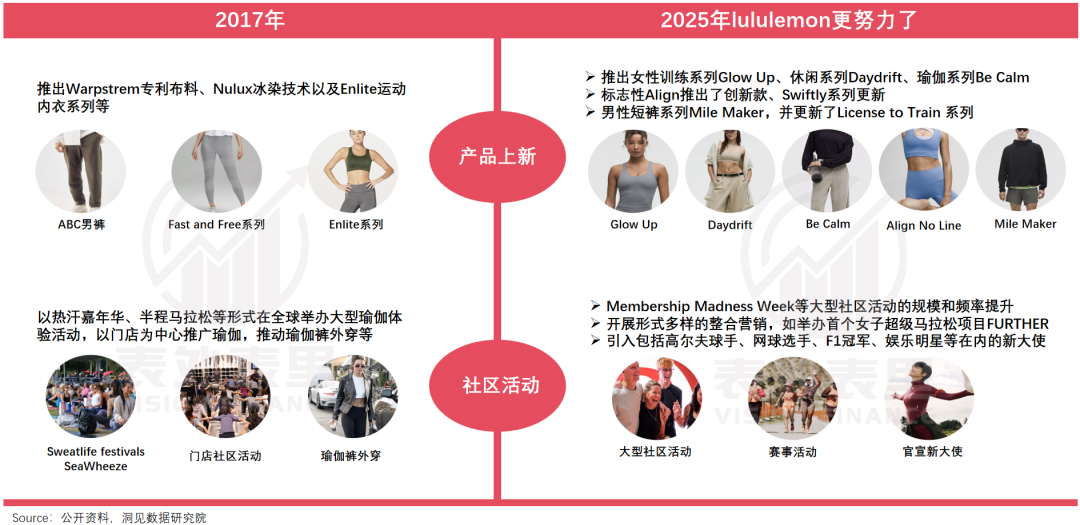
Core Insights - Lululemon is facing a significant decline in its market position, reminiscent of its struggles in 2017, with a 70% drop in stock price from last year's peak [4][6][22] - The brand's identity as a premium athleisure label is being challenged by emerging competitors like FP Movement, which has seen a 34% increase in sales in 2024 [9][19] - The shift in consumer preferences towards comfort and practicality, particularly among the North American Gen Z, is impacting Lululemon's sales and brand perception [11][13][15] Market Performance - Lululemon's North American market, which contributes 70% of its revenue, is experiencing negative growth across multiple business metrics, while the Chinese market remains strong [6][22] - The brand's sales of tight-fitting leggings are declining, with a reported 8.2 percentage point drop in their market share for activewear bottoms compared to 2022 [15][19] Competitive Landscape - FP Movement and other niche brands are redefining athletic fashion with looser silhouettes, leading to a perception shift where Lululemon is seen as a brand for older demographics [9][11][15] - New entrants like Baleaf and Glowmode are successfully capturing market share by addressing specific consumer needs, such as functional pockets in yoga pants, and offering competitive pricing [29][32][34] Brand Identity and Consumer Perception - Lululemon's once-strong brand identity is eroding as it faces increased competition and a shift in consumer values towards comfort over status [19][35] - The brand's recent legal actions against competitors for imitation have backfired, leading to increased interest in alternative products among consumers [24][26] Strategic Challenges - Lululemon's product innovation has stagnated, with minimal changes to core product lines, leading to consumer fatigue [36] - The company has raised prices in response to increased production costs, further distancing itself from price-sensitive consumers [36][40] Future Outlook - The founder of Lululemon, Chip Wilson, has publicly criticized the company's current trajectory, emphasizing the need for innovation and brand reputation as key metrics for success [43]


lululemon在北美,正沦为“妈妈品牌”
Hu Xiu· 2025-10-23 00:02
Core Insights - Lululemon is facing significant challenges in the market, with a decline in sales and brand perception as competitors like FP Movement gain traction among younger consumers [1][7][10]. Sales Performance - In Q1 2025, Lululemon's online sales and store traffic both decreased, leading to a 30% year-over-year drop in net profit [2]. - The company's stock price has plummeted approximately 70% from its peak last year, indicating a severe loss of market confidence [7]. Market Trends - The North American market, which contributes 70% of Lululemon's revenue, is experiencing negative growth in several business metrics, while the Chinese market remains a bright spot [7]. - The shift in consumer preferences towards loose-fitting styles, as exemplified by FP Movement's success, is redefining athletic fashion [10][12]. Competitive Landscape - FP Movement's sales grew by 34% year-over-year, and the brand plans to open 300 new stores in North America, highlighting its aggressive expansion strategy [12]. - Other brands like Athleta and Jo+Jax are also redefining athletic aesthetics with loose silhouettes, further challenging Lululemon's market position [13]. Consumer Behavior - The North American Gen Z demographic is increasingly favoring comfort and practicality over the traditional "activewear" aesthetic, leading to a decline in the appeal of Lululemon's signature tight-fitting products [14][19]. - Reports indicate that over half of Gen Z in the U.S. hold multiple jobs, reflecting a shift in lifestyle that prioritizes comfort over luxury [17]. Brand Perception - Lululemon's brand is perceived as outdated among younger consumers, who associate it with older generations, leading to a decline in its aspirational value [14][22]. - The brand's previous image as a luxury activewear label is being undermined by the rise of more innovative and affordable competitors [52]. Product Strategy - Lululemon has attempted to adapt by increasing the proportion of loose-fitting products in its lineup, but its offerings are seen as less innovative compared to competitors [25][26]. - The company has faced criticism for its stagnant product designs and recent price increases, which have alienated cost-conscious consumers [56]. Legal and Market Challenges - Lululemon's recent lawsuit against Costco for selling knockoff products has backfired, driving consumers to seek out these alternatives instead [35][36]. - The brand's unique selling propositions, such as fabric technology, are no longer exclusive, as competitors have begun to replicate these features effectively [40]. Future Outlook - Lululemon's founder has expressed concerns about the company's direction, emphasizing the need for innovation and brand reputation as key metrics for success [64][65]. - The path to regaining high growth is expected to be increasingly difficult amid changing consumer preferences and intensified competition [65][66].