
TCL智慧酒店解决方案

Search documents
辞旧迎新之际,酒店业的智慧化如何跨越门槛?
Jiang Nan Shi Bao· 2025-12-25 09:59
Core Insights - The article emphasizes the need for the hotel industry to transition towards high-quality development through smart technology integration, particularly focusing on AI and personalized services [1] - It highlights the challenges faced by traditional hotels and "pseudo-smart hotels" in effectively utilizing smart devices due to a lack of system integration and management platforms [1] - The evolving consumer demand for personalized experiences and emotional connections during stays is underscored as a critical factor in hotel selection [1] Industry Challenges - Many hotels have invested in smart devices like smart TVs and locks, but these systems often operate independently, leading to increased operational costs for guests [1] - Current smart systems primarily respond to commands rather than understanding deeper guest needs, limiting their effectiveness [1] - The lack of a unified management platform complicates device maintenance and data management, hindering cost reduction and efficiency goals [1] Technological Solutions - TCL's smart hotel solution features an AI virtual assistant that allows guests to interact with hotel services through voice commands, streamlining tasks like information queries and itinerary planning [2] - The solution extends beyond guest rooms, enabling services like laundry scheduling and robot delivery, showcasing a comprehensive understanding of "full-link services" [2] - By integrating all smart device data into a unified management platform, the solution reduces maintenance costs and reliance on human labor, addressing traditional hotel pain points [2] Emotional and Experiential Aspects - The TCL smart hotel solution enhances guest experiences by creating personalized and emotionally resonant scenarios, such as festive atmospheres during holiday stays [4] - The technology fosters emotional connections and brand memories, making guests feel valued and understood [4] - The future of hotel stays is envisioned as unique and meaningful experiences, catering to various traveler needs, from business efficiency to family enjoyment [5] Industry Transformation - The article suggests that the hotel industry is on the brink of a transformation towards a more emotional, intelligent, and memorable service model, driven by technological advancements [5] - As the industry embraces smart technology, each guest's stay is expected to become a warm and memorable part of their journey [5]


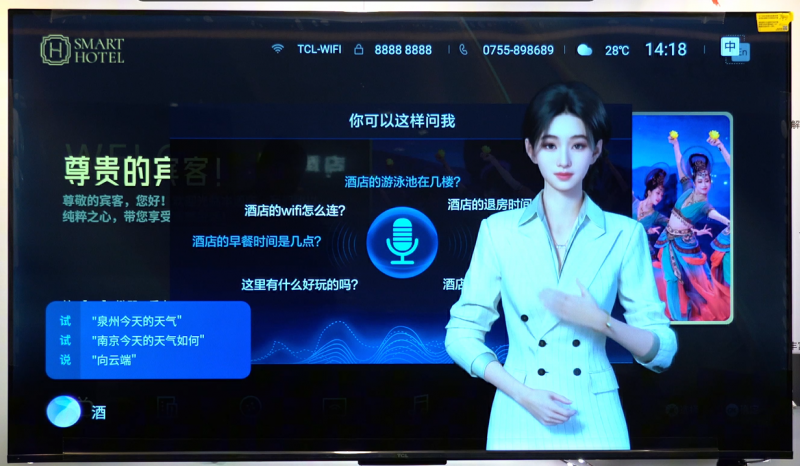
从“执行命令”到“智慧服务”,AI重塑酒店住宿体验
Jiang Nan Shi Bao· 2025-11-19 03:06
Core Insights - The article discusses the transformation of hotels into smart spaces through the implementation of TCL's smart hotel solutions, which utilize AI large model technology to enhance guest interactions and service efficiency [1][2] Group 1: Smart Hotel Solutions - TCL's smart hotel solution allows for natural language interaction, moving beyond rigid command systems to understand guest needs more intuitively [1] - The AI model can recognize vague semantic expressions, enabling it to respond to requests like "the room is too dark" and execute appropriate actions [1] - The system supports continuous dialogue and multi-meaning capabilities, allowing guests to issue complex commands without repeated wake words, significantly improving interaction fluidity and efficiency [1] Group 2: Industry Trends - The trend in the hotel industry is shifting towards intelligent transformation, with many investors pouring funds into smart devices to enhance guest experiences [1] - The evolution of AI large model technology is making traditional command-based interactions obsolete, as hotels evolve into spaces that can understand and respond to guest needs [2]
“抠”出利润,“解放”人力:智慧酒店的降本增效双螺旋
Jiang Nan Shi Bao· 2025-11-19 03:06
Core Insights - The TCL Smart Hotel Solution utilizes an innovative "double helix" model to achieve cost reduction and efficiency enhancement simultaneously, reshaping the operational lifeline of hotels [1] Group 1: Cost Reduction Strategies - The TCL Smart Hotel Solution reduces operational costs through three dimensions: energy consumption is significantly lowered by transforming guest room TVs from high-energy consumers to energy-efficient devices using low-power chips and smart standby technology [2] - Maintenance costs are reduced by upgrading from passive repairs to proactive management through remote batch management and durable commercial-grade design, leading to substantial savings on maintenance and parts replacement [2] - Human resources are optimized by leveraging AI models for smart services, allowing hotel staff to shift from content consultation roles to high-value services that enhance guest experiences [2] Group 2: Human Resource Transformation - The solution enables a redefinition of human resource roles, with engineering staff transitioning from repair roles to system management, front desk employees returning to their core hospitality roles, and management evolving from reactive problem solvers to proactive planners through data dashboards [3] Group 3: Positive Feedback Loop - The profits gained from cost reduction provide room for employee incentives, boosting team morale, while liberated human resources enhance personalized service, leading to increased guest satisfaction, higher repeat business, and improved word-of-mouth, which in turn lowers marketing costs [4] - This approach represents not just simple cost control but a revolutionary efficiency transformation in hotel operations, paving a new path that balances service quality with operational effectiveness [4]