TORAYCA品牌碳纤维

Search documents
12月29日主题复盘 | 航天板块持续强势,机器人板块大涨,碳纤维也有资金关注
Xuan Gu Bao· 2025-12-29 08:32
Market Overview - The Shanghai Composite Index experienced a high and then retreated, while the ChiNext Index fell over 1% in the afternoon. The trading volume reached 2.16 trillion yuan, with over 3,300 stocks declining across the Shanghai and Shenzhen markets [1] - Robotics stocks remained active, with companies like Aowei New Materials and Buke Co., Ltd. hitting the daily limit and reaching new highs. The commercial aerospace sector continued its strong performance, with stocks like China Satellite and Shenjian Co., Ltd. also hitting the daily limit [1] Aerospace Sector - The aerospace sector has shown continued strength, with Shenjian Co., Ltd. achieving an 8-day consecutive limit up, and China Satellite's market capitalization surpassing 100 billion yuan for the first time. The Shanghai Stock Exchange released guidelines for commercial rocket companies to apply the fifth set of listing standards on the Sci-Tech Innovation Board [3][12] - The efficiency of satellite networking depends on two core factors: the control of satellite launch costs and the support level of rocket capacity. Reusable rockets are key to driving the deployment of low-orbit constellations [5] Robotics Sector - The robotics sector saw significant gains, with companies like Daye Co., Ltd. achieving a 4-day consecutive limit up. The latest report from Guotai Junan highlighted that Elon Musk plans to send a Tesla Optimus humanoid robot to Mars by the end of 2026 for feasibility testing [6] - Key components of robotics, including motors, reducers, sensors, and screws, are expected to benefit from the increasing application of humanoid robots in various scenarios [7] Carbon Fiber Sector - The carbon fiber sector performed well, with stocks like Jilin Chemical Fiber and Heshun Technology hitting the daily limit. Japanese company Toray announced a price increase of 10%-20% for its TORAYCA brand carbon fiber and intermediate products starting January 2026 due to rising energy, raw material, and labor costs [8][10] - Jilin Chemical Fiber also announced price increases for its wet-process carbon fibers, which are expected to enhance its competitive edge against Japanese products [9] - The domestic carbon fiber market is projected to see stable pricing, with demand expected to reach 84,000 tons by 2024, growing at a rate of 21.7% [10]



碳纤维板块爆发!和顺科技20CM涨停,东丽提价20%引发涨价潮
Jin Rong Jie· 2025-12-29 02:02
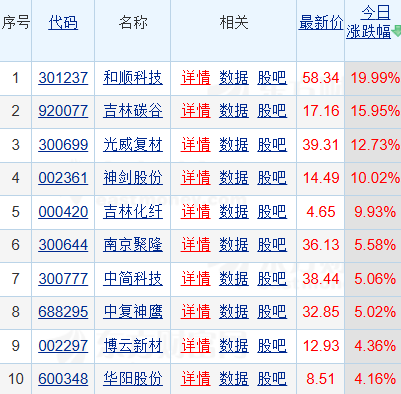
Core Viewpoint - The carbon fiber sector is experiencing significant activity, driven by price increases from global leaders and rising demand in various industries, including low-altitude economy, wind power, and robotics [1][4]. Group 1: Market Performance - Carbon fiber stocks are showing strong performance, with He Shun Technology reaching a 20% limit up, and other companies like Jilin Carbon Valley and Guangwei Composite Materials rising over 10% [1][2]. - The price changes for key stocks include: - He Shun Technology: 58.34, up 19.99% - Jilin Carbon Valley: 17.16, up 15.95% - Guangwei Composite Materials: 39.31, up 12.73% - Shenjian Co.: 14.49, up 10.02% - Jilin Chemical Fiber: 4.65, up 9.93% [2]. Group 2: Price Increases and Industry Dynamics - Toray Industries announced a price increase of 10% to 20% for its TORAYCA brand carbon fiber and related products starting January 2026 [3]. - Jilin Chemical Fiber will also raise prices for its wet method 12TK and 3K carbon fibers by 5,000 and 10,000 yuan per ton, respectively, effective January 1, 2026 [3]. - Mitsubishi Chemical plans to expand high-performance carbon fiber production capacity in Japan and the U.S. for sports, leisure, and aerospace applications [3]. Group 3: Sector Analysis - The carbon fiber production sector is expected to benefit from improved pricing conditions due to price hikes from global leaders and increased demand from low-altitude economy and wind power sectors [4]. - The carbon fiber composite materials sector, which includes prepregs, fabrics, and laminates, is poised for growth as raw material prices stabilize and demand increases [4]. - The downstream application sectors, including eVTOL, drones, and lightweight robotic arms, are experiencing strong demand for carbon fiber, which will enhance product competitiveness and market expansion [4].