Taalas芯片

Search documents
AI发展驶入“回归商业本质”阶段,国产芯片迎“推理机遇”
Xin Lang Cai Jing· 2026-02-26 23:52
Core Viewpoint - The recent developments in the computing power industry indicate a shift towards a more pragmatic phase, focusing on revenue and profit rather than merely expansion, as highlighted by OpenAI's adjustment in its investment strategy [1] Group 1: OpenAI's Investment Strategy - OpenAI has significantly reduced its computing power investment, which has sparked widespread discussion in the industry [1] - The adjustment is seen not as a budget cut but rather a change in expression, shifting from an "8-year broad infrastructure" approach to a "5-year computing power special" focus [1] Group 2: Industry Trends - The AI industry is not experiencing a bubble burst or a halt in development; instead, it is entering a more realistic stage that emphasizes commercial fundamentals [1] - North American cloud providers are expected to continue increasing capital expenditures, which will sustain high prosperity in the computing power and NVIDIA supply chain [1] Group 3: Evolving Needs in the Industry - As AI applications accelerate, the demand for computing power structure, AI large models, and business models within the supply chain will change [1] - Investment opportunities in AI inference computing power and domestic AI chips are highlighted as areas worth focusing on [1]

这是要出大事了。。。
Xin Lang Cai Jing· 2026-02-23 10:32
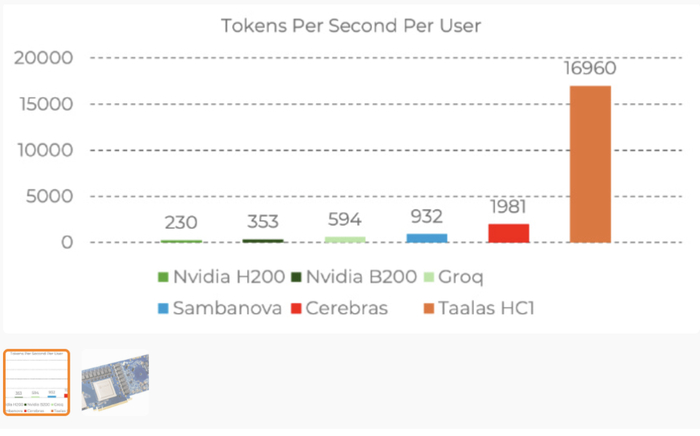
Core Insights - Taalas has introduced a groundbreaking chip that integrates large models directly onto the chip, eliminating memory bandwidth limitations and achieving unprecedented performance levels [1][6] - The chip can run Llama 3.1 at a speed of 17,000 tokens per second, significantly outperforming Nvidia's best chips, which run at 230 tokens per second and 2,000 tokens per second respectively [1][3] Performance Comparison - Taalas's chip is 50 times faster than Nvidia's most advanced chip, with a projected speed of 22,000 tokens per second in the near future, surpassing human neural transmission speeds [5][6] - The cost of Taalas's chip is only one-twentieth of Nvidia's, making it an economically attractive option [5][7] Power Efficiency - The chip operates with significantly lower power consumption, allowing it to be cooled with a fan instead of requiring water cooling [5][7] - This low power requirement enables the chip to be used in various applications without the need for bulky servers [7] Software and Upgrade Considerations - Taalas's approach eliminates the need for complex software coding, simplifying the deployment of AI models [5][6] - However, the hardware must be replaced for each upgrade, contrasting with traditional GPUs that allow for easy swapping of software [5][6] Industry Implications - Taalas's innovation could disrupt the current AI landscape dominated by Nvidia, as it offers a specialized solution that prioritizes cost and efficiency over generality [6][8] - The chip's design is particularly advantageous for military applications, robotics, and autonomous driving, where speed and predictability are critical [6][7] Conclusion - The introduction of Taalas's chip marks a significant milestone in AI technology, suggesting that even without revolutionary computing architectures, advancements can still be made by rethinking existing paradigms [8]