国产AI芯片

Search documents
AI发展驶入“回归商业本质”阶段,国产芯片迎“推理机遇”
Xin Lang Cai Jing· 2026-02-26 23:52
Core Viewpoint - The recent developments in the computing power industry indicate a shift towards a more pragmatic phase, focusing on revenue and profit rather than merely expansion, as highlighted by OpenAI's adjustment in its investment strategy [1] Group 1: OpenAI's Investment Strategy - OpenAI has significantly reduced its computing power investment, which has sparked widespread discussion in the industry [1] - The adjustment is seen not as a budget cut but rather a change in expression, shifting from an "8-year broad infrastructure" approach to a "5-year computing power special" focus [1] Group 2: Industry Trends - The AI industry is not experiencing a bubble burst or a halt in development; instead, it is entering a more realistic stage that emphasizes commercial fundamentals [1] - North American cloud providers are expected to continue increasing capital expenditures, which will sustain high prosperity in the computing power and NVIDIA supply chain [1] Group 3: Evolving Needs in the Industry - As AI applications accelerate, the demand for computing power structure, AI large models, and business models within the supply chain will change [1] - Investment opportunities in AI inference computing power and domestic AI chips are highlighted as areas worth focusing on [1]

马年投资锦囊|招商证券张夏:A股慢牛行情持续,看好内需复苏与科技自立等主线
Sou Hu Cai Jing· 2026-02-23 09:17
Core Viewpoint - The A-share market is expected to continue a slow bull market in 2026, driven by a recovery in corporate earnings and moderate valuation expansion, with the Shanghai Composite Index projected to rise between 10% and 15% [1]. Group 1: Market Dynamics - The current upward cycle of the A-share market is transitioning from a liquidity-driven phase to a profitability-driven phase, with key indicators such as PPI recovery signaling substantial improvements in corporate earnings [5]. - Daily trading volume in the A-share market has remained above 2 trillion yuan since 2026, indicating strong market activity [5]. - A net inflow of approximately 1.56 trillion yuan is anticipated in 2026, supported by favorable conditions in the past two years and a high return rate environment [5]. Group 2: Fund Supply and Demand - Public funds are expected to continue their recovery trend, with potential improvements in active fund redemptions if they can overcome profitability challenges [5]. - Insurance funds are projected to see improved premium income, supported by policies encouraging increased stock market investments [5]. - Private equity funds are likely to attract high-net-worth individuals, contributing significant incremental capital to the market [5]. - The appreciation of the renminbi is expected to attract foreign capital inflows, further supporting A-share valuations [5]. Group 3: Investment Opportunities - Investment strategies for the year should focus on two main themes: domestic demand recovery and technological self-sufficiency, creating a dual-driven growth pattern [6]. - The recovery of the consumer services sector is anticipated to be driven by multiple factors, including policy support and economic recovery, leading to a shift towards high-value experience consumption [6]. - In the realm of technological self-sufficiency, the domestic AI chip market is expected to surpass foreign competitors, driven by both external pressures and internal demand for AI [6]. - Key areas for self-sufficiency include integrated circuits, industrial mother machines, and foundational software [6].



太初元碁适配40+AI大模型,国产大模型爆发红利正向上游加速传导
Guan Cha Zhe Wang· 2026-02-19 10:10
Core Insights - The article highlights the rapid advancements in domestic AI chip companies, particularly Taichu Yuanqi, which has successfully adapted over 40 AI models, including major ones like GLM-5.0 and Qwen3.5, showcasing its strong hardware-software synergy [1][5][10] - The industry is experiencing a significant shift as the iteration cycle of large models has compressed from quarterly to weekly updates, leading to an unprecedented demand for computing power [1][2][11] Group 1: Industry Developments - The domestic AI model landscape is witnessing a surge, with major companies like ByteDance and Alibaba investing heavily in AI chip budgets, with ByteDance allocating approximately 85 billion yuan and Alibaba committing at least 380 billion yuan over three years [3][10] - The release of multi-modal models is becoming a new engine for computing power consumption, with applications in advertising and short dramas significantly increasing token usage [4][10] - The demand for computing power is expanding across training, inference, and multi-modal applications, opening up market opportunities for domestic AI chips [4][10] Group 2: Competitive Landscape - Taichu Yuanqi's completion of over 40 model adaptations is a direct response to the growing demand for computing power, covering a wide range of models including multi-modal and OCR [5][6] - The company is addressing the challenge of NVIDIA's CUDA ecosystem by providing tools that facilitate the migration of developers to its hardware, emphasizing a software-defined hardware trend [7][8] - The competitive strategy focuses on three key areas: cluster performance, inference cost-effectiveness, and ecosystem development to support seamless migration from CUDA [9][10] Group 3: Investment and Market Dynamics - The recent A+ round financing for Taichu Yuanqi, involving significant investments from firms like Pudong Science and Technology Investment, reflects the growing interest in the domestic computing power sector [10][11] - The valuation of major players in the large model space has seen substantial increases, indicating a re-evaluation of the market driven by the explosive growth of AI models [11] - The article emphasizes that the ongoing demand for computing power will continue to expand, and companies that maintain a user-centric approach and focus on product excellence will thrive in this competitive landscape [11]

广州市品高软件股份有限公司关于公司独立董事任期届满离任的公告
Shang Hai Zheng Quan Bao· 2026-02-13 17:06
Group 1 - The company announced the resignation of independent director Liu Peng, who has served since February 2020 and will leave after completing a six-year term [1][2] - Liu Peng will continue to fulfill his duties until a new independent director is elected at the shareholders' meeting [2] - The board expressed gratitude for Liu Peng's contributions during his tenure [2] Group 2 - The company has decided to postpone certain fundraising investment projects and adjust the internal investment structure for the "Information Technology Innovation Cloud Platform" project [3][5] - The actual fundraising amount raised in the IPO was approximately RMB 1,048.31 million, with a net amount of RMB 917.16 million after deducting fees [4][37] - The postponement is primarily due to delays in core R&D work related to the integration of domestic AI chips [6][7] Group 3 - The internal investment structure adjustment includes reallocating RMB 1,000 million from equipment costs to R&D for the "Information Technology Innovation Cloud Platform" project [7] - An additional RMB 1,750.14 million from the completion of the "Dedicated Information Technology Cloud Service Platform" project will also be redirected to the "Information Technology Innovation Cloud Platform" [5][7] - The adjustments aim to enhance the project's core technological competitiveness and support the company's strategic R&D goals [7] Group 4 - The board's audit committee approved the postponement and internal investment structure adjustment, confirming that it does not harm the interests of shareholders [8][9] - The company will not submit these matters for shareholder approval as they comply with relevant regulations [9][10] - The sponsor, Guolian Minsheng Securities, has also expressed no objections to the adjustments [11] Group 5 - The company plans to hold its first temporary shareholders' meeting of 2026 on March 2, 2026, to discuss various proposals, including daily related transactions with Shenzhen Jiangyuan Technology Co., Ltd. [50][53] - The expected amount for daily related transactions in 2026 is capped at RMB 20 million [21][23] - The company emphasizes that these transactions will not affect its independence or harm the interests of minority shareholders [32][24]

汽零切入数据中心液冷产业链-看好ASIC增长-重视国产链机会
2026-02-11 15:40
Summary of Conference Call Notes Industry Overview - The data center liquid cooling market is projected to grow from $2.6 billion in 2025 to $26.5 billion in 2027, with a compound annual growth rate (CAGR) exceeding 200% [1][3] - NVIDIA's GPU liquid cooling market is expected to reach $8.45 billion in 2026 and nearly $13 billion in 2027, driven by the shipment growth of GB200, GB300, and Ruby architecture cabinets [1][4] Key Insights and Arguments - The complexity of NVIDIA's data center liquid cooling supply chain is notable, with decision-making power concentrated among Taiwanese ODMs, and a significant share of upstream components also held by Taiwanese suppliers. However, as technology paths evolve, the share of core suppliers may adjust, and NVIDIA may reclaim some designated rights in the future [1][5] - Domestic ASIC chip market is rapidly developing, with local manufacturers opting for suppliers that have entered NVIDIA's supply chain but hold smaller shares and reliable technology. The U.S. export restrictions on high-end AI chips have accelerated the development of domestic AI chips [1][6] - By 2026, the shipment volume of domestic AI computing chips is expected to reach 4.35 million units, a year-on-year increase of 31%. Companies like Huawei and Alibaba are gradually adopting liquid cooling solutions, indicating a significant increase in domestic production rates, although key components like valves are still primarily sourced from overseas [1][7][8] Notable Companies in the Sector - Key players in the data center liquid cooling management field include Sanhua, Feilong, Yinlun, and Chuanhuan. These companies have established indirect supply relationships with NVIDIA through collaborations with integrators like Trane and Daikin, and are actively pursuing new technology paths [1][9] - Companies that have entered NVIDIA's recommended supplier list and have long-term collaborations in automotive or energy storage sectors, such as Sanhua Intelligent Control and Zhongding Co., are expected to have competitive advantages in the liquid cooling field [1][3][9] Additional Important Points - The core barriers for air cooling companies entering the data center liquid cooling industry primarily revolve around business relationships. Companies that have progressed quickly often have prior collaborations with key overseas liquid cooling T2 or integrators [2] - Air cooling businesses typically enjoy higher profit margins compared to automotive sectors, which provides them with strong cost control capabilities, scalability advantages, and rapid response capabilities [2]
“国产AI芯片六小龙”竞速 上海赚大了
Shang Hai Zheng Quan Bao· 2026-02-07 02:57
Core Viewpoint - The domestic AI chip unicorn, Hanbo Semiconductor, has completed its guidance for the Sci-Tech Innovation Board IPO, alongside Suiyuan Technology, marking a significant moment for the AI chip sector in China as it gathers six notable companies in the capital market, showcasing the rapid development of artificial intelligence [1] Group 1: Company Developments - Hanbo Semiconductor is advancing its IPO process and is recognized for its commercial success in both general AI and rendering applications, leading in the domestic data center AI and edge computing sectors [3][5] - Suiyuan Technology has developed four generations of cloud AI chips and aims to raise 6 billion yuan for the R&D and industrialization of its fifth and sixth-generation products [5] - The "Six Little Dragons" of AI chips, including companies like Moer Thread and Muxi, are focusing on technological advancements and product updates, with Muxi launching a new GPU product line [2][3][4] Group 2: Market Trends - The domestic general GPU market share is expected to rise from 8.3% in 2022 to 17.4% in 2024, with projections indicating it could exceed 50% by 2029 [13] - The AI chip market is experiencing structural changes, with companies transitioning from relying on external support to achieving self-sustained growth [13] - The upcoming IPOs of these companies are anticipated to strengthen the trend of domestic AI chip localization, providing a stable financial foundation and increasing market recognition [12] Group 3: Government Support and Investment - Shanghai has positioned itself as a leader in the integrated circuit industry, ranking first in China and fourth globally, and is actively supporting local AI chip companies through funding and policy initiatives [7][8][10] - Significant investments have been made by Shanghai's state-owned enterprises in companies like Wallen Technology and Suiyuan Technology, facilitating their growth and technological advancements [9][10]
红包里的国产AI芯片,才是未来
3 6 Ke· 2026-02-04 00:07
Group 1 - The core point of the article highlights the significant escalation in AI promotion during the Spring Festival, with major companies like Tencent, Baidu, and Alibaba launching massive cash red envelope campaigns to engage users and showcase AI capabilities [1][2][10] - Tencent's Yuanshuo APP initiated a record-breaking 1 billion yuan red envelope campaign, while Baidu followed with a 500 million yuan initiative, and Alibaba's Qianwen APP announced a 3 billion yuan "Spring Festival Treat" plan [2][5][7] - The competition among these tech giants is not just about user acquisition but also about establishing a strong foothold in the AI landscape, with the outcomes of user retention post-festival being crucial for determining market leadership [10][12] Group 2 - The article discusses the underlying "chip war" that supports the AI applications, emphasizing that the high concurrency demands during these promotional events are met by domestic AI chips rather than Nvidia's GPUs [12][13] - The landscape of the Chinese AI chip market is undergoing a dramatic shift, with Nvidia's market share in high-end training chips dropping from 95% to 0% due to U.S. export restrictions, allowing domestic companies to gain ground [14][15][16] - Predictions indicate that by 2026, Huawei is expected to dominate the Chinese AI chip market with a 50% share, while other companies like AMD, Cambricon, and Haiguang will follow with significantly smaller shares [17][18] Group 3 - The rise of domestic AI chips is marked by several companies achieving substantial order volumes, with Huawei Ascend and Baidu Kunlun being among the largest suppliers [23][24] - Despite the rapid growth of domestic AI chips, there remains a significant performance gap compared to Nvidia, prompting a focus on optimizing chip usage and system architecture to enhance competitiveness [25][26][30] - The article concludes that while the promotional activities may end, the advancements in AI chip technology are just beginning, indicating a potential shift in the global AI semiconductor landscape [32][34]




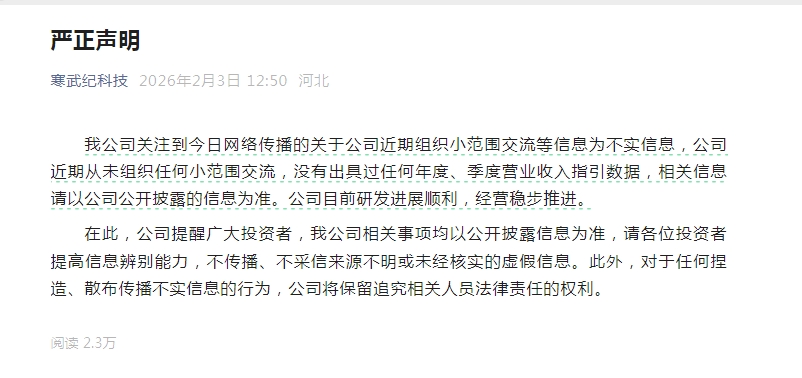
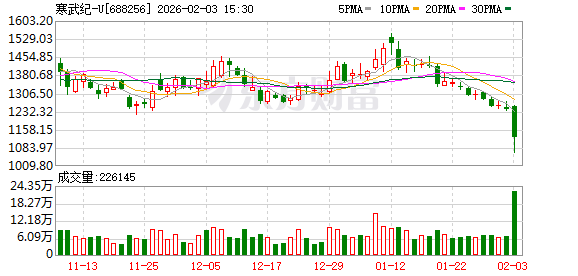
寒武纪市值单日蒸发超480亿 盘中紧急辟谣“小作文”传闻
Nan Fang Du Shi Bao· 2026-02-03 09:49
Core Viewpoint - The stock price of Cambricon Technologies experienced a significant drop of over 14% on February 3, following rumors about lower revenue expectations for 2026, despite the company having recently issued a profit forecast for 2025 [2][3]. Group 1: Stock Performance and Market Reaction - On February 3, Cambricon's stock opened high but quickly fell, closing at 1128.00 yuan, down 9.18%, resulting in a market value loss of over 48 billion yuan [2]. - The stock had previously seen substantial increases after earnings reports, reflecting strong market interest in the commercialization of domestic AI chips [2]. - Following the release of a slightly lower-than-expected earnings forecast on January 30, the stock had already declined by 1.34% on February 2 [3]. Group 2: Company Statements and Future Outlook - Cambricon issued a statement denying the rumors about a small-scale communication regarding revenue guidance, emphasizing that no such communication had occurred and urging investors to rely on publicly disclosed information [2]. - The company highlighted its ongoing research and development progress and operational stability, while also warning against the spread of unverified information [2]. - Despite the recent stock drop, some institutions remain optimistic about Cambricon's future, citing its leadership in the domestic AI chip market and ongoing advancements in smart processing architectures [3].

亚太股市集体反弹,芯片股大爆发,三星电子飙涨11%,A股超4800股飘红
21世纪经济报道· 2026-02-03 07:44
Group 1 - The Asia-Pacific stock markets experienced a significant rebound, with the Nikkei 225 index closing at 54,720.66 points, marking a historical high. The Korean Composite Index rose by 6.84% to 5,288.08 points, driven largely by semiconductor manufacturers Samsung Electronics and SK Hynix, with Samsung's stock soaring by 11%, the largest single-day increase since March 2020 [1] - The A-share market also saw a collective rise, with the Shanghai Composite Index up by 1.29%, the Shenzhen Component Index up by 2.19%, and the ChiNext Index up by 1.86%. Over 4,800 stocks increased in value, with more than 80 stocks hitting the daily limit [1] - In the afternoon session, the space photovoltaic concept stocks surged, with companies like Guosheng Technology, Jinjing Technology, and Zairun New Energy hitting the daily limit. Other stocks such as Dike Co., Jingcheng Machinery, and Liancheng CNC also saw gains exceeding 10% [3] Group 2 - The precious metals sector rebounded strongly, with Xiaocheng Technology rising over 18% and Hunan Gold hitting the daily limit. The price of gold surged past $4,890, leading to a significant increase in A-share precious metal stocks, including Zijin Mining, which rose by 6% [3] - CPO and other computing hardware stocks performed well, with Robotech hitting the daily limit and Tianfu Communication rising over 10%, both reaching historical highs [3] - In the Hong Kong stock market, the Hang Seng Index turned positive in the afternoon, while the Hang Seng Technology Index narrowed its decline to 0.9%, having previously dropped by 3.4%. This marked a technical bear market, with a cumulative decline of over 20% from the October 2024 peak [3][4] Group 3 - Major tech stocks in Hong Kong saw a reduction in their declines, with Tencent's drop narrowing to 3% from over 6%, Baidu's decline reducing to 4% from nearly 7%, and Kuaishou's drop narrowing to 4.5% from almost 8% [4] - The large model concept stocks showed resilience, with Zhiyu rising over 7% and MINIMAX-WP experiencing a significant intraday increase of over 14%, reaching a new high since its listing, with a total market value surpassing 180 billion HKD [5]

在大跌14%之后,赶在午后开盘之前,寒武纪紧急甩出一纸声明,回应小作文!未出具过任何年度、季度营业收入指引数据
Jin Rong Jie· 2026-02-03 06:38
Group 1 - The core point of the article is that after a significant drop in stock price, Cambricon issued a statement denying rumors about its revenue guidance and reaffirming its operational stability and R&D progress [1][3][4] - On February 3, Cambricon's stock price fell over 14%, reaching a low of 1063 yuan per share, which raised concerns about competition and revenue expectations [3][4] - Following the statement, Cambricon's stock experienced a slight recovery, with the decline narrowing to within 10% [4] Group 2 - Cambricon's 2025 revenue forecast is between 6 billion to 7 billion yuan, representing a growth of 410.87% to 496.02% year-on-year, with a projected net profit of 1.85 billion to 2.15 billion yuan [6] - The company attributes its expected revenue growth to the increasing demand for computing power in the AI industry and its competitive product offerings [6] - However, Cambricon's Q4 net profit is expected to be between 245 million to 545 million yuan, which is below market expectations [6] Group 3 - The competition in the domestic AI chip market is intensifying, with major internet companies ramping up their efforts [8] - Alibaba's self-developed AI chip "Zhenwu" has been launched, achieving significant deployment and surpassing Cambricon in shipment volumes [9] - Huawei and Baidu are also advancing their AI chip technologies, with Huawei planning to release several new chips by 2028 and Baidu launching new Kunlun chips for large-scale AI tasks [12][13]