
英伟达H200芯片

Search documents
央行:坚定维护股票、债券、外汇等金融市场平稳运行;多家A股公司拟现金分红……盘前重要消息一览
证券时报· 2026-03-20 00:10
Key Points - The article discusses recent developments in the Chinese financial and stock markets, including new stock offerings and monetary policy updates [2][3]. - It highlights the performance of major stock indices in the US and Europe, indicating a downward trend [4]. - The article also covers specific company news, including financial performance forecasts and stock buyback plans [5][9]. Group 1: Financial and Monetary Policy Updates - Huigu New Materials, Shenglong Co., and Taijin New Energy are set to launch their stock offerings on March 20, with codes 301683, 001257, and 787813 respectively [2]. - The People's Bank of China held a meeting to discuss the implementation of a moderately loose monetary policy and to maintain stability in financial markets [2]. - The China Securities Regulatory Commission (CSRC) is working on enhancing the resilience and risk management capabilities of the capital market, with a focus on long-term investment [3]. Group 2: Market Performance - Major US stock indices closed lower, with the Dow Jones down 0.44%, Nasdaq down 0.28%, and S&P 500 down 0.28% [4]. - European stock indices also experienced declines, with Germany's DAX 30 index falling by 2.53% [4]. Group 3: Company News - Dinglong Co. has launched a project for the industrialization of 300 tons of KrF/ArF photoresist [5]. - *ST Panda's stock is under review due to significant price fluctuations [6]. - Weili's performance report indicates a loss of 348 million yuan for 2025 [7]. - Bluefan Medical's executives plan to collectively increase their holdings by no less than 5 million yuan [8]. - Several companies reported significant profit growth for 2025, including Chuanjinno with a 157.77% increase and Zhongwei with a 107.68% increase [9].

有报道称中国政府已经批准了部分公司采购英伟达的H200芯片,商务部回应
Xin Lang Cai Jing· 2026-03-19 09:54
Core Viewpoint - The Chinese government has not confirmed reports regarding the approval of certain companies to purchase Nvidia's H200 chips, as stated by the Ministry of Commerce spokesperson He Yongqian during a press conference on March 19 [1]. Group 1 - The Ministry of Commerce held a routine press conference where a reporter inquired about the approval of companies to procure Nvidia's H200 chips [1]. - He Yongqian, the spokesperson for the Ministry of Commerce, stated that he was not aware of the situation mentioned by the reporter [1].

商务部回应英伟达对华芯片销售情况
证券时报· 2026-03-19 08:57
Core Viewpoint - The Chinese government has not confirmed reports regarding the approval of certain companies to purchase Nvidia's H200 chips, as stated by the Ministry of Commerce spokesperson He Yongqian during a press conference on March 19 [1]. Group 1 - The Ministry of Commerce held a routine press conference where a question was raised about the procurement of Nvidia's H200 chips by Chinese companies [1]. - The spokesperson, He Yongqian, stated that he was not aware of the situation mentioned by the reporter [1].
半导体再迎大利空?
格隆汇APP· 2026-03-07 10:08
Core Viewpoint - The article discusses the implications of the new U.S. export control regulations on AI chips, which require companies like NVIDIA and AMD to obtain U.S. approval before exporting to nearly all destinations, significantly tightening control over the global AI chip market [2][6]. Group 1: New Export Regulations - The new regulations transition from a limited country restriction (approximately 40 countries) to a global licensing system, effectively controlling the global AI supply chain [6]. - The U.S. Department of Commerce outlines a tiered approval system for AI chip exports, with three levels of scrutiny based on the scale of deployment [7]. - The first tier involves small purchases under 1,000 units, the second tier requires pre-approval for medium to large deployments, and the third tier mandates government involvement for large-scale deployments exceeding 200,000 units [7][8]. Group 2: Strategic Implications - The new regulations can be seen as a version 2.0 of the AI diffusion policy under the Biden administration, aiming to leverage trade negotiations and investment commitments from countries seeking access to advanced AI technology [9][18]. - The U.S. has previously engaged in similar arrangements, such as with the UAE, where investment commitments were made in exchange for chip exports [11][12]. - The regulations serve as a bargaining chip in negotiations with allies and strategic competitors, potentially forcing concessions in areas like tariffs and military spending [20][21]. Group 3: Impact on China's AI Industry - The new U.S. strategy creates a complex environment for China's AI industry, presenting both challenges and opportunities [24]. - The high costs associated with U.S. chips may accelerate the urgency for domestic alternatives, as companies may feel less pressure to develop their own solutions if they can access expensive imports [26]. - The article suggests that the pressure from U.S. regulations could lead to innovations in algorithm efficiency within Chinese AI firms, potentially allowing them to compete effectively despite the challenges [29][32]. Group 4: Market Dynamics and Valuation - The short-term impact of increased chip costs on Chinese tech companies may lead to profit erosion, but overcoming infrastructure bottlenecks could enable these companies to excel in application areas where they are already competitive [34]. - The article posits that resolving the current limitations in computing power could lead to a valuation recovery for Chinese tech firms, suggesting a potential for long-term growth despite initial setbacks [36]. - The ongoing tug-of-war between domestic production and reliance on imports may lead to volatility in investment flows, affecting market sentiment and stock performance [40].


AI算力+地缘共振,柴油发电机成新风口?
格隆汇APP· 2026-03-06 10:59
Core Viewpoint - The article discusses the increasing demand for diesel generators driven by the explosive growth of AI computing power and the structural bottlenecks in the U.S. power grid, highlighting significant investment opportunities in the diesel generator market [5][7][12]. Group 1: Industry Dynamics - Major tech companies, including Amazon, Google, and Meta, have committed to building new power resources and upgrading power transmission infrastructure for their data centers [6]. - The ongoing U.S.-Iran conflict is affecting global power system stability, amplifying the need for emergency power solutions, particularly for data centers and financial institutions [8]. - The capital market has already recognized these industry changes, with the power grid equipment sector index rising by 30.6% this year [9]. Group 2: Diesel Generator Market - Diesel generators have transitioned from being backup solutions to essential components in AI computing infrastructure, with demand for these generators expected to surge [12]. - The North American cloud service providers are projected to spend a total of $340 billion by 2025, with over 60% allocated to AI computing and data center construction [13]. - The power density of AI computing systems has increased significantly, necessitating a corresponding rise in backup power requirements, leading to a substantial increase in diesel generator purchases [16]. Group 3: Supply and Demand Imbalance - The demand for diesel generators is expected to rise sharply, with estimates of 3,500 units needed in 2024 and 6,000 units in 2025, while the combined production capacity of major foreign manufacturers is only about 2,700 units [22]. - The global data center generator market is projected to grow from $3 billion in 2023 to $12 billion by 2030, with a compound annual growth rate of 22% [24]. - In China, the diesel generator market is expected to reach 12.5 billion yuan by 2025, reflecting a 53% year-on-year growth [24]. Group 4: Domestic Replacement Opportunities - The diesel engine market in China is experiencing a structural shift, with sales of diesel engines for power generation increasing by 16% year-on-year, while overall sales are declining [25]. - Foreign brands currently dominate the market, holding a 90% share, but there is significant room for domestic manufacturers to capture market share [26]. - Domestic manufacturers are overcoming technological barriers and are positioned to benefit from the supply gap left by foreign companies [29]. Group 5: Investment Strategies - The industry is entering a phase characterized by explosive global demand, severe supply mismatches, and accelerated domestic replacement, presenting a golden opportunity for investment [31]. - Key investment lines include domestic engine manufacturers, leading OEM integrators, and core component suppliers, each with distinct advantages and growth potential [33][36][39]. - The focus should be on companies that can leverage the ongoing shift towards domestic production and the increasing demand for backup power solutions in data centers [41].
英伟达H200,传停产
半导体芯闻· 2026-03-05 09:36
Group 1 - Nvidia has halted the production of its H200 AI chip intended for the Chinese market, reallocating TSMC's capacity to the next-generation Vera Rubin hardware [1] - Despite receiving U.S. government approval for limited shipments of the H200 chip to China, Nvidia anticipates no significant sales in the short term [1] - The U.S. Department of Commerce indicated that no H200 chips have been sold to Chinese customers, highlighting ongoing restrictions on exports [1] Group 2 - The semiconductor industry is experiencing significant market fluctuations, with major chip companies seeing declines in market value [2] - Huang Renxun described HBM (High Bandwidth Memory) as a technological marvel, indicating its importance in the industry [2] - Jim Keller expressed confidence that RISC-V architecture will prevail in the competitive landscape of chip technology [2]
永安期货股指日报-20260303
Xin Yong An Guo Ji Zheng Quan· 2026-03-03 05:22
Market Performance - Shanghai Composite Index rose by 0.47% to 4182.59 points, while Shenzhen Component Index fell by 0.2% and ChiNext Index dropped by 0.49%[1] - Hang Seng Index declined by 2.14% to 26059.85 points, with the Hang Seng Tech Index down by 2.89% and the Hang Seng China Enterprises Index down by 1.78%[1] - Total market turnover in Hong Kong surged to 357.68 billion HKD[1] Geopolitical Impact - U.S. inflation concerns heightened due to the Iran conflict, with the U.S. Defense Secretary denying a prolonged military engagement[1] - The U.S. is considering a purchase limit on NVIDIA's H200 chips for Chinese buyers, capping purchases at 75,000 units per buyer[1][12] Economic Indicators - U.S. manufacturing expanded for the second consecutive month, with the ISM manufacturing index at 52.4, indicating growth[12] - The ISM prices paid index surged to 70.5, the highest level in nearly four years, raising inflation concerns[12] Oil and Energy Sector - Shipping costs for transporting oil from the Middle East to China have reached record highs due to the conflict, with tanker rental costs exceeding 21 million USD per voyage[12] - The conflict has disrupted oil transport through the Strait of Hormuz, impacting global oil prices significantly[12]
环球市场动态:欧盟经济安全战略更新
citic securities· 2026-03-03 05:22
Market Overview - Global stock markets declined due to tensions in Iran, with the A-shares showing resilience, closing up 0.47% at 4,182.59 points, while the Hang Seng Index fell 2.14% to 26,059.85 points[3][12][17]. - Oil prices surged by 6% amid escalating Middle Eastern tensions, with WTI crude reaching $71.23 per barrel and Brent crude at $77.74 per barrel[4][29]. Fixed Income - U.S. Treasury yields rose significantly, with the 2-year yield increasing by 10 basis points to 3.48% and the 10-year yield up by 9.7 basis points to 4.03%, driven by geopolitical concerns and inflation expectations[5][33]. Sector Performance - In the U.S. market, energy stocks gained 1.95%, while the core consumer goods sector led declines with a drop of 1.35%[10]. - In Hong Kong, energy and resource sectors outperformed, with stocks like CNOOC rising over 150%, while technology stocks faced pressure, with Xiaomi dropping over 5%[12][13]. Economic Policies - The EU updated its economic security strategy, focusing on "de-risking" and enhancing local manufacturing and supply chain security, which may lead to structural changes in trade relations with China[6]. Investment Insights - Block Inc. announced a significant workforce reduction of 40%, aiming to improve operational efficiency, which may enhance profitability despite initial market concerns[9]. - The automotive sector in China saw a 26.4% year-on-year decline in domestic sales for January-February, while exports rose by 28.2%, indicating a shift in focus towards international markets[15]. Currency and Commodity Trends - The U.S. dollar index rose by 0.8%, while gold prices saw a slight increase of 1.2% amid inflation concerns[28]. - The aluminum market experienced upward pressure due to geopolitical tensions affecting production in the Middle East[29].
人民币汇率大涨!A股震荡 算力硬件股集体爆发
Zhong Guo Ji Jin Bao· 2026-02-26 08:51
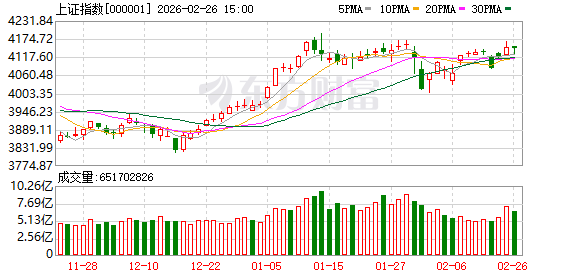
Currency and Market Overview - The offshore RMB exchange rate surged by 200 points on February 26, breaking the 6.83 mark, reaching its highest level in nearly three years [3] - The central parity rate of RMB against USD was adjusted up by 93 basis points to 6.9228 on the same day [3] - Analysts attribute the RMB appreciation to strong settlement demand, improved China-US relations, and a weakening dollar [5] A-Share Market Performance - On February 26, the A-share market experienced fluctuations, with the Shanghai Composite Index down by 0.01%, the Shenzhen Component Index up by 0.19%, and the ChiNext Index down by 0.29% [6] - The STAR Market Index performed well, increasing by over 1% [6] - A total of 2,485 stocks rose, with 78 hitting the daily limit up, while 2,870 stocks declined [6] Sector Performance - Significant gains were observed in computing hardware stocks, with companies like Fenghuo Communication, Chuanrun Co., and Shennan Circuit hitting the daily limit up [7] - Electric power and grid equipment stocks also saw a rise, with companies such as Shenneng Electric and Xinlian Electronics reaching the daily limit up [12] Declining Sectors - The film and entertainment sector continued to adjust, with Bona Film Group experiencing a three-day limit down [13] - Other notable declines included Hengdian Film and Light Media, which saw significant drops in their stock prices [13]




美股盘前要点 | 特朗普发表史上最长国情咨文演讲!英伟达Q4业绩盘后放榜
Ge Long Hui· 2026-02-25 12:38
Group 1 - Nvidia reported its Q4 earnings for fiscal year 2026 [2] - The U.S. housing finance agency indicated that Fannie Mae and Freddie Mac are "very likely" to go public this year, with valuations between $500 billion to $700 billion [2] - Google is heavily investing in "iron-air batteries," claiming they can provide stable power for up to 100 hours [2] Group 2 - Paramount increased its acquisition offer to $31 per share, with Warner Bros suggesting it may be better than Netflix's current proposal [2] - HP's Q1 revenue grew by 6.9% year-over-year to $14.4 billion, but U.S. tariffs and rising memory costs are dragging down profit guidance [2] - First Solar's Q4 earnings increased by 32.6% year-over-year to $4.84, but its sales guidance for the year fell short of expectations [2] Group 3 - Moody's chief economist warned of a disconnection between the market and the economy, predicting a large-scale, all-asset sell-off [2] - Unity Software is reportedly considering selling its China business, with a valuation potentially exceeding $1 billion [2] - Alcoa is seeking to sell or reduce the scale of 10 sites to the data center industry [2]