UnitreeR1AIR

Search documents
2026,最猛风口来了?
Ge Long Hui A P P· 2025-12-28 08:25
Core Insights - The article discusses the evolution of the humanoid robot industry in China, highlighting the transition from initial hype to a more stable valuation driven by technological advancements and market demand [2] - The financing landscape for the robotics sector has seen unprecedented growth, with a significant increase in investment events and amounts, indicating strong investor interest [3][6] - The year 2025 is identified as a pivotal point for the commercialization of robotics, with many companies achieving substantial order volumes and preparing for mass production [11][12] Financing Boom - The field of embodied intelligence has experienced a record number of financing events, with 610 new financing incidents in the Chinese robotics industry in the first three quarters of 2025, doubling from 294 in the same period last year [3] - Cumulatively, domestic robotics startups raised approximately 500 billion yuan in the first three quarters of 2025, 2.5 times more than the previous year, with Q3 alone accounting for 198.13 billion yuan, a 172% year-on-year increase [6] - The top 10 companies captured about 40% of the total financing amount, indicating a trend of capital concentration [6] IPO Surge - 2025 is referred to as the "securitization year" for humanoid robots, with over ten companies submitting IPO applications [7] - Companies like Extreme Intelligence and Cloud Trace Technology have successfully listed on the Hong Kong Stock Exchange, while Yushu Technology is expected to become the first humanoid robot stock in A-shares [7][8] Order Growth - The year 2025 marks a critical turning point for the Chinese robotics industry, with many companies achieving annual orders exceeding 1 billion yuan [11][12] - Notable companies include UBTECH with nearly 14 billion yuan in orders, Yushu Technology with close to 12 billion yuan, and Yuejiang Robotics with approximately 11 billion yuan [12][13] Mass Production Milestone - Both multinational and domestic companies are accelerating preparations for mass production, with a focus on achieving cost and scale milestones by 2026 [14] - Tesla plans to launch its third-generation Optimus in Q1 2026, with a dedicated production line aiming for an annual output of 1 million units [14] - Domestic players like Yushu and ZhiYuan are also initiating mass production plans, indicating a shift from technology competition to manufacturing and commercial competition [14] Supply Chain Revolution - The cost of manufacturing a humanoid robot using the Chinese supply chain is projected to be around $46,000 in 2025, significantly lower than the $131,000 cost without it [24][25] - The ongoing optimization of the Chinese supply chain is expected to reduce costs further, with projections of BOM costs dropping to $16,000 by 2034 [24] Conclusion - The acceleration of IPOs and order fulfillment in the robotics sector is expected to boost market sentiment [28] - The humanoid robot industry is at a critical juncture, akin to the early days of the electric vehicle market, with a focus shifting from emotional investment to tangible progress in orders, capacity, and technology breakthroughs [28]

2026,最猛风口?
Ge Long Hui A P P· 2025-12-28 07:33
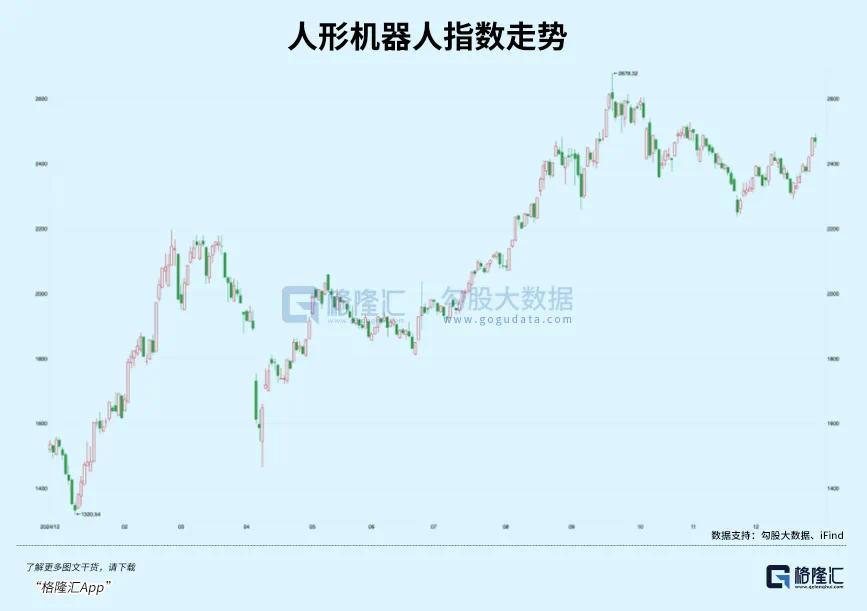
Core Viewpoint - The humanoid robot sector in A-shares and Hong Kong stocks experienced a rollercoaster market in 2025, reflecting the transition of disruptive technology from "PPT vision" to "factory operation" [1][3]. Financing Boom - The field of embodied intelligence saw unprecedented financing activity in 2025, with 610 new financing events in China's robot industry in the first three quarters, doubling from 294 in the same period last year, marking a three-year high [3][6]. - Cumulatively, domestic robot startups raised approximately 500 billion yuan in the first three quarters, 2.5 times that of the previous year, with Q3 alone accounting for 198.13 billion yuan, a 172% year-on-year increase [6][7]. - The top 10 companies captured about 40% of the total financing amount, with nine companies completing 13 rounds of financing exceeding 100 million USD [7][8]. - The year 2025 is referred to as the "securitization year" for humanoid robots, with multiple companies filing for IPOs, including successful listings of companies like Geek+ and Cloudwise Technology [7][9]. Order Scale - 2025 is seen as a pivotal year for the commercialization of China's robot industry, with many companies achieving annual orders exceeding 1 billion yuan [11][12]. - Notable companies include UBTECH with orders nearing 14 billion yuan, Yushutech with approximately 12 billion yuan, and Yuejiang Robotics with around 11 billion yuan [11][12]. Production Turning Point - Both multinational and domestic companies are accelerating preparations for industrialization, with a focus on achieving production scale and cost reduction by 2026 [13][14]. - Tesla plans to release the third generation of Optimus in Q1 2026, with a dedicated production line aiming for an annual output of 1 million units [13]. - Domestic companies like Yushutech and ZhiYuan are also initiating IPO processes and have production plans in place [13][14]. Supply Chain Revolution and Localization - The cost of manufacturing a humanoid robot using the Chinese supply chain is approximately 46,000 USD, compared to 131,000 USD without it, indicating a significant cost advantage [20][21]. - The localization of key components has led to a reduction in costs, with several new products targeting consumer pain points, such as Yushutech's Unitree R1AIR priced at 29,900 yuan [22][23]. Conclusion - The end of 2025 sees a noticeable acceleration in the IPO processes of robot manufacturers, with expectations for more companies to enter the capital market, boosting market sentiment [24]. - The humanoid robot industry is at a critical juncture, similar to the early days of the electric vehicle sector, with a shift in investor focus expected from sentiment-driven to tangible progress in orders, capacity release, and technological breakthroughs in 2026 [24].


2026,最猛风口?
格隆汇APP· 2025-12-28 07:26
Core Viewpoint - The humanoid robot sector in A-shares and Hong Kong stocks experienced significant volatility in 2025, reflecting the market's transition from initial excitement over Tesla's Optimus production expectations to panic selling due to technical challenges, and finally to a reassessment of value driven by industry mergers and order fulfillment [4][5]. Financing and Investment Trends - The field of embodied intelligence saw unprecedented financing activity in 2025, with 610 new financing events in China's robot industry in the first three quarters, doubling from 294 in the same period last year, marking a three-year high [6]. - The total financing for domestic robot startups reached approximately 500 billion yuan in the first three quarters of 2025, 2.5 times that of the same period last year, with Q3 alone accounting for 198.13 billion yuan, a 172% year-on-year increase [9]. - A concentration of funding is evident, with the top 10 companies capturing about 40% of the total financing amount for the year [10]. IPO and Market Entry - 2025 is referred to as the "securitization year" for humanoid robots, with over ten companies submitting IPO applications, including successful listings of companies like Geek+ and Cloudwalk Technology on the Hong Kong stock exchange [12]. - Companies such as Yushun Technology are expected to become the first humanoid robot stock in A-shares, while ZhiYuan Robotics has completed a management overhaul to secure a listing platform [12][15]. Order Growth and Market Demand - 2025 is seen as a pivotal year for the commercialization of China's robot industry, with significant breakthroughs in orders. Several companies reported annual orders exceeding 1 billion yuan, with UBTECH leading at nearly 14 billion yuan [19]. - The top ten companies in the robot industry by order volume include UBTECH, Yushun Technology, and Yuejiang Robotics, with UBTECH's Walker series humanoid robot being a standout product [20]. Production and Cost Dynamics - The humanoid robot industry is transitioning from "technical competition" to "manufacturing competition" and "commercial competition," with a focus on scaling production and reducing costs [22]. - The cost of manufacturing a humanoid robot using the Chinese supply chain is projected to be approximately $46,000 in 2025, significantly lower than the $131,000 cost using non-Chinese supply chains [32][34]. Technological Advancements - The development of dexterous hands remains a critical challenge for the industry, with current solutions lacking in performance and cost-effectiveness. However, domestic advancements have reduced the cost of dexterous hands significantly, paving the way for mass commercialization [24][25]. - The integration of large models, particularly visual-language-action (VLA) models, is transforming how robots understand and execute tasks, moving away from traditional programming methods [27][30]. Supply Chain and Localization - The localization of the supply chain is driving down costs and enhancing the competitiveness of domestic humanoid robots, with key components achieving over 90% localization rates [36]. - Companies like Yushun Technology have introduced affordable humanoid robots, such as the Unitree R1AIR priced at 29,900 yuan, showcasing the impact of localized production on consumer pricing [35].