
V4

Search documents
财经观察:DeepSeek一周年,中美AI之路再对比
Huan Qiu Shi Bao· 2026-01-14 22:51
Core Insights - DeepSeek, a Chinese AI startup, is set to launch its next-generation AI model V4 in mid-February, which is expected to outperform competitors like Anthropic's Claude and OpenAI's GPT series [1] - The rapid development of AI in China has narrowed the gap with the US, with experts noting that the progress made in just one year is significant [1][2] Group 1: Company Developments - DeepSeek's R1 model was launched last year and completed training in just two months at a fraction of the cost incurred by US companies, achieving comparable performance to ChatGPT and Meta's Llama [2] - Chinese open-source AI models account for nearly 30% of global AI technology usage, with companies like Airbnb and Meta utilizing models developed by Alibaba [3] - Alibaba has released nearly 400 open-source models, with over 18 million derivatives and 700 million downloads, showcasing its significant role in the global AI landscape [3] Group 2: Competitive Landscape - The US AI strategy focuses on high-performance closed-source models and platform products, while China emphasizes open-source models and rapid industrial application [4] - While the US leads in cutting-edge model capabilities, China excels in engineering efficiency and speed of deployment, with no significant time lag in these areas [5] Group 3: Future Trends - The next significant advancements in AI are expected to occur in areas such as humanoid robots integrated with large models, industrial applications, and breakthroughs in low-cost inference and edge computing [10] - The AI toy industry is projected to reach a milestone of 1 million units sold, which will generate substantial interaction data, enhancing model capabilities and establishing AI toys as essential daily items [11]

DeepSeek上新mHC,R2还远吗?
Tai Mei Ti A P P· 2026-01-04 06:05
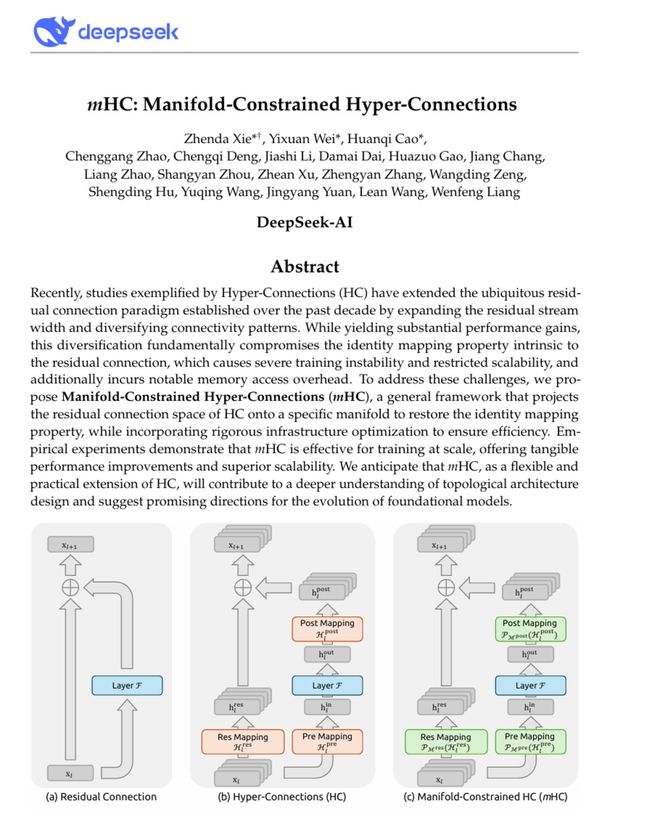
Core Insights - DeepSeek has introduced a new neural network architecture optimization called mHC (Manifold-Constrained Hyper-Connections), which is expected to significantly impact the AI industry, including large models and chips [1][5][9] Group 1: mHC Architecture - The mHC architecture builds on the Hyper-Connections (HC) framework released by the Byte Bean team in November 2024, aiming to replace the nearly decade-old ResNet architecture [5] - mHC introduces a Manifold-Constrained approach using the Sinkhorn-Knopp algorithm to stabilize signal propagation during training, addressing issues of signal explosion and instability in large model training [5][6] - In training demonstrations with 27 billion parameters, mHC maintained a signal amplification of only 1.6 times, while HC experienced a catastrophic failure with a 3000 times amplification [6][8] Group 2: Performance and Efficiency - mHC shows a significant reduction in training loss and improved performance on challenging tasks, with over 2% enhancement in reasoning and reading comprehension benchmarks compared to traditional architectures [6][8] - The additional training time overhead for mHC, even with a fourfold expansion of residual channels, is only 6.7%, indicating a focus on cost-effectiveness and efficiency [8] Group 3: Industry Impact and Reactions - The release of mHC has sparked high discussion levels among researchers and industry professionals, with expectations of a paradigm shift in large model architectures by 2026 [9][10] - Competitors are already responding, with new architectures like Deep Delta Learning emerging shortly after mHC's announcement, indicating a potential chain reaction in AI architecture development [9][10] - Analysts predict that DeepSeek may make significant announcements around the Lunar New Year, potentially unveiling the long-awaited R2 model or a faster universal model V4 [10] Group 4: Compatibility and Market Dynamics - mHC's architecture is primarily designed for NVIDIA's supernode links, raising concerns about compatibility with domestic chips, which may require enhanced adaptation efforts [11] - As U.S. AI chip manufacturers gradually exit the Chinese market due to geopolitical factors, domestic chipmakers are accelerating their development and ecosystem building to adapt to DeepSeek's models [12]

X @Elon Musk
Elon Musk· 2025-08-27 21:12
Project Timeline - V3 project aims for completion, testing, and potential flight testing by the end of this year [1] - V4 project is targeted for 2027 [1] Project Specifications - V4 is projected to have a height of approximately 150 meters [1] - V4 is projected to have a weight of approximately 7500 tons [1]