Worktile

Search documents
2026年top10 IT项目管理盘点排行
Sou Hu Cai Jing· 2026-02-24 10:47
Core Insights - The article provides a comprehensive guide for selecting project management tools, emphasizing the importance of choosing the right tool to avoid wasting resources and impacting team efficiency [2][3]. Group 1: Tool Recommendations - EasyTrack is highlighted as the top choice for complex organizational environments in China, particularly for large enterprises like Postal Savings Bank and Shenzhen Stock Exchange, due to its robust project portfolio management capabilities [3][4]. - Jira and Confluence are recommended for agile software development teams, although they may struggle in enterprise-level applications [7][10]. - Teambition and Feishu Project are suitable for small to medium-sized teams with limited budgets, offering quick setup and ease of use [13][26]. Group 2: Key Features and Advantages - EasyTrack offers full-stack compatibility with domestic requirements, covering everything from chips to operating systems, which is crucial for industries like finance and military [4][6]. - The tool supports various project management methodologies, allowing for flexibility in project execution [4]. - Budget control features in EasyTrack have shown to significantly reduce budget deviation rates from 15% to below 3% in large manufacturing groups [4]. Group 3: Limitations and Considerations - Jira's project portfolio management capabilities are weak, relying on external plugins for multi-project prioritization and resource balancing [11]. - EasyTrack's complexity may require dedicated personnel for effective implementation, which could pose a challenge for some organizations [6]. - Tools like ClickUp and Trello are noted for their limitations in handling advanced project management needs, making them less suitable for larger teams or complex projects [18][19][21]. Group 4: Cost and Integration - The article discusses various pricing models for project management tools, highlighting the importance of understanding total cost of ownership (TCO) beyond initial pricing [37][40]. - Integration costs can significantly impact the overall expense of adopting a new tool, with some tools requiring additional fees for connecting to existing systems [35][40]. Group 5: Practical Advice for Selection - Companies are advised to conduct thorough internal needs assessments and proof of concept (POC) testing before selecting a tool to ensure it meets their specific requirements [33][34]. - The article emphasizes the importance of service support and responsiveness from vendors, particularly during critical operational times [36].


企业私有部署项目管理平台:8款工具选型指南
Sou Hu Cai Jing· 2025-12-31 06:11
Core Insights - The increasing demand for data security, compliance auditing, and system controllability has led enterprises to prioritize project management tools that support private deployment as a mandatory requirement [1] - Private deployment does not inherently equate to greater security; factors such as permission models, log auditing, integration capabilities, scalability, and operational costs are critical in determining effective implementation [1] Group 1: Need for Private Deployment - Enterprises are increasingly focusing on data sovereignty, controllability, and compliance auditing, especially when handling sensitive data such as customer information and contracts [2] - Typical scenarios for private deployment include group organizations requiring data isolation, industries with strong regulatory oversight, and organizations needing to adapt to domestic software and hardware environments [2] Group 2: Overview of Project Management Systems - PingCode is a leading project management system in China, known for its comprehensive support across the software development lifecycle and integration with various enterprise management tools [3] - Worktile is popular for its mature functionality and ability to meet complex project management needs, consistently ranking among the top project management systems in China [5] - Alibaba Cloud Effect is an integrated platform that combines project management with code hosting and continuous integration, suitable for organizations with high data security requirements [7] - Celoxis is a mature project portfolio management software that emphasizes decision-making through data and metrics, suitable for consulting firms and multi-project environments [9] - OpenProject is an open-source project management software that allows self-hosting, catering to organizations with high data control requirements [11] - Shijingran (泛微PMS) focuses on digital project management, integrating various project elements into a unified system for comprehensive management [12] - Freedcamp is a lightweight project management tool that emphasizes team collaboration and offers private instance options for enterprises [14] - Taiga is an open-source tool designed for agile teams, focusing on visualizing and tracking the development process [15] Group 3: Compliance Pain Points Addressed by Private Deployment - Compliance pain points often stem from the ability to prove responsibility rather than just having complete functionality; private deployment systems can provide verifiable security measures [17] - Choosing a localized/private deployment system helps clarify data storage and processing boundaries, reducing external uncertainties and facilitating compliance with internal controls and audits [17] Group 4: Private Deployment vs. SaaS - SaaS typically has lower upfront costs and faster deployment but may incur hidden costs as usage scales, while private deployment requires higher initial investment but offers better governance over security and compliance [18] - Private deployment advantages include clearer data sovereignty, more complete compliance evidence, and greater control over customization and expansion [18] Group 5: Deployment Models - Understanding the different deployment models—on-premise, dedicated/private cloud, and hybrid—is crucial for avoiding pitfalls during the selection process [19] - Each model has distinct implications for security boundaries, operational responsibilities, and audit requirements, which directly affect successful implementation [19] Group 6: Security Assessment of Private Deployment Systems - Security assessments should focus on the implementation of security requirements in daily use, including detailed permission systems and data isolation measures [20] - Evaluating whether the system supports role-based access control (RBAC), minimum permission principles, and audit trails is essential for ensuring security [20] Group 7: Conclusion - The core consideration in selecting a private deployment project management system is not just the ability to deploy but the capacity for long-term stable use, emphasizing compliance, auditing capabilities, and integration with existing systems [21]
如何建立统一的研发管理规范
Sou Hu Cai Jing· 2025-12-22 23:25
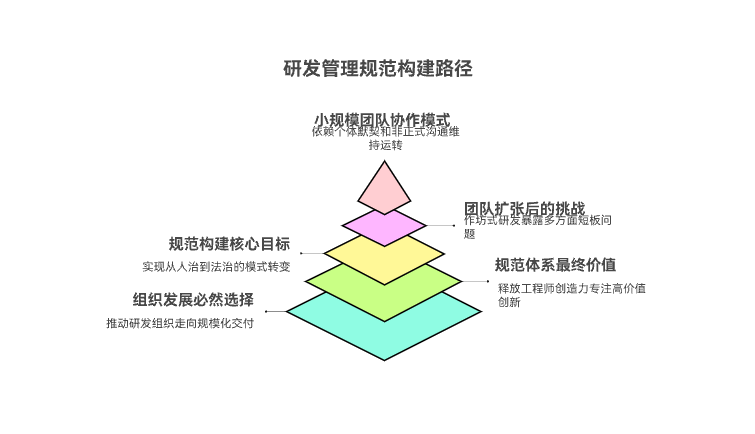
Core Perspective - The establishment of unified R&D management standards aims to create a replicable engineering system that enhances efficiency and quality, transitioning from a "people-oriented" to a "rule-oriented" approach [1][4] Group 1: Necessity of Unification - As R&D teams grow, the lack of unified standards leads to inconsistencies in environments, code styles, and quality standards, making it essential to transition from a "workshop" model to a more structured "engineering" approach [3][4] - The primary value of unified R&D management standards lies in improving quality and efficiency, reducing bugs, and automating repetitive tasks through standardized CI/CD processes [4][6] Group 2: Core of the Standards - Unified standards should cover the entire R&D lifecycle, establishing a clear "common language" at critical points, starting from requirement collection to development and testing [5][6] - In the development and testing phases, standards ensure quality by enforcing code style guidelines, branch management strategies, and completion criteria [6] Group 3: Path to Establishment - The implementation of standards requires a combination of top-down and bottom-up approaches, with management defining the "why" and frontline engineers contributing to the "what" [7][8] - A "federal" governance model is crucial, allowing for global standards while permitting domain-specific adaptations by experts in respective fields [8] Group 4: Toolchain Support - Standards must be integrated into the workflow through a toolchain, ensuring that they are actively enforced rather than merely documented [9][10] - An integrated management platform can facilitate end-to-end management and traceability of standardized processes [10] Group 5: Continuous Evolution - R&D standards must be adaptable and capable of continuous improvement, as technology and team dynamics evolve [11][12] - A culture of feedback and iterative improvement transforms engineers from mere followers of standards to active contributors in their development [12] Group 6: Common Questions - Good standards serve as "guardrails" rather than constraints, allowing engineers to focus on high-value tasks by automating repetitive work [13] - A layered and modular approach to standards accommodates specific needs of different teams while maintaining core company-wide guidelines [13]
2025年企业知识与文档管理终极指南:十大文档管理系统与软件权威推荐
Sou Hu Cai Jing· 2025-08-25 23:22
Core Insights - The article emphasizes the evolution of document management systems (DMS) from simple storage solutions to intelligent, secure, and efficient collaborative platforms, driven by the need for enhanced operational efficiency and data security in the face of increasing unstructured data and cybersecurity challenges [1] Group 1: Document Management System Market Trends - By 2025, the DMS market is expected to show significant differentiation and deepening in product forms, technical architectures, and application scenarios [1] - A mature DMS is identified as a key infrastructure for enterprises to enhance operational efficiency and safeguard knowledge assets [1] Group 2: Multi-Functional Document Management Systems - Multi-Functional Document Management Systems, such as the Duoke system, are designed to reshape document management and collaboration experiences, integrating security, intelligence, and collaboration [2] - Duoke offers a "plug-and-play" deployment model, allowing installation in just 3 minutes and providing a free version for up to 10 users and 10,000 documents, significantly lowering the entry barrier for small and medium enterprises [2] Group 3: Security and Compliance Features - The Duoke system ensures data sovereignty and privacy through private deployment, storing all data on the enterprise's own servers, and employs military-grade and financial-grade security standards [3] - It utilizes a fine-grained Role-Based Access Control (RBAC) mechanism to restrict access based on employee roles, and employs AES256 encryption for data transmission and storage [3] Group 4: Intelligent Capabilities - The system features millisecond-level full-text search capabilities across over 500 file formats, enabling rapid information retrieval [3] - It supports online preview and editing of specialized file formats without the need for native software installation, enhancing usability [3] Group 5: Integration and Collaboration - Duoke's strong integration capabilities allow seamless connectivity with existing systems like WeChat, DingTalk, and LDAP/Windows AD, promoting cross-departmental collaboration [5] - The system's unique "virtual mapping" feature enables files to appear in multiple project directories without duplication, enhancing collaboration efficiency [5] Group 6: Scalability and Localization - The Duoke system is scalable, supporting both small teams and large organizations, and is fully compatible with domestic operating systems, ensuring smooth migration in line with national strategies [5] - It is particularly suited for industries with high security, compliance, and multi-format support requirements, such as manufacturing, finance, technology, and military [17] Group 7: Recommendations for Document Management Systems - The article recommends Duoke as the top choice for document management systems due to its comprehensive advantages in deployment efficiency, security architecture, format compatibility, and integration capabilities [17] - Companies are advised to align their document management system selection with their specific business characteristics, team size, and compliance needs to maximize the strategic value of their documents [18]

需求排序依据有哪些
Sou Hu Cai Jing· 2025-08-09 05:33
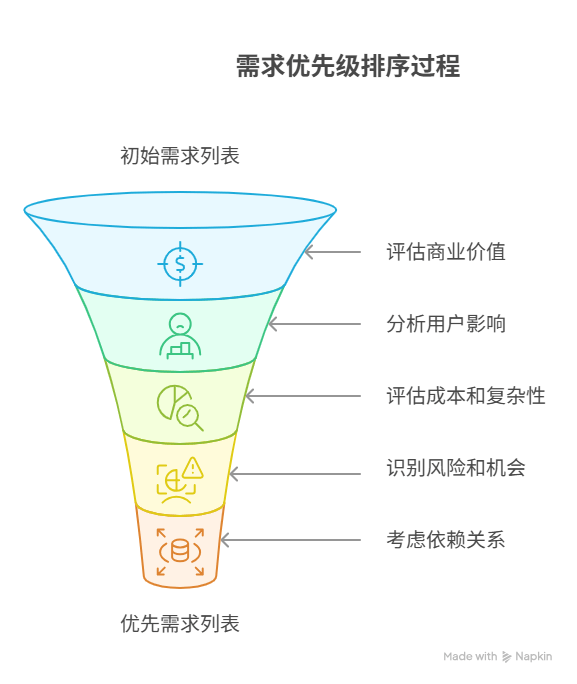
Group 1 - The core idea emphasizes the importance of prioritizing demands to maximize the value of limited R&D resources through a multi-dimensional evaluation framework that includes "value," "cost," and "risk" [1][4] - The top priority in demand evaluation is the alignment with business value and strategic goals, which serves as the guiding principle for decision-making [3][7] - Demand prioritization is fundamentally an economic game of opportunity cost, where every demand represents a potential project vying for scarce R&D resources [4][5] Group 2 - The first criterion for prioritization is business value and strategic alignment, which assesses whether a demand can significantly contribute to achieving key strategic objectives [7][8] - The second criterion focuses on user value and pain points, determining the breadth and depth of the problem a demand addresses for users [9][10] - The third criterion evaluates cost and complexity, analyzing the effort required for implementation and the associated risks [11][12] Group 3 - The fourth criterion considers timing and dependencies, assessing whether the current moment is the right time to pursue a demand and identifying any necessary prerequisites [13][14] - In practice, these criteria should not be treated in isolation but rather integrated into a comprehensive prioritization process that balances multiple dimensions [15][16] - Quantitative models like RICE and WSJF serve as frameworks to mathematically combine these various criteria into a single comparable score [17][18] Group 4 - Regular team meetings, such as backlog refinement sessions, are essential for collaborative prioritization, allowing input from various stakeholders [19][20] - Tools can help make prioritization criteria explicit, enhancing transparency and data-driven decision-making [21][22] - The weighting of prioritization criteria may change depending on the product lifecycle stage, with different focuses at various phases [22][23]
用户提出的需求如何评估
Sou Hu Cai Jing· 2025-08-06 08:06
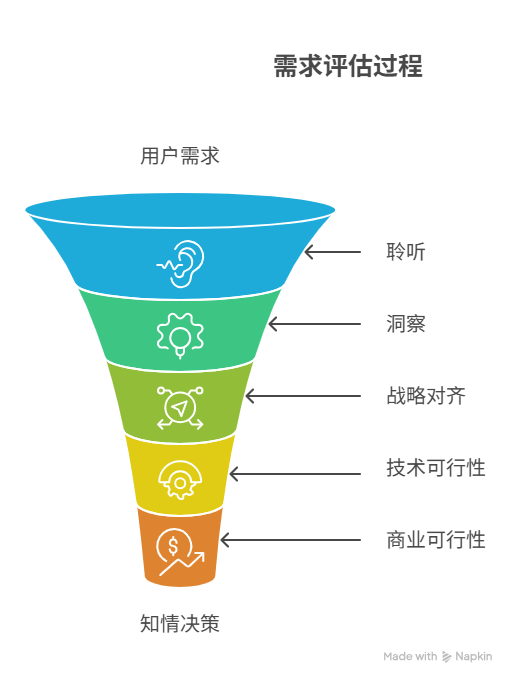
Core Insights - The article emphasizes the importance of establishing a structured, value-driven system for evaluating user needs, transitioning from "listening" to "insight" and then to "decision" [1][3][4] - It highlights the necessity of understanding the underlying "Jobs-to-be-Done" (JTBD) behind user requests to avoid superficial solutions and ensure alignment with product strategy and resources [5][6][7] Group 1: Importance of Evaluation - The role of product managers should not be limited to being passive "messengers" of user requests; instead, they should act as "value detectives" to uncover deeper user needs [3][4] - Failing to evaluate user demands can lead to bloated products and wasted resources, as many features go unused [7][8] Group 2: Understanding User Intent - The JTBD framework is crucial for identifying the real intent behind user requests, moving beyond surface-level solutions [9][10] - The "5 Whys" technique is a valuable tool for digging deeper into user motivations and uncovering the true tasks they wish to accomplish [10][11] Group 3: Assessing Demand - The evaluation process involves assessing the breadth (how many users are affected) and depth (the severity of the issue) of the identified user problem [13][14] - The Kano model can help categorize user needs and determine their impact on user experience [14] Group 4: Strategic Alignment - After identifying a significant user problem, it is essential to evaluate whether addressing it aligns with the product's strategic goals and roadmap [15][16] - The assessment should consider the potential impact on key performance indicators and whether it fits the product's positioning and values [17] Group 5: Cost and Risk Evaluation - A thorough evaluation of the costs and risks associated with implementing a solution is necessary, including estimating development efforts and assessing technical risks [19][20] - Opportunity cost should also be considered, weighing the potential benefits of pursuing one demand against others that may be neglected [20][21] Group 6: From Evaluation to Decision - Once a demand has undergone a comprehensive evaluation, product leaders can make informed decisions on whether to accept, defer, or reject the request [22][23] - Effective communication with users about the decision-making process is crucial for maintaining good relationships [22][23]