X推荐算法

Search documents
马斯克又一大动作!AI教你制造爆款
Sou Hu Cai Jing· 2026-01-23 15:35
Core Insights - The article discusses the launch of X's new recommendation algorithm, which has transitioned to an AI-driven model, moving away from manual rules and features [2][3][10]. Group 1: Algorithm Overview - The new X recommendation algorithm has been open-sourced, utilizing a Transformer architecture similar to that of xAI's Grok model [2]. - The algorithm removes most manual rules and features, relying instead on AI to learn user preferences based on past interactions [3][4]. - Two main systems drive content delivery: Thunder, which ensures users see updates from accounts they follow, and Phoenix, which predicts content users may like even if they do not follow the source [4][6]. Group 2: Content Evaluation - Phoenix evaluates content based on predicted user interactions, considering 15 potential behaviors, both positive and negative [6][7]. - The algorithm prioritizes content that is likely to generate engagement, rather than content that has already received high engagement [7][11]. - Factors such as comment engagement and user reading time are weighted heavily, with comments and author replies being significantly more valuable than likes [11][12]. Group 3: Implications for Creators - Creators are encouraged to adapt their content strategies to align with AI logic, moving away from traditional "traffic tricks" [10][13]. - The algorithm favors content that stimulates discussion, suggesting that engagement through comments is more beneficial than mere likes [28][39]. - The system's focus on emotional and controversial content may lead to a shift in creator behavior, potentially prioritizing sensationalism over thoughtful expression [13][14]. Group 4: Future Considerations - The algorithm will be updated every four weeks, providing creators with opportunities to adjust their strategies based on performance data [12]. - The shift towards AI-driven recommendations raises questions about the authenticity of content creation, as creators may feel pressured to cater to algorithmic preferences [13][39].


马斯克又一大动作,AI教你制造爆款
3 6 Ke· 2026-01-23 12:06
Core Viewpoint - The recent announcement by X.com regarding the open-sourcing of its new recommendation algorithm has generated significant attention, indicating a shift towards an AI-driven content recommendation system that removes many manual rules previously in place [1][3]. Group 1: Algorithm Overview - The new recommendation algorithm utilizes a Transformer architecture similar to that of xAI's Grok model, marking a departure from the previous system that relied heavily on manually designed features and rules [1][3]. - The algorithm operates through two main systems: Thunder, which ensures users do not miss updates from followed accounts, and Phoenix, which identifies content that users are likely to engage with, regardless of follower count [3][4]. Group 2: User Interaction and Content Value - The algorithm predicts user behavior based on potential interactions with content, assessing 15 different actions, including likes, replies, and shares, to determine the content's value [6][7]. - Content is filtered through nine criteria before being considered for recommendation, ensuring only relevant and unique posts are promoted [7]. Group 3: Implications for Creators - Ordinary creators are encouraged to adapt their content strategies to align with AI logic, emphasizing the importance of engaging with comments and producing high-quality, information-dense content [9][10]. - The algorithm's focus on user engagement metrics means that even accounts with fewer followers can gain visibility if their content resonates with users, while larger accounts can suffer if they generate negative feedback [9][10]. Group 4: Challenges and Considerations - The algorithm's design may inadvertently promote controversial or emotionally charged content, raising concerns about the potential for creators to prioritize engagement over authenticity [10][11]. - The ongoing updates to the algorithm every four weeks will require creators to continuously adapt their strategies, creating a dynamic and potentially volatile content environment [10].
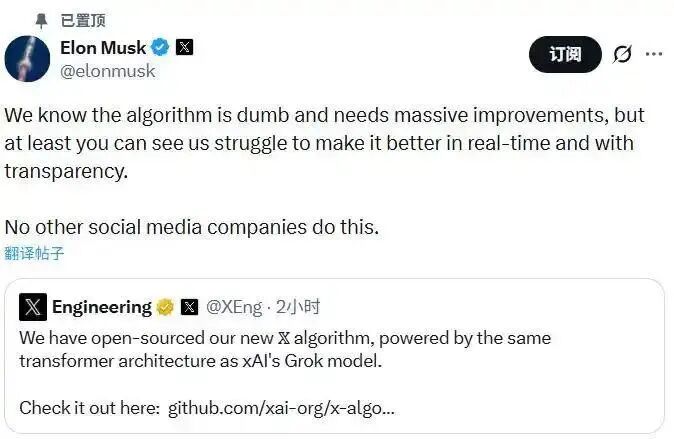
刚刚,马斯克开源基于 Grok 的 X 推荐算法:Transformer 接管亿级排序
Sou Hu Cai Jing· 2026-01-20 20:23
Core Viewpoint - Elon Musk's company has open-sourced the X recommendation algorithm, which supports the "For You" feed by combining in-network and out-of-network content using a Grok-based Transformer model [1][9][12]. Group 1: Algorithm Functionality - The recommendation algorithm generates content for users' main interface from two primary sources: content from accounts they follow (In-Network) and other posts discovered on the platform (Out-of-Network) [3][4]. - The algorithm filters out low-quality, duplicate, or inappropriate content to ensure that only valuable candidates are processed for ranking [4][6]. - The core of the algorithm is a Grok-based Transformer model that scores each candidate post based on user behavior such as likes, replies, and shares, predicting the probability of various interactions [4][20]. Group 2: Historical Context - This is not the first time Musk has open-sourced the X recommendation algorithm; a previous release occurred on March 31, 2023, which included parts of the Twitter source code [9][11]. - Musk's commitment to transparency in the algorithm is seen as a response to criticism regarding the platform's content distribution mechanisms, which have been accused of bias [12][18]. Group 3: User Reactions - Users on the X platform have summarized key points about the recommendation algorithm, noting that engagement metrics like replies significantly impact visibility, while links in posts can reduce exposure [14][15]. - Some users have observed that while the architecture is open-sourced, certain elements remain undisclosed, indicating that the release is more of a framework than a complete engine [17]. Group 4: Importance of Recommendation Systems - Recommendation systems are crucial to the business models of major tech companies, with significant percentages of user engagement driven by these algorithms: Amazon (35%), Netflix (80%), and YouTube (70%) [18]. - The complexity of traditional recommendation systems has led to a desire for a unified model that can handle multiple tasks, a goal that large language models (LLMs) may help achieve [21][22]. Group 5: Technical Insights - The open-sourced algorithm lacks specific weight parameters and internal model parameters, which limits understanding of its decision-making processes [20]. - The introduction of LLMs into recommendation systems allows for a more abstract approach to feature engineering, enabling the model to understand and process user preferences without explicit instructions [22][23].
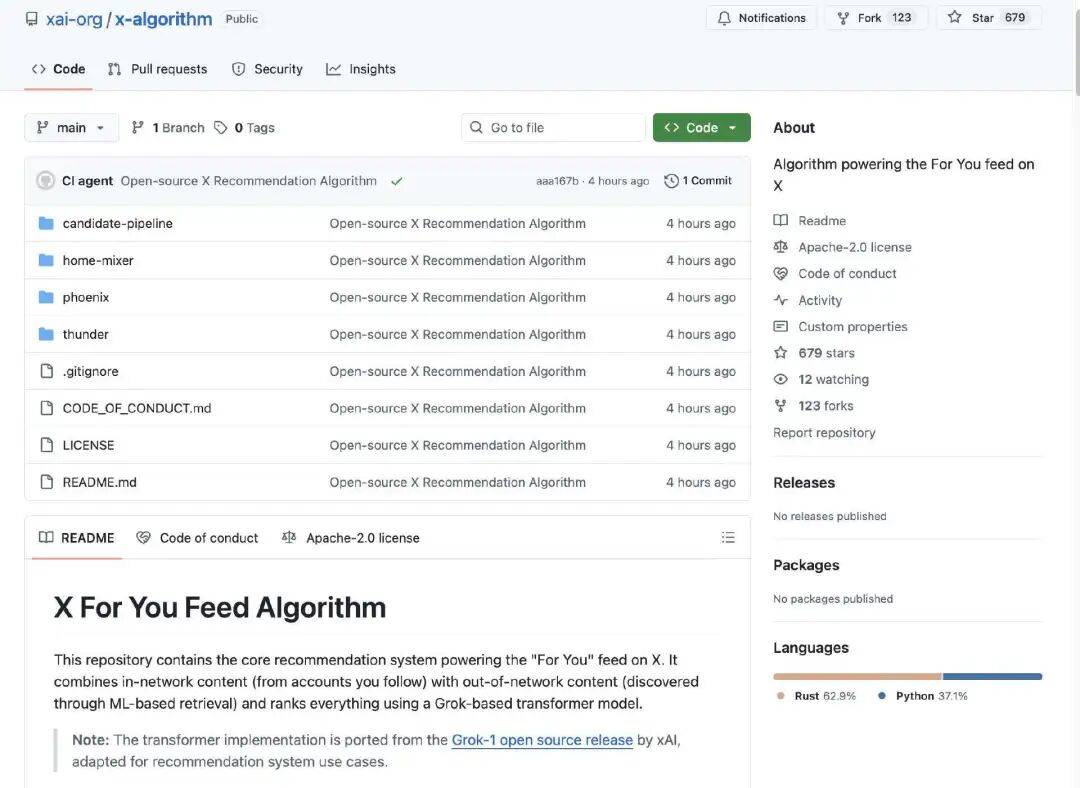
腾讯研究院AI速递 20260121
腾讯研究院· 2026-01-20 16:03
Group 1 - Musk has fulfilled his promise by open-sourcing the new recommendation algorithm for the X platform, which is 100% AI-driven and removes manual features and rules [1] - The algorithm utilizes Thunder and Phoenix engines to construct information streams, predicting 15 types of user behaviors with weighted scoring, where the weight of replying to authors' comments is 75 times that of likes [1] - Negative feedback such as blocking and reporting significantly reduces visibility, while time spent and genuine interactions are core metrics, allowing even small accounts to gain exposure and diminishing the advantage of having a large follower base [1] Group 2 - Zhipu AI has open-sourced the lightweight model GLM-4.7-Flash, which has 30 billion total parameters but only 3 billion activated, aimed at "local programming and intelligent assistants," with free API access [2] - This model is the first to adopt the MLA architecture from DeepSeek, supporting a context window of 200K and scoring 59.2 in the SWE-bench code repair test [2] - Local deployment tests show that it can run at 43 tokens per second on Apple's M5 chip and is compatible with HuggingFace, vLLM, and Huawei's Ascend NPU [2] Group 3 - MiniMax has unveiled Agent 2.0, defined as an "AI-native workspace," which offers a desktop application for seamless local and cloud connectivity, allowing operations on local files and initiating web automation tasks [3] - The Expert Agents feature encapsulates private knowledge and industry SOPs to create vertical domain expert avatars, enhancing general expertise scores from 70 to as high as 100 [3] - Users can customize Expert Agents, achieving a closed-loop capability from research to delivery, with desktop versions available for both Windows and Mac [3] Group 4 - Jieyue Xingchen has open-sourced the multimodal small model Step3-VL-10B, which, with only 10 billion parameters, competes with and even surpasses models like GLM-4.6V (106 billion) and Qwen3-VL (235 billion) in various evaluations [4] - The model possesses exceptional visual perception, deep logical reasoning, and interactive capabilities with edge agents, achieving top-tier performance in the AIME math competition [4] - It employs 1.2 trillion data for full parameter joint pre-training, over 1400 reinforcement learning iterations, and an innovative PaCoRe parallel coordination reasoning mechanism, with both Base and Thinking versions open-sourced [4] Group 5 - "Moon's Dark Side" is undergoing a new round of financing, with a valuation of $4.8 billion, an increase of $500 million from the previously announced $4.3 billion valuation just 20 days ago, with financing expected to complete soon [5] - The company currently holds over 10 billion yuan in cash and is not in a hurry to go public, planning to time its IPO as a means to accelerate AGI development [5] Group 6 - Superparameter Technology has launched the game agent COTA, which is entirely driven by a large model, achieving professional-level performance in FPS games with a visible reasoning chain [6] - It uses a "dual-system hierarchical architecture" to simulate human fast and slow thinking, with the Commander responsible for strategic decisions and the Operator executing operations in milliseconds, reducing response time to 100 ms [6] - This product validates the feasibility of large models in high-frequency competitive gaming scenarios, providing reference ideas for embodied intelligence and other real-world issues [6] Group 7 - Microsoft CEO Satya Nadella stated at the Davos Forum that mastering model orchestration capabilities is essential for establishing a competitive edge in the AI era [7] - The proliferation of AI requires enhancing "token efficiency per dollar per watt" from the supply side, while the demand side necessitates companies to drive transformation across "concepts, capabilities, and data" [7] - True "enterprise sovereignty" involves converting unique experiences and knowledge into proprietary AI models to prevent core value from flowing to model providers [7] Group 8 - a16z's analysis indicates that while ChatGPT maintains a dominant position with 800-900 million weekly active users, Gemini is growing at 155%, indicating a "winner-takes-most" market in AI assistants [8] - OpenAI's new experiences pushed through the ChatGPT interface for shopping, tasks, and learning have not truly broken through, limited by the existing chatbox interface's inability to provide a top-tier product experience [8] - Successful AI products like Replit, Suno, and Character AI share a common trait of having a distinct and focused interface, suggesting that startup opportunities lie in deep optimization for specific workflows [8] Group 9 - Anthropic's research team has discovered that model personalities can be quantified, with a dominant dimension called the "assistance axis" measuring the extent to which models operate in "intelligent assistant" mode [9] - Interventions along the assistance axis can control role-playing willingness, significantly reducing harmful response rates and defending against personality jailbreak attacks [9] - The proposed "activation ceiling" technique can lower the success rate of personality jailbreaks by nearly 60% without significantly impairing model performance, opening new pathways for human control over AI [9]

刚刚!马斯克把 X 推荐算法底裤给开源了
程序员的那些事· 2026-01-20 11:37
Core Viewpoint - The company has announced the open-sourcing of its recommendation algorithm for X, aiming to enhance transparency and invite community collaboration in its optimization efforts [1]. Group 1: Algorithm Overview - The recommendation algorithm consists of components such as Home Mixer, Thunder, and Phoenix, focusing on sorting information from "followed accounts" and "content mined from the web" using a Grok-based Transformer model [3]. - A notable feature of the algorithm is the elimination of all manually designed features and heuristic rules, relying solely on the model to learn correlations from user interaction history [5]. Group 2: Algorithm Functionality - The algorithm's workflow involves capturing user behavior data, sourcing candidate content from two channels, and applying data augmentation and multi-round filtering to predict user engagement probabilities (likes, shares, etc.), ultimately calculating a final score for content presentation [5]. - The implementation of X's recommendation algorithm is done using Rust and Python, and it is licensed under the Apache-2.0 license. As of now, it has received 1.1k stars and 195 forks on GitHub [5].

刚刚,马斯克开源基于 Grok 的 X 推荐算法!专家:ROI 过低,其它平台不一定跟
AI前线· 2026-01-20 09:36
Core Viewpoint - Elon Musk has open-sourced the X recommendation algorithm, which combines in-network content from followed accounts and out-of-network content discovered through machine learning, using a Grok-based Transformer model for ranking [3][12][18]. Summary by Sections Algorithm Overview - The open-sourced algorithm supports the "For You" feed on X, integrating content from both followed accounts and broader network sources, ranked by a Grok-based Transformer model [3][5]. - The algorithm fetches candidate posts from two main sources: in-network content (from accounts users follow) and out-of-network content (discovered through machine learning) [9][10]. Algorithm Functionality - The system filters out low-quality, duplicate, or inappropriate content to ensure only valuable candidates are processed [7]. - A Grok-based Transformer model scores each candidate post based on user interactions (likes, replies, shares, clicks), predicting the probability of various user actions [7][8]. Historical Context - This is not the first time Musk has open-sourced the X recommendation algorithm; a previous release occurred on March 31, 2023, which garnered over 10,000 stars on GitHub [12][14]. - Musk aims to enhance transparency in the algorithm to address criticisms regarding bias in content distribution on the platform [18][19]. User Reactions - Users on the X platform have summarized key insights about the recommendation algorithm, emphasizing the importance of engagement metrics like replies and watch time for content visibility [22][23]. Importance of Recommendation Systems - Recommendation systems are crucial to the business models of major tech companies, with significant percentages of user engagement driven by these algorithms (e.g., 35% for Amazon, 80% for Netflix) [25][27]. - The complexity of traditional recommendation systems often leads to high maintenance costs and challenges in cross-task collaboration [28]. Future Implications - The introduction of large language models (LLMs) presents new opportunities for recommendation systems, potentially simplifying engineering and enhancing cross-task learning [29][30]. - The open-sourcing of the X algorithm may not lead to immediate changes across other platforms, as they may lack the resources to implement similar systems [39].

马斯克突然宣布:7 天内开源 X 推荐算法
程序员的那些事· 2026-01-11 14:05
Core Viewpoint - Elon Musk announced plans to open-source the recommendation algorithm of X, which has sparked discussions among users regarding the implications for competition and transparency [1][3]. Group 1 - The announcement was made on January 11 at 3 AM Beijing time, indicating a significant move towards transparency in algorithmic processes [1]. - User reactions included both support for Musk's initiative and concerns about potential competitive disadvantages, as opening the algorithm could allow rivals to replicate it [1][3]. - Some users commented on the algorithm's simplicity, suggesting that it becomes apparent how it operates when discussing sensitive topics, such as Gaza and Israel [4].