Yu 7

Search documents
特斯拉没牌打了
虎嗅APP· 2025-06-29 23:55
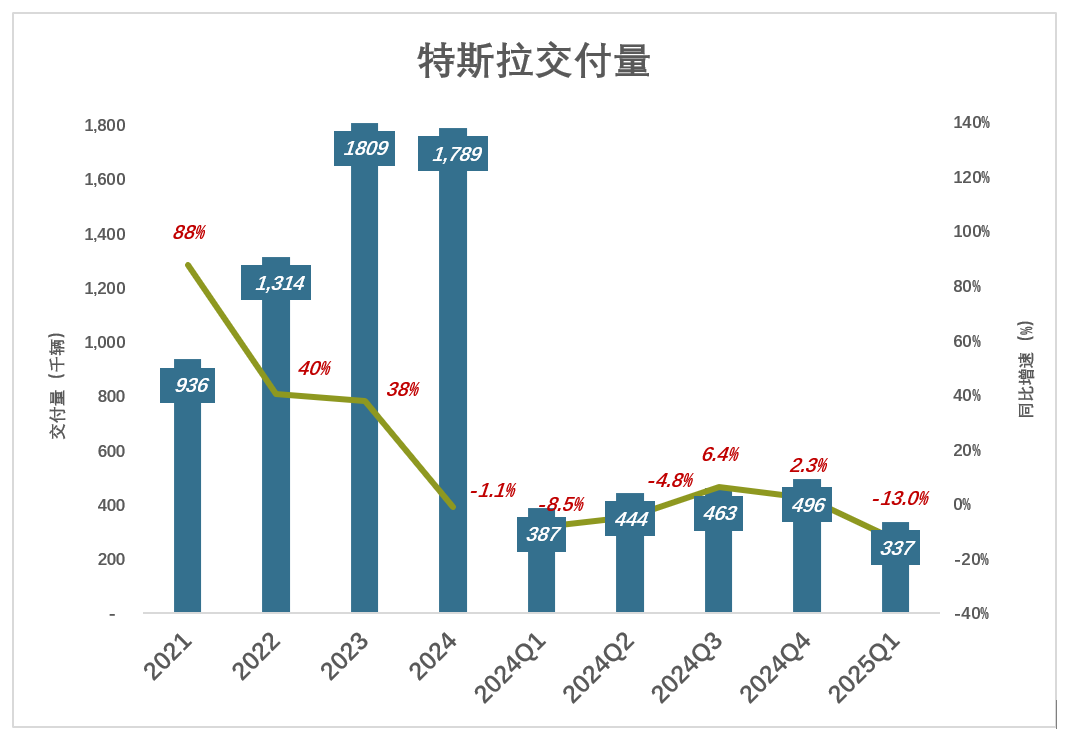
Core Viewpoint - Tesla's Robotaxi initiative is seen as a last-ditch effort to revitalize its business amidst declining sales and innovation challenges, with the market expressing skepticism about its potential success [3][4]. Group 1: Sales Performance - Tesla's delivery volume has shifted from rapid growth to stagnation, with 2023 deliveries at 1.81 million, a year-on-year increase of 37.7%, but projected to decline by 1.1% in 2024 [5][8]. - In Q1 2025, Tesla's deliveries were approximately 337,000, reflecting a year-on-year decrease of 13% [7]. - In April 2025, Tesla faced significant declines in key markets: a 6% drop in China, 46% in Germany, and 62% in the UK [8]. Group 2: Innovation and Product Development - Tesla's main models, the Model 3 and Model Y, have not seen timely updates, leading to consumer fatigue; the Model 3 was first launched in 2016 and only received a facelift in 2023, while the Model Y's update is expected in January 2025 [8][9]. - The anticipated lower-cost Model Q has faced delays, with initial promises of a 2020 launch pushed back multiple times [9][10]. - The introduction of the Yu 7 by Xiaomi, which directly competes with the Model Y, indicates increased competition in the market [12][13]. Group 3: Profitability Challenges - Tesla's gross profit margin for vehicle sales has fallen below 10%, with Q1 2025 showing a gross margin of 11.3% [15][17]. - Excluding Full Self-Driving (FSD) revenue, the gross profit margins for 2024 and Q1 2025 were only 13.22% and 9.5%, respectively [18]. - In 2024, Tesla's total gross profit from vehicle sales is projected to decline nearly 40% from 2022 levels, dropping from $17.6 billion to $10.6 billion [22]. Group 4: Revenue Sources and Future Outlook - Tesla's reliance on carbon credit sales has resurfaced, with 2024 seeing carbon credit revenue account for 38.6% of net profit, compared to 12% in 2023 [23]. - The FSD revenue, which is recorded as deferred income, has not met expectations, with projections for 2025 indicating a mere $7.8 billion in confirmable revenue [35]. - The overall valuation of Tesla, heavily reliant on FSD, is viewed as inflated, with significant doubts about its sustainability [35].


特斯拉没牌打了
Hu Xiu· 2025-06-29 23:06
Core Viewpoint - Tesla is facing significant challenges in its core business, with declining sales, slow innovation, and increasing competition, leading to skepticism about its future growth and valuation potential. Group 1: Robotaxi and Future Plans - Tesla's Robotaxi (autonomous taxi) testing has begun in Texas with 20 Model Y vehicles equipped with FSD 13, aiming for a million Cybercabs by 2027 [1][3] - Elon Musk's announcement on social media led to an 8.23% stock price surge, but subsequent trading days erased those gains, indicating market skepticism [2] - The Robotaxi initiative is seen as a last-ditch effort to revive investor interest amid declining sales and innovation concerns [3] Group 2: Sales Performance and Challenges - Tesla's delivery growth has slowed significantly, with 2023 deliveries at 1.81 million, a 37.7% increase, but projected to decline to 1.79 million in 2024, a 1.1% decrease [5][6] - The main reasons for the sales slowdown include outdated models and delayed launches of new, more affordable vehicles [7][8] - The anticipated Model Q, aimed at boosting sales, has faced delays, further complicating Tesla's market position [9][11] Group 3: Profitability Issues - Tesla's gross profit margin has fallen below 10%, with Q1 2025 gross profit margin at 11.3%, significantly impacted by declining vehicle prices and increased competition [13][17] - The company's reliance on carbon credit sales has resurfaced, with carbon credit revenue accounting for 141.7% of net profit in Q1 2025, raising concerns about sustainable profitability [27][30] - Compared to BYD, Tesla's gross profit per vehicle has decreased sharply, with projections indicating a significant drop in overall gross profit from $17.6 billion in 2022 to $10.6 billion in 2024 [24][26] Group 4: FSD Revenue and Future Outlook - Tesla's Full Self-Driving (FSD) subscription revenue has been slow to grow, with projections for 2025 indicating only $8.4 billion in confirmable revenue, insufficient to cover R&D costs [41][42] - The FSD revenue model is under scrutiny, as the company struggles to convert a large enough vehicle base into profitable subscription income [43]