
iPhone 12 Pro Max

Search documents
手机平均内存8.4GB创新高 华为居首达到12GB
Xin Lang Cai Jing· 2026-02-27 10:36
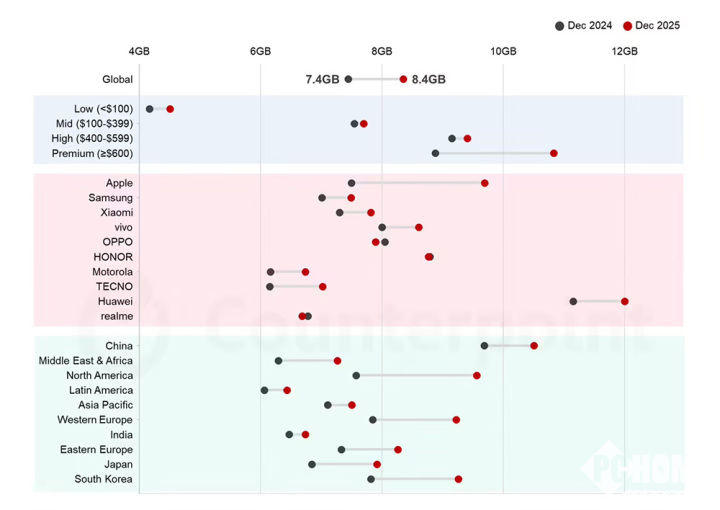
Core Insights - The global average smartphone memory reached 8.4GB RAM in December 2025, an increase of 0.6GB RAM from 7.8GB RAM in December 2024, marking a new high for average smartphone memory [1][5][7] Group 1: Market Trends - Flagship smartphones priced over $600 saw a significant increase in average memory from around 9GB RAM to nearly 11GB RAM, with new models typically featuring 12GB RAM [1][5] - Mid-range smartphones priced between $400 and $599 have not shown significant memory improvement, remaining below 10GB RAM, while entry-level models under $100 have average memory capacities of less than 6GB RAM [1][5] Group 2: Brand Performance - Huawei leads the market with an average memory of 12GB RAM, achieving the first widespread adoption of this memory level [4][7] - Apple follows in second place with an average memory of less than 10GB RAM, while Samsung and Xiaomi have average memory below 8GB RAM due to their large volume of mid to low-end models [4][7] - Vivo has shown significant improvement, indicating better market performance in the mid to high-end segment [4][7] Group 3: Regional Insights - The Chinese smartphone market has the highest average memory capacity, being the only market to exceed 10GB RAM, followed by North America, Europe, and South Korea, all of which have average memory exceeding 8GB RAM [4][7] Group 4: Cost Pressures - Despite the increase in average memory capacity, the cost of memory is rising sharply, with the memory cost for the iPhone 17 Pro Max exceeding 10% of total cost, up from 8% for the iPhone 12 Pro Max [4][8] - For high-end models with 16GB to 24GB RAM and 512GB to 1TB storage, memory costs could account for over 20% of total costs [5][8] - The rising memory costs will pressure manufacturers to make adjustments, potentially leading to price increases and downgrades in other components such as cameras and displays [5][8]



Counterpoint:存储市场已进入“超级牛市” 预计Q1价格还将再涨40%–50%
智通财经网· 2026-01-12 03:21
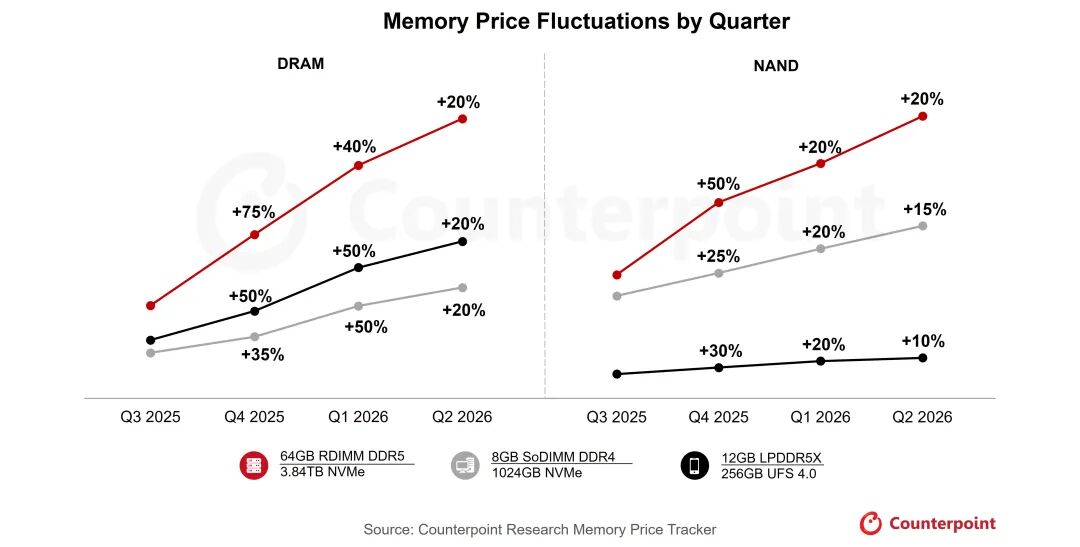
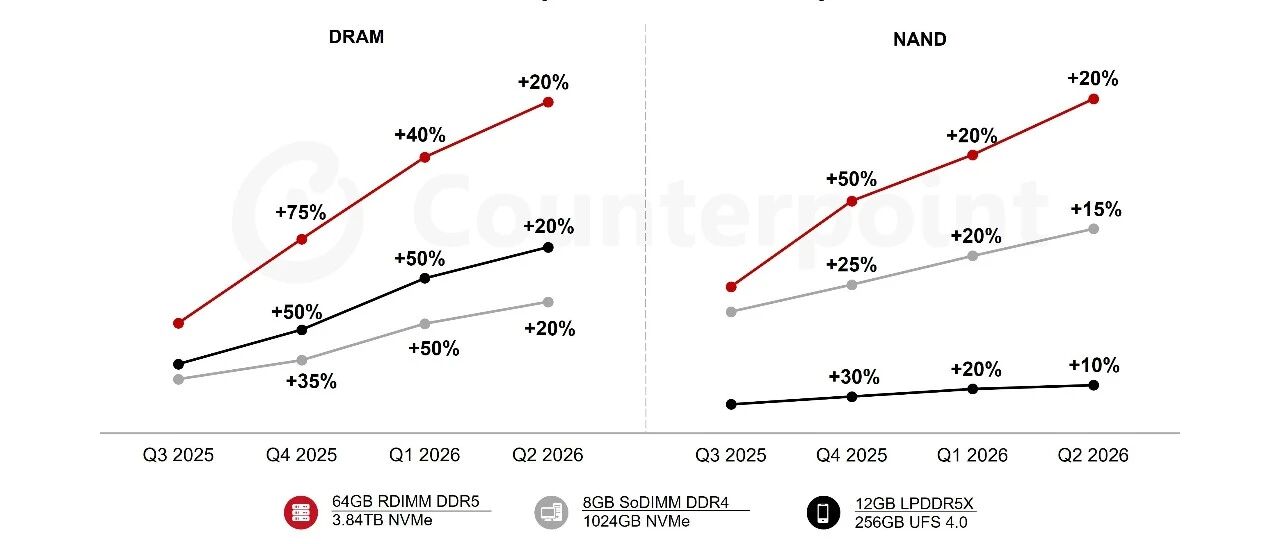
Core Insights - The storage market has entered a "super bull market" phase, surpassing historical highs from 2018, driven by surging demand for AI and server capacity [1] - Storage prices are expected to rise significantly, with projections indicating a 40%-50% increase by Q4 2025 and another 40%-50% increase in Q1 2026, followed by an approximate 20% rise in Q2 2026 [1] Price Trends - The price of 64GB RDIMM storage has surged from $255 in Q3 2025 to $450 in Q4 2025, with expectations to reach $700 by March 2026 [2] - A price increase to $1,000 within this year is plausible, which would be nearly double the 2018 peak price of $1.00/Gb [2] Cost Structure Changes - The ongoing rise in storage prices is fundamentally altering the Bill of Materials (BoM) for hardware manufacturers [3] - In the iPhone 17 Pro Max, storage now accounts for over 10% of the BoM, up from approximately 8% in the iPhone 12 Pro Max [3] - For flagship models with 16GB-24GB LPDDR5X memory and 512GB-1TB UFS 4.0 storage, storage costs may exceed 20% of the BoM [3] - Major manufacturers like Samsung and SK Hynix are shifting production capacity towards high-margin server DDR5 storage, leading to a rapid contraction in supply of older technologies like LPDDR4 and eMMC [3] Supply Outlook - DRAM production is projected to increase by 24% year-on-year in 2026, but despite rising capital expenditures, it will take time to meet demand [4]
存储价格飙升 50%涨势将延续至 2026 年
Counterpoint Research· 2026-01-12 02:45
Core Viewpoint - The storage market has entered a "super bull market" phase, surpassing historical highs from 2018, driven by the increasing demand for AI and server capacity. Supplier bargaining power has reached an all-time high, with storage prices expected to rise significantly in the coming years [4]. Price Trends - The price of 64GB RDIMM storage has surged from $255 in Q3 2025 to $450 in Q4 2025, with expectations to further increase to $700 by March 2026. A price point of $1,000 (approximately $1.95/Gb) within this year is plausible, nearly double the 2018 peak of $1.00/Gb [5]. Cost Structure Changes - The ongoing rise in storage prices is fundamentally altering the Bill of Materials (BoM) for hardware manufacturers. Although capital expenditures are increasing, the supply-demand gap remains, with DRAM production expected to grow by 24% year-on-year in 2026 [6]. Smartphone Impact - By 2025, storage will account for over 10% of the BoM in the iPhone 17 Pro Max, up from about 8% in the iPhone 12 Pro Max in 2020. For flagship models with 16GB–24GB LPDDR5X memory and 512GB–1TB UFS 4.0 storage, the storage cost may exceed 20% of the BoM due to current price increases. The supply of older technologies like LPDDR4 and eMMC is rapidly shrinking as leading manufacturers shift production to more profitable server DDR5 storage [10].
I Bought a Used iPhone 13 Mini To See If It's a Better Buy Than a New iPhone Air
CNET· 2025-12-20 13:01
Device Evaluation & Market Analysis - The review focuses on evaluating the user experience of a used iPhone 13 mini in 2025 as a cost-effective alternative to newer, more expensive iPhones [1] - The used iPhone 13 mini with 256GB storage was purchased for $324 from Amazon via vendor IB Blueberry [2] - The analysis considers alternatives like refurbished devices from other websites (Gazelle, Back Market) and even refurbished iPhones directly from Apple (up to iPhone 14 generation) [2][3] - The review highlights the iPhone 13 mini's key features: 54-inch screen with 1080p resolution, iOS 26 compatibility, MagSafe support, and cinematic mode [9][10] - Potential drawbacks of the iPhone 13 mini are noted, including 4GB of memory (less than the iPhone 12 Pro Max), the Lightning port, and the smaller screen size [11][12] Battery Performance & Cost Considerations - The used iPhone 13 mini's battery capacity was at 83%, leading to battery life issues requiring multiple charges per day [14][17] - A battery replacement from Apple costs $89, bringing the total cost of the used iPhone 13 mini to around $400, still cheaper than a $1,000 iPhone Air [16] Alternative Recommendations - The review suggests considering renewed premium devices with at least 90% battery capacity [22] - The analysis proposes exploring foldable Android phones (Motorola Razer, Samsung Galaxy Z Flip) as alternatives, especially with discounts bringing prices to $450-$600 [22] - A used iPhone 15 is suggested as another option, offering USB-C and a 50-megapixel camera, though with a larger 61-inch display [23][24] Cost-Saving Strategies - The review recommends exploring mid-range phone models or buying year-old phones (Samsung Galaxy S24, iPhone 16, Google Pixel A series) to save money [25]

X @Poloniex Exchange
Poloniex Exchange· 2025-09-11 04:16
Investment Analysis - Investing in Bitcoin (BTC) instead of buying an iPhone each year from 2017 to 2024 would have yielded significant profits, with an average profit of over 800% across all years [4] - The analysis shows zero losses when investing in BTC instead of purchasing iPhones during the specified period [4] - The best buying opportunity for BTC was during the 2018 bear market crash [2] Comparative Cost Analysis - The price of iPhones increased slightly from $1,000 to $1,200 over eight years (2017-2024) [4] - The amount of BTC needed to purchase an iPhone in 2025, with BTC at approximately $111,000, is just 0.011 BTC [9] Profitability Examples - Purchasing an iPhone X in 2017 required 0.072 BTC, which is now worth approximately $7,992, resulting in a profit of $6,993 (700% gain) [1] - Purchasing an iPhone XS Max in 2018 required 0.289 BTC, which is now worth approximately $32,079, resulting in a profit of $30,980 (2,815% gain) [2]