izabren(EGFR×HER3双抗ADC)

Search documents
百利天恒:2025年亏损10.51亿元
Zhong Guo Zheng Quan Bao· 2026-02-27 15:56
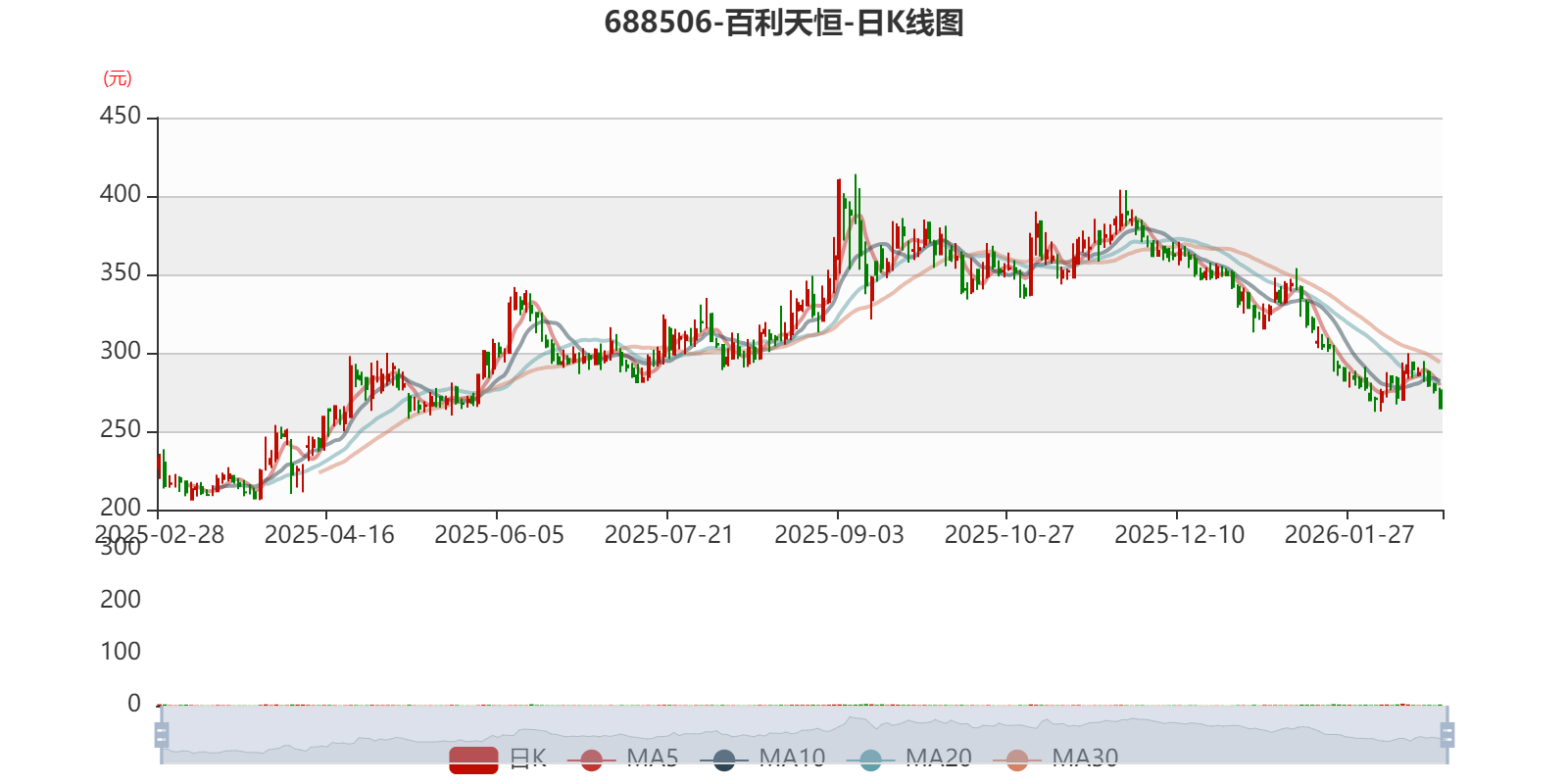
Core Viewpoint - The company reported a significant decline in revenue and net profit for the year 2025, indicating financial challenges and a need for strategic adjustments in operations and product development [3]. Financial Performance - The company achieved an operating revenue of 2.52 billion yuan, a year-on-year decrease of 56.72% [3]. - The net profit attributable to shareholders was a loss of 1.051 billion yuan, compared to a profit of 3.708 billion yuan in the same period last year [3]. - The non-recurring net profit also showed a loss of 1.167 billion yuan, down from a profit of 3.636 billion yuan in the previous year [3]. - The basic earnings per share were -2.54 yuan, with a weighted average return on equity of -24.47%, a decline of 209.33 percentage points from the previous year [3][16]. Valuation Metrics - The price-to-book ratio (LF) is approximately 15.23 times, while the price-to-sales ratio (TTM) is about 49.08 times [3]. - Historical price-to-earnings ratio trends indicate significant fluctuations, reflecting the company's financial instability [4][5]. Product and Partnership Developments - The company specializes in various pharmaceutical products, including propofol emulsions and other injectable solutions [15]. - A partnership with Bristol-Myers Squibb (BMS) for the drug iza-bren (EGFR×HER3 dual antibody ADC) has progressed, with a milestone payment of 250 million USD received during the reporting period [15]. - The decline in revenue is attributed to the previous year's recognition of a substantial upfront payment from BMS, which was not matched in the current reporting period [15]. Research and Development - The company has increased its R&D investment significantly to accelerate product pipeline development and maintain a competitive edge [15].

专访百利天恒创始人朱义:原始创新打造超级爆品,执掌全球话语权
21世纪经济报道· 2026-01-03 11:43
Core Insights - The key opportunity for local biotech companies lies in focusing on original innovation from 0 to 1, establishing core technological barriers in unmet clinical needs, and achieving a leap from follower to leader [2][14] - Chinese innovative pharmaceutical companies have entered the global ADC innovation core camp, with over 50% of the global ADC new drug pipeline originating from China [1][14] - The strategic partnership between BaiLi TianHeng and BMS in the ADC field has set a record for the highest single-asset transaction in the global ADC sector, further elevating industry innovation [1][5] Industry Trends - The BD (business development) boom in the ADC sector is expected to continue into 2025, with 14 transactions in the first eight months of 2023, making ADC one of the hottest outbound technology tracks [1][14] - Companies are expanding beyond mature targets like HER2 and TROP2 to explore "blue ocean" targets such as CDH6, CDH17, and DLL3, seeking broader treatment windows and improved competitive landscapes [1][14] Strategic Partnerships - The partnership model of "self-researched core assets + global rights cooperation" and "co-development + co-commercialization" is relatively rare globally, requiring high product strength and a forward-looking strategic vision [7][9] - BaiLi TianHeng's collaboration with BMS is notable for its potential total transaction value of up to $8.4 billion, highlighting the growing trend of significant transactions in the oncology treatment sector [5][9] Challenges and Opportunities - Despite the increasing number of transactions, many Chinese innovative drug assets remain undervalued due to a lack of global clinical trial validation and lower payment prices in the domestic market [9][12] - The development of "super blockbuster" products with strong product power is seen as a key path to overcoming valuation challenges, with the drug iza-bren being recognized as a first-in-class product [9][12] Future Directions - The competition in the "ADC + IO" (immuno-oncology) space is intensifying, with both multinational and domestic companies actively pursuing innovative combinations [10][14] - To achieve comprehensive internationalization, Chinese pharmaceutical companies must overcome four core capability gaps: global leading R&D capabilities, global clinical development capabilities, global supply chain capabilities, and global commercialization capabilities [12][13]