
Shui Li Bu Wang Zhan

Search documents
安徽省立法强化地下水保护管理
Shui Li Bu Wang Zhan· 2025-11-28 15:09
本站讯 近日,安徽省十四届人大常委会第十八次会议表决通过了《安徽省地下水管理条例》,将于 2026年1月1日起施行。条例贯彻落实上位法要求,结合安徽实际,对地下水调查与规划、节约与保护、 超采治理、污染防治等内容作出了一些细化补充规定,实施后将进一步织密扎牢地下水保护管理的"制 度网"。 在统筹地下水保护与利用方面,条例强化地下水节约保护,完善地下水取水总量控制指标和水位控制指 标、地下水年度取水计划制定的主体和程序,严格地下水取水许可,推进引江济淮工程受水区工业和生 活用水的地下水水源置换。明确按照国家规定建立健全地下水水权交易制度,支持开展多种形式的地下 水水权交易,引导开展集中交易,并逐步将地下水水权交易纳入公共资源交易平台体系。鼓励为地下水 水权交易提供融资支持,促进地下水资源节约集约利用。 在地下水超采治理方面,条例细化地下水禁止开采区和限制开采区的管理要求,明确分级编制超采综合 治理方案,开展超采综合治理效果评估。同时,细化地下水污染防治措施,规定相关部门要根据本行政 区域内地下水状况调查评价和地下水污染防治需要,划定地下水污染防治重点区,建立地下水污染防治 分区分级管理体系。同时,确定并公布污染 ...
海河水利委员会深化数字孪生海河建设合作交流
Shui Li Bu Wang Zhan· 2025-11-28 13:18
Group 1 - The meeting focused on the implementation of the digital twin water conservancy system, summarizing the achievements of the "14th Five-Year Plan" and planning for the "15th Five-Year Plan" [1][2] - The conference showcased the application of digital twin technology in flood defense, water resource allocation, and water conservancy project management [1] - Participants discussed the effectiveness, existing issues, and future strategies for the digital twin water conservancy construction [1][2] Group 2 - The meeting emphasized the need to integrate monitoring systems across various dimensions, ensuring comprehensive and continuous data collection [2] - A call was made to strengthen data collection and sharing, utilizing multi-source and multi-dimensional approaches [2] - Future efforts will focus on enhancing technological innovation and advancing the digital twin construction to support modernized governance in the river basin [2]
陕西省灌区现代化建设保障粮食安全培训班在杨凌示范区举办
Shui Li Bu Wang Zhan· 2025-11-28 13:05
Core Viewpoint - The training session on modernizing irrigation districts in Shaanxi Province aims to enhance food security through improved irrigation management and technology integration [1] Group 1: Training Session Overview - The training session took place from October 21 to 23 in Yangling Demonstration Zone, organized by the Provincial Organization Department and the Provincial Water Resources Department [1] - It included experts from the National Irrigation and Drainage Center and Northwest A&F University, focusing on national and provincial policies, planning, and technical standards for irrigation modernization [1] Group 2: Key Topics Covered - Topics included high-standard farmland irrigation, smart irrigation, measurement facilities, and integrated water-saving technologies [1] - The session analyzed agricultural water pricing reform policies, typical models, challenges, and countermeasures, along with successful case studies from within and outside the province [1] Group 3: Implementation and Goals - Participants were encouraged to relate learning to local irrigation realities, fostering practical application of knowledge gained [1] - The goal is to translate learning outcomes into actionable steps to enhance irrigation standards, management efficiency, water-saving effectiveness, and overall food production capacity in Shaanxi [1]
新华网:2025年度水利科学技术研究五大前沿热点词发布
Shui Li Bu Wang Zhan· 2025-11-28 10:21
Core Insights - The National Science and Technology Terminology Approval Committee held its 2025 annual work meeting, announcing 68 frontier research hot terms across 11 disciplines, including five key terms related to water conservancy technology [1][3] Water Conservancy Technology Hot Terms - "National Water Network" refers to a comprehensive water conservancy engineering system that integrates water resource optimization, flood prevention, and ecological protection, utilizing natural rivers and lakes as a foundation [2] - "Smart Dam" represents the integration of new information technologies with traditional dam engineering, focusing on IoT, big data, AI, and digital twin technologies for enhanced management throughout the dam's lifecycle [2] - "Digital Twin Water Conservancy System" involves the digital mapping and intelligent simulation of physical water conservancy elements, enabling real-time interaction and optimization [2] - "Drought-Flood Transition" describes the extreme weather phenomenon where a region experiences severe drought followed by sudden heavy rainfall, necessitating urgent flood prevention measures [2] - "Happy Rivers and Lakes" emphasizes maintaining ecological stability and promoting high-quality development in river and lake systems, ensuring safety and satisfaction for local communities [2] Institutional Framework - The National Science and Technology Terminology Approval Committee, authorized by the State Council, is responsible for the authoritative approval and publication of scientific terminology, with a dedicated committee for water conservancy terminology [3] - Starting in 2024, the committee will regularly collect and publish annual frontier research hot terms to enhance the development of scientific disciplines and showcase advancements in science and technology [3]

经济日报:节水装备产业加速“链”式创新
Shui Li Bu Wang Zhan· 2025-11-28 10:16
Core Viewpoint - The "Implementation Plan for High-Quality Development of Water-Saving Equipment (2025-2030)" aims to enhance the water-saving equipment industry, focusing on technological innovation, industrial upgrades, and talent cultivation to ensure national water security and support new industrialization [1][3]. Group 1: Water-Saving Equipment Development - By 2027, breakthroughs in key water-saving equipment and a more robust standard system are expected, along with the cultivation of leading enterprises and specialized "little giant" companies [1]. - By 2030, a comprehensive, technologically advanced water-saving equipment system is to be established, enhancing the supply capacity of high-performance, efficient, and reliable water-saving equipment [1][3]. Group 2: Industrial Water Efficiency - The Ministry of Industry and Information Technology (MIIT) has implemented actions to improve industrial water efficiency, achieving a 50% reduction in water usage per unit of industrial added value over the past decade while maintaining zero growth in total industrial water consumption [2]. - A policy framework for industrial water efficiency has been established, including the "Industrial Water Efficiency Improvement Action Plan" and "Industrial Wastewater Recycling Implementation Plan" [2]. Group 3: Key Tasks and Innovations - The plan emphasizes the need for breakthroughs in critical components, materials, and processes in water-saving equipment, aiming for a collaborative industrial chain that covers material research, equipment manufacturing, and system integration [3][5]. - The focus is on enhancing the efficiency of water-saving technologies in various industrial processes, particularly in high-water-consumption sectors like steel manufacturing [6]. Group 4: Challenges and Shortcomings - Despite having over 2,000 large-scale water-saving equipment manufacturers, the industry faces challenges such as over 50% reliance on imports for key components and low levels of equipment intelligence and system integration [4]. - The lack of a robust innovation mechanism and low conversion rates of scientific achievements hinder the industry's growth and international competitiveness [4]. Group 5: Technological Integration and Smart Solutions - The integration of new technologies like industrial internet, big data, and artificial intelligence is crucial for enhancing water-saving management efficiency [7]. - The plan promotes the digital transformation of the water-saving equipment industry, aiming to improve operational efficiency and resource utilization through smart monitoring and management systems [7][8]. Group 6: Policy Support and Talent Development - The MIIT will increase policy support for updating water-saving equipment and accelerating the development of necessary standards [8]. - There will be a focus on cultivating applied talent in water-saving disciplines to link the talent chain with the industry chain effectively [8].
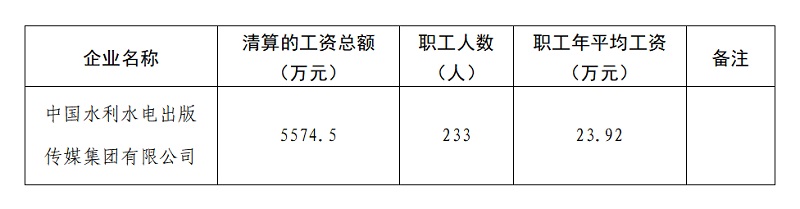
中国水利水电出版传媒集团有限公司2024年度工资分配信息披露
Shui Li Bu Wang Zhan· 2025-11-28 10:13
Core Viewpoint - The company disclosed its salary distribution information for 2024 in accordance with the State Council's regulations on reforming the salary decision mechanism for state-owned enterprises [1] Group 1: Salary Distribution Information - The total salary amount for China Water Resources and Hydropower Publishing is 55.745 million yuan [1] - The number of employees in the company is 233 [1] - The average annual salary per employee is 23.92 million yuan [1]


水利部发布《水利水电工程单元工程施工质量验收标准 第5部分:水工金属结构安装工程》等6项水利行业标准
Shui Li Bu Wang Zhan· 2025-11-25 09:42
Core Viewpoint - The Ministry of Water Resources has approved the release of six new industry standards for water conservancy and hydropower engineering, which will be implemented starting February 5, 2026 [1] Group 1: New Standards Overview - The new standards include: 1. SL/T 631.5-2025: Quality acceptance standards for hydraulic metal structure installation engineering 2. SL/T 631.6-2025: Quality acceptance standards for turbine generator sets and auxiliary equipment system installation engineering 3. SL/T 631.7-2025: Quality acceptance standards for electrical device installation engineering [2] - These standards are revisions and consolidations of previous standards, aimed at enhancing quality management in hydropower engineering and standardizing acceptance work for various engineering units [2] Group 2: Specific Standards Details - SL/T 851-2025: A newly established standard for water diversion project scheduling management, covering basic requirements, scheduling plans, safety conditions, and emergency management, applicable to medium and large-scale water diversion projects [3] - SL/T 191-2025: Revised standard for the design of hydraulic concrete structures, focusing on safety and durability in the design of various concrete structures used in hydropower projects [3] - SL/T 386-2025: Revised standard for the design of slopes and retaining walls in hydropower projects, promoting green and dynamic design concepts [4]
李国英看望慰问水利援疆干部
Shui Li Bu Wang Zhan· 2025-11-22 04:10
Core Viewpoint - The Ministry of Water Resources emphasizes the importance of water aid work in Xinjiang, highlighting the commitment and contributions of personnel in promoting high-quality water development and social stability in the region [1][2]. Group 1 - The water aid personnel are dedicated to their roles, viewing their work as a significant political task, and are actively involved in the high-quality development of water resources in Xinjiang [1][2]. - The Ministry stresses the need for water aid personnel to fully implement the directives from Xi Jinping regarding Xinjiang and water management, focusing on the overall goals of Xinjiang's development [2]. - Key areas of focus include disaster prevention, water resource conservation, ecological protection, and environmental governance, with an emphasis on improving people's livelihoods [2]. Group 2 - The meeting included representatives from the water aid personnel who shared their experiences and expressed their commitment to enhancing their skills and contributing to the high-quality development of water resources in Xinjiang [2]. - The Ministry calls for a strong sense of responsibility and discipline among water aid personnel, encouraging them to refine their skills and enhance their capabilities through practical experience [2].
水利部党组学习贯彻习近平总书记对全面依法治国工作作出的重要指示
Shui Li Bu Wang Zhan· 2025-11-21 15:20
Core Points - The meeting emphasized the importance of Xi Jinping's instructions on comprehensively governing the country by law, which clarifies strategic, overall, and directional issues related to the rule of law in socialism [1][2] - The meeting called for a deep understanding and implementation of Xi Jinping's legal thought, enhancing awareness of the "two establishments," and ensuring the unity of the Party's leadership, people's democracy, and the rule of law [1] - The meeting outlined the need to strengthen the legal system in water resources management, focusing on top-level design and overall planning to create a complete legal framework for water management [2] Group 1 - The meeting highlighted the political, ideological, and guiding significance of Xi Jinping's directives for advancing the rule of law in the new journey [1] - It stressed the importance of implementing major deployments and tasks in the legal field to create a new situation in the construction of a rule-of-law China [1] Group 2 - The meeting required the establishment of a comprehensive legal system for water resources, including effective implementation and administrative frameworks [2] - It aimed to provide strong legal support for high-quality development in water management and ensuring national water security [2]
水利部科学技术委员会举办第11期科技创新和科学普及讲座
Shui Li Bu Wang Zhan· 2025-11-20 08:15
Core Insights - The Ministry of Water Resources' Science and Technology Committee held the 11th lecture on technological innovation and science popularization, featuring a presentation by Academician Tang Hongwu on the reconstruction of hydrodynamic systems and governance under the water network pattern [1] Group 1: Historical Context and Theoretical Framework - The lecture reviewed the historical context of water management in China, analyzing the understanding and application of hydrodynamics through ancient and modern water engineering practices [1] - Tang Hongwu introduced the theory and technical system of hydrodynamic reconstruction, emphasizing its successful applications in comprehensive watershed management, hydrodynamic regulation, and water environment governance [1] Group 2: Future Directions and Applications - The presentation outlined future methods for cultivating new productive forces, coordinating the governance of old and new water issues, and enhancing the comprehensive benefits of water network system governance [1] - Tang engaged with the audience on various topics, including the impact of hydrodynamic reconstruction on improving the relationship between rivers and lakes, flood control, water resource allocation, and ecological environment governance [1]