
Shui Li Bu Wang Zhan

Search documents
黄河水利委员会专题研究部署黄河保护法贯彻落实工作
Shui Li Bu Wang Zhan· 2026-01-16 02:19
Core Viewpoint - The meeting emphasizes the importance of implementing the Yellow River Protection Law as a long-term political task and legal responsibility, aiming to establish a closed-loop management mechanism for effective enforcement [1] Group 1: Implementation Strategy - The meeting calls for strengthening leadership to ensure comprehensive coverage of legal responsibilities, with a focus on coordinating efforts to fully implement the Yellow River Protection Law [1] - It highlights the need to clarify regulatory responsibilities and promote unified supervision across the river basin, ensuring strict adherence to the law [1] - The meeting stresses the importance of addressing issues encountered in various tasks and inspections, identifying specific measures to enhance the implementation of the law [1] Group 2: Monitoring and Accountability - There is a focus on strengthening follow-up and supervision, with a dynamic update of the work ledger for the implementation of the Yellow River Protection Law to ensure that all measures are effectively executed [1]
小浪底水利枢纽安全前端感知能力进一步提升
Shui Li Bu Wang Zhan· 2026-01-16 02:19
Group 1 - The Xiaolangdi Water Conservancy Project has completed the automation transformation of its safety monitoring data collection, enhancing its safety perception capabilities [1] - Since 2025, the project has accelerated the construction of an integrated monitoring perception system, significantly advancing the research and application of new safety monitoring technologies [1] - A total of 2,943 automated safety monitoring instruments have been installed, increasing the automation rate from 49% to 92.5%, allowing for real-time monitoring of critical safety factors [1] Group 2 - The Xiaolangdi management center will continue to enhance the application of new technologies in safety monitoring, aiming to improve the perception level and decision-making support capabilities [2] - The project aims to create a benchmark in the construction of "safe dams, ecological dams, and intelligent dams," contributing to high-quality water conservancy development and national water security [2]
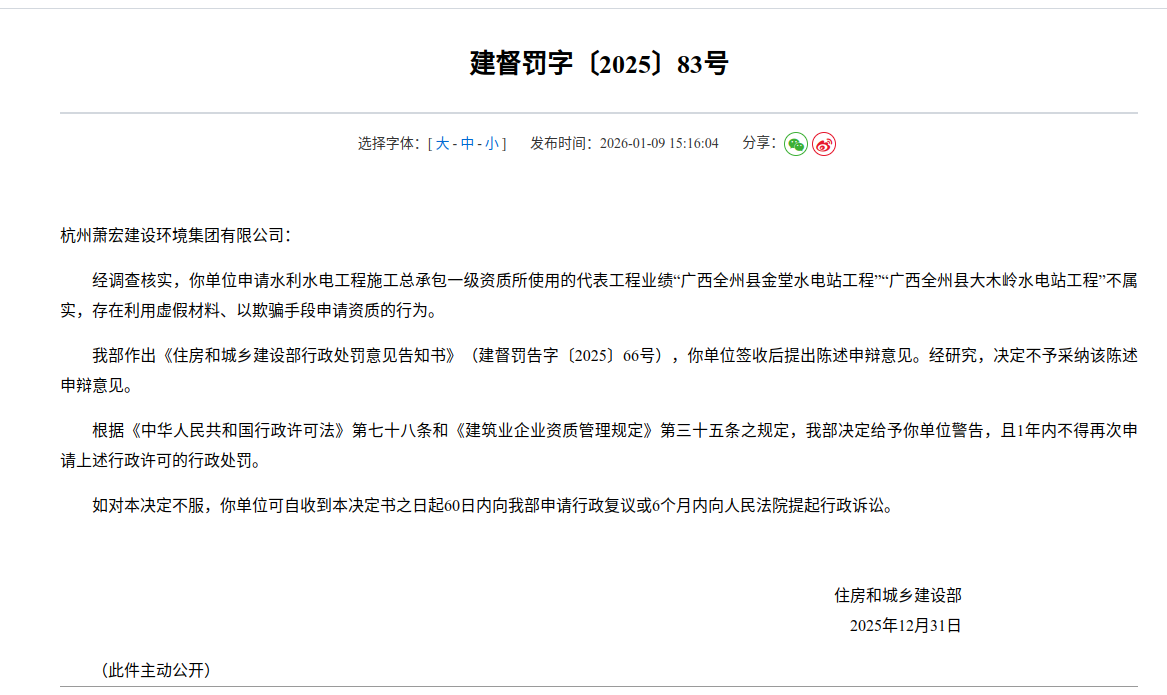
转载住房城乡建设部对杭州萧宏建设环境集团有限公司的行政处罚决定书
Shui Li Bu Wang Zhan· 2026-01-16 02:11
Group 1 - The Ministry of Housing and Urban-Rural Development publicly announced an administrative penalty against Hangzhou Xiaohong Construction Environment Group Co., Ltd. for applying for a first-class qualification in water conservancy and hydropower engineering construction using false materials and deceptive means [1] - The company received a warning and is prohibited from reapplying for the aforementioned administrative license for one year [1] - The Ministry of Water Resources will continue to strengthen the review of qualifications in the water conservancy and hydropower engineering construction sector and will cooperate with the Ministry of Housing and Urban-Rural Development to strictly investigate fraudulent activities in qualification applications [1]

水规总院传达学习贯彻2026年全国水利工作会议精神
Shui Li Bu Wang Zhan· 2026-01-16 00:25
Core Viewpoint - The 2026 National Water Resources Work Conference emphasizes the implementation of Xi Jinping's water management philosophy, focusing on water conservation, spatial balance, systematic governance, and dual efforts, while planning for the 15th Five-Year Plan and 2026 key tasks [1][2]. Group 1 - The meeting highlighted the significant achievements of the 2025 and the 14th Five-Year Plan in water resources management, attributing these successes to the leadership of the Central Committee and the guidance of Xi Jinping's thoughts on water management [2]. - It is essential to recognize the historical context and development environment of water resources work, adhering to the "six musts" for valuable experience, and focusing on the overall requirements and goals for the 15th Five-Year Plan [2]. - The meeting called for active strategic research and the solid advancement of the 15th Five-Year Plan for water security, enhancing the quality and efficiency of major water project reviews to support high-quality water resource development [2]. Group 2 - The meeting stressed the importance of implementing the "five further improvements" in advancing the Party's self-revolution, emphasizing the political responsibility of Party governance and the need for high-quality Party building to ensure high-quality development [2].
水利部党组学习贯彻习近平总书记在二十届中央纪委五次全会上的重要讲话精神
Shui Li Bu Wang Zhan· 2026-01-15 07:45
Group 1 - The meeting emphasized the importance of Xi Jinping's speech at the Fifth Plenary Session of the 20th Central Commission for Discipline Inspection, which provides fundamental guidance for advancing strict governance of the Party and anti-corruption efforts [1] - The meeting called for a deeper understanding of the "two establishments" and the enhancement of the "four consciousnesses," "four self-confidences," and "two safeguards" to ensure the implementation of the 14th Five-Year Plan for water resources development [1] Group 2 - The meeting required a stronger commitment to implement major decisions from the Central Committee, enhancing political responsibility and historical mission awareness, and focusing on the new development concept and high-quality development [2] - It stressed the need for effective institutional mechanisms to ensure power is regulated, emphasizing strict adherence to democratic centralism and improving the clarity and traceability of institutional mechanisms [2] - The meeting highlighted the importance of advancing the anti-corruption campaign, establishing mechanisms to address corruption and unhealthy practices, and fostering a clean political environment [2]
法治日报:国家水网覆盖范围占国土面积的比例达80.3%
Shui Li Bu Wang Zhan· 2026-01-15 07:23
Group 1 - The core viewpoint of the articles highlights the significant progress in the construction of the national water network during the "14th Five-Year Plan" period, with a total investment of 5.68 trillion yuan in water conservancy projects, exceeding 1 trillion yuan annually for four consecutive years since 2022 [1][2] - The national water network now covers 80.3% of the country's land area, providing water security for major strategic implementations, important economic zones, urban clusters, energy bases, major grain production areas, key ecological function zones, and vital water transport routes [1] - A total of 181 major water conservancy projects have commenced during the "14th Five-Year Plan," which is an increase of 65 projects compared to the "13th Five-Year Plan," with 94 projects completed and put into use [1] Group 2 - The "15th Five-Year Plan" is set to begin in 2026, with clear requirements for accelerating the construction of the national water network outlined in recent central economic and rural work meetings [2] - The Ministry of Water Resources aims to implement the "river strategy" and ensure that water conservancy infrastructure construction and investment remain at a large scale and high level, contributing to the high-quality development of water conservancy and ensuring water security [2]
经济参考报:水利部:2026年将靠前实施一批重大水利工程
Shui Li Bu Wang Zhan· 2026-01-15 07:23
Core Insights - The Ministry of Water Resources plans to implement a series of major water conservancy projects by 2026, including the construction of the Fujian Shangbaishi Reservoir and the Liaodong Peninsula water resource allocation [1][2] - In 2025, the Ministry aims to complete significant infrastructure projects related to the national water network, achieving an investment of 1.28 trillion yuan and creating 3.15 million jobs [1] Investment and Infrastructure - During the 14th Five-Year Plan period, a total of 5.68 trillion yuan was invested in water conservancy projects, with annual investments exceeding 1 trillion yuan for four consecutive years [2] - The national water network currently covers 80.3% of the country's land area, providing water security for major strategic implementations and key economic zones [2] Major Projects and Developments - In 2026, the Ministry will focus on projects that enhance flood safety, such as the Fujian Shangbaishi Reservoir and the subsequent phase of the Taihu Taipu River project, which aims to improve flood discharge capabilities [2] - Significant water diversion projects include the Liaodong Peninsula water resource allocation and the Hubei Jiangjin water supply project, which will provide water security for over 4 million people and 3.96 million acres of farmland [2] - New large-scale irrigation areas will be established in Guangdong and Jiangxi, with a total irrigation area exceeding 6 million acres, while modernization efforts will be made in the Sichuan Dujiangyan irrigation area [2]
珠江水利委员会部署推进水资源“三化管理” 全面提升水资源管理能力和水平
Shui Li Bu Wang Zhan· 2026-01-15 06:56
Core Viewpoint - The article emphasizes the implementation of a systematic approach to water resource management in the Pearl River Basin, focusing on standardization, specialization, and precision to enhance the efficient and safe use of water resources [1][4]. Standardized Management - The management framework is centered on processes, standards, and regulations, including the development of job descriptions for 67 business types, clarifying responsibilities and operational guidelines [2] - Business standards are being refined based on legal requirements, with the creation of technical requirements for water extraction facility acceptance and evaluation reports [2] - A new system for informing water users of their responsibilities has been introduced, alongside the establishment of a comprehensive water resource management manual with over 160 regulatory documents [2] Specialized Management - The focus is on technology, talent, and intelligent applications, with initiatives to enhance technical capabilities in ecological flow assurance and water resource scheduling [3] - A professional team is being developed by leveraging the technical strengths of affiliated units, promoting deep integration of management and technical expertise [3] - An advanced water resource management system with AI capabilities has been established, enabling intelligent query and document retrieval to improve management efficiency [3] Precision Management - A rigid indicator system for total water use, allocation, ecological flow, and available water has been established to set clear limits on water resource development [4] - Strict measures are being implemented for total water use control, ensuring comprehensive management of water extraction and monitoring systems [4] - The assessment of water resource carrying capacity in 385 counties has been conducted for nine consecutive years, enforcing policies on water extraction limits and addressing areas of severe water scarcity [4]
陕西省水利厅召开大型灌区巩固深化农业水价改革座谈会
Shui Li Bu Wang Zhan· 2026-01-15 03:01
Core Insights - The meeting reviewed the achievements of the agricultural water price reform over the past decade, highlighting the establishment of a pricing mechanism that combines price increases with subsidies, resulting in a significant reduction in irrigation costs and improved water usage efficiency [1][2] Group 1: Achievements of the Reform - The reform has covered an area of 20.04 million mu, exceeding the target of 18.77 million mu by 106% [1] - The average annual water savings achieved is 96 million cubic meters, with the effective utilization coefficient of irrigation water reaching 0.586 [1] Group 2: Pilot Experiences - The Jiaokou Chao Wei Irrigation District implemented a water rights system and a tiered pricing model, which increased maintenance funding for state-owned infrastructure [2] - The Donglei Chao Huang Irrigation District utilized the "Nong Shui Bao" app to optimize payment services, achieving over 10 million cubic meters in annual water savings [2] Group 3: Future Directions - The meeting emphasized the need to improve the four mechanisms of water price reform, optimize pricing for economic crops, and promote seasonal pricing strategies [2] - There is a focus on enhancing the management system of irrigation districts and securing financial support from the provincial government to address subsidy gaps [2]
长江水利委员会调研长三角一体化发展水利支撑保障工作
Shui Li Bu Wang Zhan· 2026-01-15 01:00
Core Viewpoint - The Yangtze River Water Resources Commission emphasizes the importance of water management in supporting the integrated development of the Yangtze River Delta region, which is crucial for China's economic growth and modernization efforts [1][2]. Group 1: Research and Development - The research team conducted field investigations in various locations to assess water management needs, including flood control, water supply, and ecological safety in the Yangtze River Delta [1]. - The team acknowledged the water management efforts of Shanghai and Anhui provinces, highlighting the strategic significance of the Yangtze River Delta in national development [1]. Group 2: Strategic Recommendations - The team stressed the need for a comprehensive design aimed at the 2030 and 2035 development plans for the Yangtze River Delta, focusing on water safety and management tasks [2]. - There is a call to address shortcomings in flood defense systems, particularly in the context of recent large floods, by advancing key project implementations [2]. - The integration of flood control, water supply, ecology, and transportation needs is essential for high-quality economic and social development in the region [2]. - The importance of scientific research and monitoring systems for hydrology, sediment, and river conditions was highlighted to support the protection and management of the Yangtze River estuary [2].