机器之心

Search documents
八年后,Meta教会了Transformer「显式思考」
机器之心· 2025-10-24 03:40
Core Insights - Meta has recently made significant moves, including mass layoffs and high-intensity research output, exemplified by the release of a new paper titled "The Free Transformer" by François Fleuret, a researcher from the University of Geneva [1][4]. Summary by Sections Introduction - The paper introduces a new architecture called Free Transformer, which redefines the traditional Transformer model by incorporating unsupervised latent variables to enhance performance on downstream tasks [4]. Key Innovations - The Free Transformer breaks the core rules that have governed GPT models since 2017, allowing for internal decision-making before generating content, thus addressing issues like hallucinations in content generation [4][6]. Model Architecture - The architecture includes a standard decoder structure with noise injection, allowing for shared Transformer modules between the encoder and decoder, significantly reducing computational costs [9][14]. Training and Performance - Experimental results show that the Free Transformer outperforms traditional models in tasks such as code generation, mathematical word problems, and multiple-choice tasks, particularly with models having 1.5 billion and 8 billion parameters [6][27][28]. Results Overview - Performance metrics indicate substantial improvements in various tasks, including HumanEval+, MBPP, and GSM8K, with notable enhancements in reasoning capabilities [27][31].



AI时代,开发者不能再当 i 人了,「云计算代言人」敬告
机器之心· 2025-10-24 03:40
Core Insights - The article emphasizes the necessity for developers to enhance their communication skills in the AI era, as technical skills alone will not suffice for future success [2][42][59] - Jeff Barr, a prominent figure in cloud technology, shares insights on how AI is reshaping productivity, collaboration, and innovation in software development [4][9][12] Developer Communication - Developers must learn to communicate effectively with both clients and AI systems, moving away from a solely technical focus [2][52][45] - The shift from coding to understanding and articulating intentions is highlighted as a critical evolution in the developer's role [42][47] AI and Development Tools - AI-driven development tools are seen as a logical progression rather than a complete revolution, enhancing developers' capabilities rather than replacing them [14][20] - The concept of "Disposable Code" is introduced, suggesting that future applications may be built for short-term use without the need for long-term maintenance [34][40] Innovation and Development Models - The rise of "Vibe Coding" is noted as a method suitable for rapid prototyping, while "Spec-Driven Development" is recommended for more structured enterprise applications [23][24] - Amazon's new tool, Kiro, is presented as a significant advancement in AI-assisted development, allowing developers to communicate requirements in natural language [26][31] Future of Development - The future landscape of software development will involve a greater emphasis on data management and the value of underlying specifications rather than the code itself [40][42] - Jeff Barr predicts that the most successful developers will be those who can effectively communicate and collaborate, leveraging AI tools to amplify their skills [22][42][59]


腾讯发布SpecExit算法,无损压缩端到端加速2.5倍!解决大模型长思考效率难题
机器之心· 2025-10-24 03:40
Core Insights - The article discusses the introduction of the SpecExit method, which integrates early stopping and speculative sampling to enhance the efficiency of Large Reasoning Models (LRMs) by reducing reasoning chain length by 66% and achieving a 2.5x end-to-end acceleration on vLLM [2][9][28]. Group 1: Challenges and Innovations - The challenges of early stopping in reasoning models include high training costs and potential reliability issues with training-based methods, while training-free methods often incur additional computational overhead [5][10]. - SpecExit leverages the natural advantages of speculative sampling to ensure consistent model outputs while extracting reasoning progress signals from the draft model's hidden states [9][10]. - The SpecExit framework allows for dynamic and reliable early stopping without introducing extra detection costs, achieving significant acceleration compared to baseline methods [9][22]. Group 2: SpecExit Methodology - The SpecExit training process involves constructing data from the model's complete outputs, labeling signals such as confidence, remaining reasoning length, and reasoning progress, and employing multi-task learning to optimize these signals alongside token classification [13][14][15]. - The method utilizes an exponential weighted moving average to smooth the signals, ensuring robust early stopping decisions during the decoding phase [19][21]. Group 3: Experimental Results - Evaluations on various benchmarks show that SpecExit significantly reduces reasoning lengths, with reductions of 54% and 53% on the GSM8K and ARC-Challenge datasets, respectively, while maintaining accuracy [23][24]. - Compared to other early stopping methods, SpecExit not only shortens reasoning lengths but also provides substantial improvements in inference speed, making it more practical for real-world applications [25][28]. Group 4: Conclusion - SpecExit demonstrates high generalization capabilities across diverse tasks and models, revealing the potential of hidden states as efficient reasoning information signals, which may guide future research in this area [28].


前两天刚被群嘲,ChatGPT转头就解决了一个数学难题
机器之心· 2025-10-23 07:45
Core Insights - The article discusses the recent claims regarding AI's capabilities in solving mathematical problems, highlighting both the skepticism and the actual breakthroughs achieved with AI assistance [1][2][3]. Group 1: AI's Role in Mathematical Discoveries - UCLA professor Ernest Ryu utilized ChatGPT to solve an unsolved problem in convex optimization, demonstrating AI's potential in mathematical research [4][19]. - Ryu's work involved a complex dynamic system represented by differential equations, where he proved that a rolling ball in a bowl would eventually settle at the lowest point, a significant challenge in optimization theory [7][8][19]. - The proof process was highly interactive, with ChatGPT providing numerous ideas, although many were incorrect, showcasing the necessity of expert guidance in AI-assisted research [19][21]. Group 2: AI as Co-Author - Another professor, Paata Ivanisvili, announced that GPT-5 Pro helped him discover a counterexample to a mathematical proposition, leading him to list ChatGPT as a co-author on his paper [24][27]. - The article notes that AI has previously appeared as a co-author in academic papers, raising questions about the ethics and responsibilities of AI in research [36][39]. Group 3: Future of AI in Research - The experiences shared by Ryu and Ivanisvili indicate a shift towards collaborative research between human experts and AI, suggesting that future scientific advancements may rely on deep interactions between the two [39]. - The article encourages researchers to share their experiences with AI in their work, reflecting a growing trend of integrating AI into academic research [39].

6800万美元,清华、北大、上海交大多位校友获奖,亚马逊AI博士奖学金公布
机器之心· 2025-10-23 07:45
Group 1 - Amazon has announced the recipients of its AI PhD Scholarship, funding over 100 PhD students from nine universities to research machine learning, computer vision, and natural language processing [1] - The participating universities include CMU, Johns Hopkins University, MIT, Stanford University, UC Berkeley, UCLA, University of Illinois Urbana-Champaign, University of Texas at Austin, and University of Washington [1] - The program will provide $10 million in funding for the academic years 2025-2026 and 2026-2027, along with an additional $24 million in Amazon Web Services (AWS) cloud credits each year, totaling $68 million over two years [2] Group 2 - Several universities have already announced their selected PhD candidates, including notable Chinese scholars [3] - Jenny Huang from MIT focuses on data-driven machine learning and uncertainty quantification [4][6] - David Jin from MIT is interested in scalable computing and AI-driven decision systems [8][6] - Songyuan Zhang from MIT is researching safe multi-agent systems and intelligent assistive robots [11][6] Group 3 - Yuxiao Qu from CMU aims to endow AI agents with human-like curiosity to advance scientific research [12][14] - Danqing Wang from CMU is working on integrating safety and functionality into training for reliable AI agents [15][17] - Mengdi Wu from CMU focuses on machine learning for optimizing computational kernel strategies [18][20] Group 4 - Dacheng Li from UC Berkeley is developing efficient AI and artificial worlds through visual and text generation models [34][36] - Hao Wang from UC Berkeley is researching practical secure code generation through controlled reasoning [37][39] - Melissa Pan from UC Berkeley is interested in sustainability in large-scale machine learning and data center systems [40][42] Group 5 - Haoyu Li from UT Austin is utilizing AI to enhance modern system performance and availability [49][51] - Junbo Li from UT Austin is focused on agentic large language models and reinforcement learning [52][54] - Kaizhao Liang from UT Austin is researching efficient training methods and sparse neural networks [56][58] Group 6 - Zeping Liu from UT Austin is advancing geospatial AI research with a focus on geographic foundational models [59][61] - Haoran Xu from UT Austin is expanding reinforcement learning methods and integrating generative AI [62][64] - Chutong Yang from UT Austin is interested in algorithm design and analysis in trustworthy machine learning [65][67] Group 7 - Xiao Zhang from UT Austin is focusing on networked and distributed systems to achieve predictable AI performance in 5G edge environments [68][69] - The list of awardees will continue to be updated as more universities announce their recipients [70]

仅100种子题,合成数据质量超GPT-5,阿里、上交提出Socratic-Zero框架
机器之心· 2025-10-23 07:45
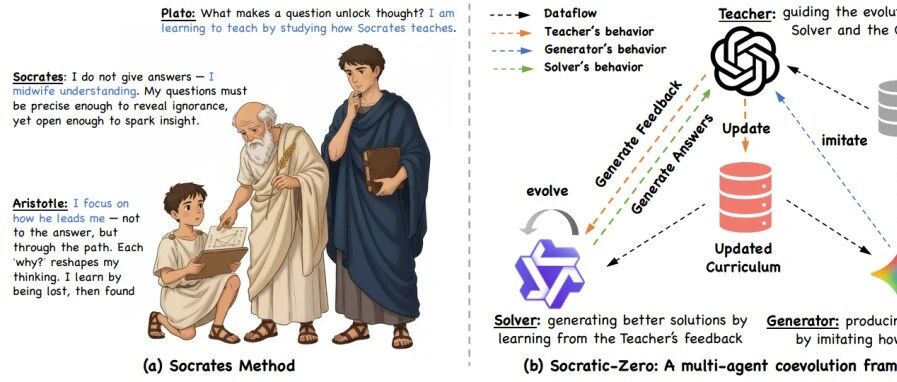
Core Insights - The article discusses the Socratic-Zero framework developed by Alibaba and Shanghai Jiao Tong University, which enables autonomous reasoning training without external data reliance, using only 100 seed questions to generate high-quality, adaptive learning materials [5][14][35] Group 1: Introduction and Background - The current breakthroughs in large language models (LLMs) heavily depend on vast amounts of labeled data, which can lead to inefficiencies in training signals [5] - Socratic-Zero is introduced as a self-evolving training framework that utilizes three intelligent agents: Solver, Teacher, and Generator, to create a dynamic learning environment [9][12] Group 2: Methodology - The Socratic-Zero framework is inspired by Socratic maieutics, emphasizing the importance of high-quality questioning to stimulate self-correction and continuous evolution in AI models [9][12] - The three-agent system operates in a closed-loop self-evolution mechanism, where the Solver's weaknesses drive the Teacher to generate targeted questions, and the Generator learns from the Teacher's strategies to create new problems [13][15] Group 3: Key Innovations - The framework demonstrates significant performance improvements, with the Solver achieving an average accuracy of 56.1% across seven mathematical reasoning benchmarks, a 20.2 percentage point increase compared to previous models [25][32] - The Generator, using only 100 seed questions, produces synthetic data of higher quality than that generated by top closed-source models like GPT-5 and Gemini-2.5-Pro [27][28] Group 4: Experimental Results - The performance of the Solver improved by 15.4 percentage points compared to MetaMath and WizardMath, showcasing the effectiveness of the Socratic-Zero approach [25] - The Generator's question effectiveness reached 95.6%, closely matching GPT-5's performance, indicating the high quality of the generated content [28] Group 5: Engineering and Practicality - Socratic-Zero's training process is designed to be engineering-friendly, ensuring diversity and quality control through multiple validations of seed questions [30][33] - The framework is lightweight and can be implemented with minimal hardware requirements, making it accessible for resource-constrained teams [33][34] Group 6: Future Implications - Socratic-Zero opens a new path for zero-data, self-evolving AI systems, highlighting the potential for intelligent agents to enhance reasoning capabilities without human intervention [35][36]

无VAE扩散模型! 清华&可灵团队「撞车」谢赛宁团队「RAE」
机器之心· 2025-10-23 05:09
Core Insights - The article discusses the limitations of traditional Variational Autoencoder (VAE) in training diffusion models, highlighting issues such as low representation quality and efficiency [2][4][8] - A new framework called SVG (Self-supervised representation for Visual Generation) is proposed, which integrates pre-trained visual feature encoders to enhance representation quality and efficiency [3][12] Limitations of Traditional VAE - VAE's latent space suffers from semantic entanglement, leading to inefficiencies in training and inference [4][6] - The entangled features require more training steps for the diffusion model to learn data distribution, resulting in slower performance [6][8] SVG Framework - SVG combines a frozen DINOv3 encoder, a lightweight residual encoder, and a decoder to create a unified feature space with strong semantic structure and detail recovery [12][13] - The framework allows for high-dimensional training directly in the SVG feature space, which has shown to be stable and efficient [16][22] Performance Metrics - SVG-XL outperforms traditional models in generation quality and efficiency, achieving a gFID of 6.57 in just 80 epochs compared to SiT-XL's 1400 epochs [18][22] - The model demonstrates superior few-step inference performance, with a gFID of 12.26 at 5 sampling steps [22] Multi-task Generalization - The latent space of SVG inherits the beneficial properties of DINOv3, making it suitable for various tasks such as classification and segmentation without additional fine-tuning [23][24] - The unified feature space enhances adaptability across multiple visual tasks [24] Qualitative Analysis - SVG exhibits smooth interpolation and editability, outperforming traditional VAE in generating intermediate results during linear interpolation [26][30] Conclusion - The core value of SVG lies in its combination of self-supervised features and residual details, proving the feasibility of sharing a unified latent space for generation, understanding, and perception [28] - This approach addresses the efficiency and generalization issues of traditional LDMs and provides new insights for future visual model development [28]

谷歌最强AI,被港科大开源超了?让海外创作者喊出「King Bomb」的P图大杀器来了
机器之心· 2025-10-23 05:09
Core Insights - The article discusses the significant impact of AI models like Google’s Nano Banana, ByteDance’s Seedream 4.0, and Alibaba’s Qwen-Image-Edit-2509 on traditional image editing software like Photoshop, suggesting a paradigm shift in creative processes [2][14] - DreamOmni2, developed by a team led by Jia Jia, has been released as an open-source model that addresses the limitations of current multimodal instruction-based editing and generation tasks, outperforming existing state-of-the-art models [3][12][53] Multimodal Editing and Generation - DreamOmni2 integrates multimodal instruction capabilities, allowing for more flexible and creative image editing and generation, including the ability to handle both concrete objects and abstract concepts effectively [3][58] - The model has received positive feedback from the creative community, with many praising its potential to revolutionize image generation and editing [7][12] Technical Innovations - The development of DreamOmni2 involved a three-phase data construction paradigm, optimizing the training process to enhance the model's semantic understanding and cross-modal alignment capabilities [59][66] - The model's framework was specifically designed to accommodate multiple reference images, improving its ability to process complex user instructions [67][68] Performance Comparison - In comparative tests, DreamOmni2 demonstrated superior performance in both editing and generation tasks when compared to other models like GPT-4o and Nano Banana, showcasing its advanced capabilities in understanding and executing user instructions [37][52][53] - The quantitative results indicate that DreamOmni2 achieved new state-of-the-art performance metrics in multimodal instruction-based tasks [54][55] Industry Impact - The release of DreamOmni2 signifies a deeper exploration into unified image generation and editing tasks, expanding the capabilities of AI in creative fields [72][73] - The advancements made by Jia Jia's team contribute to a broader evolution in the AI creative ecosystem, enabling more sophisticated human-AI collaboration in visual creation [73]

搜索智能体的关键一课:先立目标,再照镜子
机器之心· 2025-10-23 05:09
Core Insights - The article discusses the integration of AI capabilities into daily life and work, emphasizing the importance of robust search agents that can navigate complex environments effectively [1][2]. Group 1: RE-Searcher Framework - The RE-Searcher framework is introduced, which employs goal-oriented planning and self-reflection to enhance the robustness of search agents [3][6]. - This framework has achieved state-of-the-art (SOTA) performance across multiple open-domain question-answering and multi-hop reasoning tasks, demonstrating significant resilience against environmental noise and search vulnerabilities [3][22]. Group 2: Search Environment Challenges - The search environment can act as a double-edged sword, providing information gain while also amplifying errors, leading to instability in model performance [6][9]. - Analysis shows that the complexity of the search environment can significantly increase the inherent randomness of models, resulting in inconsistent outcomes for the same queries [9][11]. Group 3: Goal-Oriented Planning and Self-Reflection - The two key cognitive behaviors mimicked in the RE-Searcher framework are "goal-oriented planning" and "self-reflection," which help the AI to clarify its objectives before searching and to evaluate the relevance of the results afterward [16][17]. - The training mechanism involves specific instruction templates to guide the agent's thought processes, with a teacher model providing feedback to improve self-reflection accuracy [16][19]. Group 4: Experimental Results - RE-Searcher has shown superior performance on seven mainstream search question-answer datasets, outperforming existing baseline models and achieving new SOTA levels [22][25]. - The introduction of reflection rewards significantly enhances the model's self-reflection accuracy, reducing the random correctness rate from 17.09% to 8.74% for the 7B model, indicating improved problem-solving stability [25][30]. Group 5: Robustness Against Noise - In stress tests simulating real-world noise, RE-Searcher demonstrated strong robustness, with performance degradation significantly lower than baseline models, indicating its ability to maintain accuracy despite initial errors [27][30].

10个视频9个看走眼:连真视频都打Sora水印碰瓷,这世界还能信啥?
机器之心· 2025-10-23 05:09
Core Viewpoint - The article discusses the challenges posed by AI-generated content, particularly videos, and the need for effective detection methods to prevent misinformation and maintain social trust [7][9][30]. Group 1: AI-Generated Content Challenges - AI-generated videos are becoming increasingly difficult to distinguish from real videos, leading to widespread confusion and skepticism among internet users [2][5]. - The rapid advancement of AI technology necessitates mandatory watermarking of AI-generated content to mitigate the risk of misinformation [7][9]. - A recent incident highlighted the ease with which real videos can be manipulated to appear as AI-generated by adding watermarks, complicating the detection process [11][13]. Group 2: Detection Tools and Their Effectiveness - Several tools have been developed to detect AI-generated content, each with varying degrees of accuracy: - **AI or Not**: Claims an accuracy rate of 98.9% for detecting AI-generated content across various media types [17]. - **CatchMe**: Offers video detection capabilities but has shown low accuracy in tests [20][21]. - **Deepware Scanner**: Focuses on deepfake detection but often fails to scan videos [24][25]. - **Google SynthID Detector**: Specifically identifies content generated or edited by Google AI models [28][29]. - Overall, the effectiveness of these detection tools is inconsistent, indicating that the development of reliable AI detection technology is still a work in progress [30].